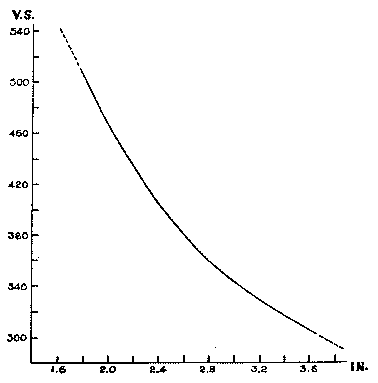
Figure 1. Relation of frequency of variator tone to height of piston.
Originally published in Psychological Monographs, 6, 1-124, 1932.
Laurence A. Petran
By "absolute pitch" is understood the remarkable ability possessed by certain few musicians (and an occasional idiot savant) to give quickly and correctly, without reference to any standard tone, the names of tones that they hear, and also the ability which still fewer musicians have to sing or whistle any tone which may be called for by name. This ability has long been coveted and more or less revered by musicians, and has been the topic of no little psychological discussion since the time of Stumpf. The main questions that have been asked are: (1) By what means are absolute pitch judgments made? (2) With what accuracy can they be made? (3) What factors facilitate or interfere with absolute pitch judgments? (4) How did possessors of absolute pitch acquire the ability? (5) Is it possible for anyone to acquire the ability? (6) What is the ability worth to its possessor?
This study first presents a discussion of the answers that have been given by psychologists and musicians to all six questions; then reports two experiments. The first is aimed at answering definitely the second question and thereby throwing some light on the first. In the first experiment nine reactors with absolute pitch, four with relative pitch, and four control reactors tuned a Stern tone variator to violin a purely from memory, ten times a day for ten days. In all cases the reactors had heard no music or tones for half an hour or a much longer period before they began tuning the variator. The second experiment was designed to study the method which has been used by practically all previous investigations on the subject, but which has inherent in it so glaring a fault that the method can hardly be called a test of absolute pitch at all. In this method the reactor who is to make absolute pitch judgments has been given at one sitting a long series of notes which he is to name one after the other: a test in which it would be impossible to say that the reactor in judging any note other than the first was not influenced to an unknown and unascertainable degree by the judgments he had made on preceding notes. In the second experiment this method is used, and results from it are compared with results from a test in which the same series of notes was given to the reactors one each morning before the reactor had heard any music or tones, and therefore had no chance of making a relative pitch judgment.
Numerous reasons for the further investigation of absolute pitch have been given by writers on the subject. These reasons may be grouped under five headings: (1) the bearing of the phenomenon of absolute pitch on theories of hearing; (2) the similarity of the mental activities involved in judgments of absolute pitch to processes usually included within the psychological categories of memory, discrimination, and simple restricted association; (3) the possible value of absolute pitch as an indicator of musical talent; (4) the advantages that the possession of absolute pitch gives musicians in the analysis and enjoyment of music; and (5) its importance to singers in the maintaining of tonality in unaccompanied vocal music.
The existence of the phenomenon of absolute pitch fits in more readily with those theories of hearing (the resonance and the extensity) which allow for the existence of local sign in the end organ than with other theories such as the telephone theory, although it puts no insuperable difficulty in the way of the latter. The current and undisputed conception of sound stimuli is that, when ranged according to pitch, they form a continuous linear series from the lowest audible to the highest audible, and each audible pitch has its position or local sign in this line. Thus Zwaardemaker [118] states that "in the auditive line in which are found the sounds audible to man . . . each point offers its own local sign which makes us attribute a certain height to the sound. This evaluation is absolute or relative." Hein [30] extends this concept by saying that " if each resonating fibre in the cochlea were connected individually to the brain center we should expect universally fine absolute pitch", and Chiloff [16] makes a similar statement. Wilkinson [112], who advocates the resonance theory in a recently developed form, states that the existence of absolute pitch implies the association between certain zones of maximal stimulation and the names of corresponding musical tones, and that these zones remain at a practically constant level in the end organ. Thus, on a resonance hypothesis, an absolute pitch judgment would depend on a rather definite, unequivocal association between a certain resonating fibre or narrow group of fibres in the cochlea and the corresponding musical pitch name; or, as Chiloff [16] contends, between the pitch name and the pattern formed by all the fibres resonating to the fundamental and upper partials of the stimulus tone. It could be argued that on the resonance theory absolute pitch should be as easily and quickly acquired for pure tones as for complex.
Dunlap (19, 20, 21) has shown that the extensity theory explains very clearly the different degrees in fineness of pitch perception found between unmusical and musical ears. "An individual who has an ' unmusical ear' judges pitch differences in a rough way, as if mere gross sizes of objects were directly compared. On the other hand, the person with a ' musical ear ' judges in a more exact way as if he noted the point to which each tone extends." Since on this theory all vibratory extents in the cochlea are coterminous at the basal end, the dominant pitch characteristic of each sound might come to be associated with stimulation of the hair cells at the upper end of the vibrating extent, and these particular hair cells would thus provide a local sign for each pitch. This local sign would not necessarily be focal in the tone sensation for the great majority of people, while it would necessarily be more so on the resonance theory. Hence it might be expected on the extensity theory that only those having much to do with music would have developed the ability to recognize pitches to any extent, and that there would be gradations in this ability corresponding to the attention which had been given the local sign feature of each tone, rather than to the whole vibrating extent. This is in accordance with what is known about absolute pitch.
Correct absolute pitch judgments furnish outstanding examples of memory and, to a certain extent, of tonal discrimination. Stumpf (95) and others assert that a well-developed memory for absolute pitch operates even after long periods of disuse, and while evidence on this point is mainly anecdotal there is enough of it to warrant consideration. None of the investigations of memory for specific tones (Wolfe, Angell and Harwood, Angell, Whipple) seem to have studied it over periods longer than ninety seconds, and practically all the work on pitch discrimination, except some of Gough and Mull, has been done with time intervals of only a few seconds between successive tones. But people with absolute pitch have been able to make pitch discriminations over long periods of time with a comparatively high degree of exactness. Finally, absolute pitch has several of the characteristics of simple association. As von Kries points out (48), it works in one direction (from tone to name) better than in the other, just as to us a foreign word suggests its English equivalent much more quickly than the English word suggests the foreign. Also, a given tone may be associated with several things: a piano key, a letter name, musical notation, a familiar song, etc. The process of naming heard tones is very similar to the controlled association reaction.
Evidence of absolute pitch in children has not generally found a place in the schemae or tests of musical talent which have been made up by psychologists, but it is likely that music teachers have always been impressed by the ability when it appeared in their scholars, and have encouraged such to go on in music. Psychologists are unanimous in stating that absolute pitch is not in itself necessary or especially important as a constituent of musical talent, but Rupp (87) raised the question whether its appearance in children might not be an indicator of musical ability. Schoen (90) gave absolute pitch tests of varying rigidity as a part of a musical talent examination to ten children selected by their music teachers. In all the resulting profiles the absolute pitch score occupies a position close to or below the average. He concludes that absolute pitch "is closely allied with other musical powers, and has a high diagnostic value." Révész (80), in his tests of 62 children for musical talent, found that the ability to locate on the piano the eight notes scattered over a wide range that were played to them correlated "highly" (.68) with what he considered the "Hauptmerkmal" of musical talent. This was the ability to sing two-measure fragments of a Schumann song after it was played to them. Some of the children without musical training performed better on this test than some of those with training. Mjøen (63) concluded from questionnaire data on musical traits found in families over several generations and reporting on a total of 2,452 people that absolute pitch was one of the most important indicators of native musical ability, more important than any other criterion except composing. König (46) suggests that the extent (number of notes a child can name correctly) and time in which absolute pitch is acquired may serve as a measure of musical talent. Mull (65) feels sure from her experiments on the acquisition of absolute pitch that there is such a relation. On the other hand, Bartholomew (11) found only negligible correlations between scores on absolute pitch ability and scores on the Seashore pitch, intensity, and consonance tests with twenty-one adults, all with musical training. Since the validity of the Seashore tests is seriously questioned, this result is not necessarily prejudicial to the suggestion that absolute pitch may be a factor indicative of musical talent, as it most certainly is of interest in things tonal.
Most of those who write from only a general information of the subject state that absolute pitch, while in no way essential to musical achievement, may be a potent source of enjoyment in following the course of music as it is heard. Following are some typical evaluations of the ability:
Stumpf (95): "Musical capacity to an unusual degree, penetrating understanding, and most complete enjoyment of great works, however, presuppose this ability. It aids substantially the hearing out of a relatively weak tone in a tone mass, certainly of attack in singing, and unity in modulation."
Wallaschek (104) thinks that absolute pitch facilitates comprehension of melody, but is necessary to musical enjoyment only when complicated passages are being followed.
Meyer (57): "Absolute pitch may indeed be scarcely of importance for the aesthetic enjoyment of music; however, this assertion cannot be made with certainty."
Abraham (1): It is an advantage mainly to composers, because those having it can work freely with units of one tone and hence can be more original than those without it, who must work with intervals (units of two tones).
Liebscher (53): " Comprehension of pitch is a means of orientation in hearing music; therein lies its only superiority to relative pitch."
Seashore (88) : "(Absolute pitch) is a source of pleasure in itself in creating a feeling of familiarity and mastery in tonal environments."
Braine (14): "Those with absolute or relative pitch make many times the progress of those not so gifted."
Auerbach (7, 8) is inclined to ridicule absolute pitch as having no place in musical aesthetics and as being useful only to the Chef of a railway station, who might recognize different train whistles thereby. Abraham (2) rebuts Auerbach's contentions in detail.
Wilson (114) states that absolute pitch, like the telephone, can be a great nuisance, and sometimes feels his own to be a curse.
Slonimsky (91) values it and adds that therewith he has been able to estimate from the motor hum the speed at which his car is going, and in the war could tell when a shrapnel shell was coming his way.
Of Weinert's (107) twenty-two musically proficient reactors with absolute pitch, only two thought that it contributed to musical enjoyment; others felt it was disturbing. Only a few of them, and those only occasionally, noticed individual keys and tones when hearing music.
On the whole, the ability is rather highly prized by musicians and is considered especially valuable for singers, for violinists, and above all for composers. Slonimsky (91) however states that absence of it does not seem to interfere with a composer's creative powers.
That primitive songs begin on a high sustained note to which return is made at the beginning of subsequent stanzas has been noted by Stumpf (97) and others. Myers (68) considers this an evidence of the awareness of absolute pitch in primitive people, and as such considered it the basis for the tonality of their music, guiding their use of intervals. However, it could as well be said that the customary tonality could be the basis for whatever absolute pitch these people may have. It must also be remembered that practically all races have musical instruments such as pan's-pipes whose scales are fixed, thereby fixing the tonalities used. Also, as Stumpf (97) points out, primitive people readily transpose their songs, often starting them according to the pitchpipe sounded as the phonographic recording is started. Hence, in many cases at least, the return to the initial note is a matter of relative, not absolute, pitch.
Since the abilities and performances included under the name of absolute pitch vary from author to author, these abilities will first be discussed individually and in detail. After this survey is completed an attempt will be made to develop a definition including only the essential factors.
1. The performance included in absolute pitch by practically every writer on the subject is that of designating a heard tone correctly with a name from a customary nomenclature, and from memory alone, without any other aid. Stumpf (95) speaks of this performance as dependent on comparison of the heard tone with a memory tone, such as the a' of violinists. Wallaschek (104) and Rupp (87), however, base the ability on a whole scale of tones imprinted in the memory. Undoubtedly both types of judgment are found, but the second must be considered the more highly developed and the more truly characteristic of absolute pitch.
There is little agreement as to the immediacy (quickness with which the judgment is given), accuracy, and time interval since the last hearing of tones which are required if the naming of a heard tone is to be called absolute pitch. Boggs (13) emphasizes that with her reactors the more immediate judgments were nearly always the more accurate, and this conclusion is validated by Baird, Gough, and Weinert. Ogden (71) attaches great importance to the immediacy feature, saying that " absolute pitch is not a judgment in which the observer compares the tone heard with a standard he has in mind, and which he can imagine or imitate vocally; for judgments of this type are erudite and rational, compared with the immediacy of absolute pitch."
The accuracy required in order that a naming judgment may be called a satisfactory absolute pitch judgment is put by many authors (Abraham, 1, Dunlap, 21, von Kries, 50) at within a semitone above or below the correct tone. Slonimsky (91) would demand that the notes from the five central octaves be judged immediately and with no errors. Jodl (37) thinks that the only limit to the possible accuracy of absolute pitch judgments is the difference sensitivity of the ear, but an approach to this limit has been experimentally tried only by Abraham (1) and Gough (24) on themselves, and by Mull (65) on a few of her reactors. All these fell short of Jodl's limit, as might be expected. Exhaustive practice would undoubtedly be necessary for the attainment of such fineness of discriminative memory.
2. von Kries in his first article on the subject (48) mentions that a heard tone may be recognized not as b or d but as agreeing with a certain familiar bell or pipe. He adds, however, that the " learning of systematic designations of pitches is an extraordinary help; a learning of many definite pitches without it is scarcely possible."
3. Revesz (78) broadens the definition of absolute pitch into the " ability to express always the same ways of behavior with respect to individual tones" ("die Fähigkeit, den einzelnen Tonen gegeniiber stets ganz gleiche Verhaltungsweisen zu äussern"). This is perhaps the most satisfactory definition of the passive (naming) judgment, and could be applied to animals and primitive peoples, if the occasion should arise. Likewise there can be no objection to von Kries' extension of the definition except that such an extension would be needed infrequently. Thus far, the essential thing in absolute pitch judgments is the unequivocal association of individual musical tones by their pitches with a definite response pattern.
4. The sense of absolute pitch has also been taken to include the ability to tell whether a piano is tuned too low or too high. Warren definitely states this (105), Wilson agrees (114), and Wallace (103) says that the term "absolute pitch" "appears to be applicable to a condition in which the ear is hypersensitive to a fixed standard of tuning and rejects as false in intonation all other sounds which do not coincide with it." Braine (14) extends this concept to the active judgment, thus: "He (a possessor of absolute pitch) can keep his violin tuned to correct pitch without use of tuning-fork or pitch-pipe." The former ability, mentioned by Warren and Wallace, seems to be much more widespread than absolute pitch, and there is no evidence as to how much the two are correlated. Not a few violinists claim to have the latter but there has never been any extensive check-up on them, and probably their accuracy would vary with the amount their violin was out of tune at the beginning of the test. Hence it would seem better to consider the former ability as at most a corollary of absolute pitch, not a constituent feature of it.
5. We now reach the active judgments of absolute pitch, as opposed to the judgments in which a heard tone is named, or passive judgments. The ability to sing with a fair degree of accuracy a tone called for by name is included under absolute pitch by some writers, but this phase has received comparatively little attention in the experimental work, Gough's and Weinert's being the only ones to treat it in any detail. There is the same lack of agreement as to the immediacy and accuracy to be required as in the case of the passive judgment, and, except for Dunlap (21), no mention as to the interval since tones have been heard previously. It is interesting that only occasional writers (Baird, Braine, Myers, and Schoen) have mentioned the extension of this ability to the tuning of an instrument such as the monochord or tone variator to a "tone held in the memory".
6. As in the case of the passive judgments, there is no reason why the verbal element may not be left out altogether on occasion. For instance, Schoen (90) suggests as a test for absolute pitch that a tone may be sounded to the reactor and that after a certain length of time he be asked to reproduce the tone.
7. Somewhat related to the last mentioned performance is the singing of a melody at the pitch at which it is learned. Konig (45) states that a child who can do this may be said to have absolute pitch, but the objection to this is that the reproduction of a melody involves a different degree of difficulty of performance and of evaluation of performance than does the reproduction of an isolated tone.
8. Meyer, in two articles published in the same year, states in one (57) that for absolute pitch "a certain degree of exactness is necessary" and in the other (58) that he does "not see any reason for refusing this name in any case where the individual is unable to determine the pitch with an average error less than a certain interval, viz., a third." Von Kries (49) accepts the latter `statement by saying that recognition of high tones as high and low tones as low may be considered a form of absolute pitch, and several writers agree with them. However, there seems to be little advantage in extending the term to cover such cases, except to emphasize the infinite number of gradations in the ability to name or reproduce tones. Recent experimental studies (Baird, Bartholomew, Gough) amply demonstrate this gradation. It would seem more useful and in accord with custom to reserve the term absolute pitch for the ability to name a given tone or intone a given note with a rather high degree of accuracy. This degree could not be set satisfactorily until studies of the distribution of the ability had been made and compared.
9. Musicians writing on the subject frequently include related abilities, such as the ability to analyze chords and counter-melodies without undue deliberation, under the head of absolute pitch. Urbach (101) sinned in this respect and drew deserved criticism from Altmann and others (3, 53, 64, 86), for including too much in his definition and thereby befogging the issue.
In this study the pitch series from the lower to the upper limits of perception will be considered as linear, that is, as made up of an infinite number of points. This is in accordance with the nature of the physical correlate of pitch ( frequency of vibration) and on the psychological side is an inherent assumption of the extensity and telephone theories. With this assumption in mind, judgments of absolute pitch may be defined as judgments based on associations learned between more or less narrowly limited ranges of the pitch series and the terms of any unequivocal nomenclature, these judgments being without reference to or aid from any tone or tones recently heard which have been given as a standard or attended to in any degree as being of a certain pitch or familiar pitch position.
Three points in the above definition require further elaboration. First, how narrow should the pitch ranges be? Von Kries in 1892 (48) stated that judgments erring by a fourth or more are valueless for musical purposes; Meyer (58) answered that no interval could be arbitrarily set up as a boundary line. Abraham ( 1) from experiments on himself concluded that judgments erring by a half tone should be considered correct, and while some psychologists have accepted this, most musicians writing on the subject assume that absolute accuracy should be required. If this is to be the basis, no reactor on whom any extensive investigation has been reported has absolute pitch. While the whole question may appear academic, it would seem more fitting on the basis of experimental results to confer the name, if at all, on those who were say eighty to ninety per cent accurate in the central part of the scale, something like fifty to sixty per cent accurate in the outer regions, and whose accuracy was not disturbed to any great extent by timbre differences.
As to the influence of nomenclature, it is probable that very few people will ever build up absolute pitch associations for pitch ranges narrower and closer together than those for which definite names are available.
The time interval since tones or music have been heard previously is obviously important, as the work on memory for isolated tones shows, but consideration of it has been neglected by practically all investigators of absolute pitch. Any attempt to control it would seriously affect any of the techniques that have been used, and would make most of them impossible. Rupp (87) recommends a half hour interval between work on different test tones, and Seashore (88) and Dunlap (21) regard the giving of a test in the early morning before any other tones or music are heard as the only complete control.
Abraham (1) gives a list of the names current in Germany in his time for the ability under discussion, and finds the name "Absolute Tonbeuwußtsein" most frequent, but "memory for absolute pitch" most suitable. In English the following names have also been used: "absolute determination of pitch" (Myers), "absolute ear" (Watt), "judgments of absolute tone" (Ladd and Woodworth), "positive pitch" (Copp). One hears also the a term "perfect pitch" used to mean or include this ability. However, the great majority of writers in English use the term "absolute pitch", and the term seems quite satisfactory. The same phrase has been used by physicists (Rayleigh and others) to designate the vibration frequency of a tone, but there is little likelihood of confusion thereby.
Methods of testing and rating absolute pitch judgments can be grouped under three heads: active, passive, and threshold. The third necessarily makes use of the first two methods, but with pitch differences much smaller than are commonly used in the first two.
The case in which the reactor names a tone presented to him is best designated by the name "passive". This method has been the one used in the great majority of investigations on the subject. The active judgment, in which the reactor reproduces a specified tone by singing, whistling, or by manipulating some instrument such as the monochord or tone variator, has received only incidental attention.
Schoen (90) distinguishes various degrees of rigidity in tests made by the active and passive methods. The most rigid test is to designate pitch after a single hearing of the tone, or to produce a tone of specified pitch. A less rigid test is to sound a tone several times till it is impressed on the hearer ; after a while a second tone is given and the reactor is asked to state whether the comparison tone is the same, or higher, or lower than the first tone. Or instead of sounding the second tone, the experimenter may ask the reactor to reproduce the first tone from memory. Again, a tone may be played or sung for the reactor several times; then the experimenter may play or sing a phrase of several tones, whereupon the reactor is to state whether or not the first tone appeared in the phrase. All these tests are undoubtedly significant for diagnostic work with music students but, except for the most rigid, can not strictly be called tests of absolute pitch.
Rupp's proposals for the investigation of musical talent (87) are by far the most thoroughgoing in the field, and show evidence of musical as well as psychological knowledge. His discussion of methods for the investigation of the threshold of absolute pitch is so fundamental that it is summarized here in detail. He states that methods for determining absolute pitch are complicated by four considerations : (1) With those who do not play or sing a threshold test is merely a test of hearing; with those who do play or sing it tests also training and education of the ear. Such training may help the reactor by giving him other points of view (associations with piano keys, tuning of strings, larynx and muscle sensations) which can be got at only through introspection. An " inner singing " is possible in all cases and can hardly be excluded. But this, and violin and piano cues may make the judgment worse, if technical accuracy and facility are lacking. (2) When the judgment-finding method is used the reactor passively makes one judgment; with the stimulus-finding method the procedure may be passive also. In this case the reactor is told which note he is to look for and then is given a series of tones which he judges as too high, too low, or correct. Or he may actively find the correct note by singing, tuning a string, or finding a piano key. With these latter methods there is much greater self-activity, and concentration increases as the tone approaches the goal. (3) a' is not sharply distinguished from not a', therefore, especially when using the stimulus-finding method, we need to find for each individual a distribution curve, range, central measure, and measure of deviation. It is also important to find averages of several lower limits and higher limits to get an average range. If tuning a string is the method used, the resulting values may be influenced by the fact that strings are usually tuned from a low pitch up. Also, thresholds for higher than a' and lower than a' should be found by starting the stimulus tone at a' and moving up or down. Results from the stimulus-finding method should be compared with results from the same procedure with the judgment-finding method. When the direction of the test series is upward to a', the point at which fifty per cent of the judgments are lower than a' and the rest equal to a' or higher than a' may be considered the average threshold. (4) Three methods are possible. (a) Konstanz-inethode: a series of equally separated steps more than covering the range must be presented; each must follow each other an equal number of times and have positions equally distributed at the beginning, middle, and end of the series. Piano steps are too large for this; tuning forks or the Tonniesser may be used, and the monochord and tone variator if they can be set at exact pitches. (b) Herstellungs-inethode: giving the reactor control of the stimulus. Difficulties here are that the range may not be equally gone over by all reactors, and that tuning too often comes from below. To obviate the first difficulty the reactors may be told not to vary over too wide a range; otherwise tones may be too much influenced by their predecessors, and not equally with all reactors. Continuous tuning is the most feasible method, but this is not possible on an instrument with discrete steps. Individual habits of tuning are influential. Most of the objections fall away with sung tones, unless the voice varies and "searches around". (c) Grenz-inethode: getting thresholds (upper and lower) by method of small steps in one direction, later reversed. This is possible with calibrated tuning forks, monochord, or variator.
It is unfortunate that Rupp never investigated musical talent experimentally in accordance with his prolegomena. Only three investigators have reported using threshold methods, and none of these extensively. Abraham (1) after practice came to locate violin a on the Tonmesser within a range of eight vibrations; the absolute position of this range was three vibrations lower with the Auswahl-methode than with the method of right and wrong cases. Raif, his co-worker, had a somewhat wider range. Gough (24) tested herself with the Whipple increment forks on successive mornings and found that she could recognize the greater increments as being different from the 435 fork tone she was trying to hold in her memory, but her success in naming individual forks was no better than chance. Mull's reactors (65) learned to a certain extent to distinguish a tone she had taught them from other tones less than a half step away.
Table 1 (page 20) on which the salient features of previous experimental work are summarized shows some rather striking characteristics common to many of the investigations. The piano is used predominantly for the presentation of tones, other instruments being used mainly for accessory investigations. Of all the authors who report tests in which a piano other than the reactor's own was used only Gough and Weinert mention anything about the make and tuning of the test piano. The duration of the stimulus has hardly ever been regularly controlled; the only case mentioned being that of Gough, who in one experiment sounded each note several times for ten seconds. Otherwise the general practice seems to have been to hold each note until it died out, or to strike it an irregular number of times. In spite of this irregularity, authors draw conclusions as to the relative familiarity of various notes of the scale, although it is rather obvious, as von Kries (48) says, that unfamiliar tones must have a greater duration than familiar tones in order to be recognized. In practically all cases a number of notes have been presented in series with pauses after individual notes for the reactor to give his judgment. Of all the studies using this method, only those of Katz (39), Revesz (80), and Bartholomew (11) give the serial order in which the notes were presented. This striking omission by all other authors of an important phase of the experimental technique can be explained on the assumption that they either underestimated the influence of notes in a series on each other, or thought that other phases of their techniques eliminated this influence. The whole subject of the effect of preceding notes on the judgment of a note will be considered in detail later. However, the following means of distraction between individual stimulus tones have been used, although there is no way of knowing whether or not the distractions accomplished their purpose. Stumpf employed conversation between test tones; Abraham, conversation and unusual modulations on the piano, which he thought the ear could not follow by interval sense; Revesz used "meaningless sound combinations" and Mull "a short but effectual period of auditory distraction"; neither of the latter two is more specific. Weinert reports some unintentional distraction, not always auditory, indulged in by some of his reactors to relieve themselves from boredom in a test period of some hours.
Very few writers specify the directions given the reactors as to how to judge the tones presented. Perhaps the majority of the reactors understood readily what was wanted of them. Neither is there much mention as to whether or not after-singing was allowed, but to judge from other points mentioned in the reports it was not indulged in with great frequency. Weinert, however, says he had a great deal of difficulty in keeping one of his reactors, a coloratura soprano, from singing arpeggios after each note. Stumpf, Gough, Mull, Bartholomew, and Weinert took systematic introspections.
A very satisfactory aid to the reactor in making his judgment is to provide him with either an actual model of the piano keyboard or a keyboard chart on which he can point out or from which he can give or record his judgment. Without such a device octave errors are bound to creep in, due to the general lack of familiarity with the octave names (as contra, once-accented, etc.). With it there is more likelihood that the letter name the reactor intends to give will be correctly given. Abraham (1) used the keyboard of a toy piano (this had only one octave) and Baird (9) a Vergil clavier—an instrument that contains the piano keyboard but which makes no musical sound. Gough (24) and Bartholomew (11) used charts of the keyboard with the name of each note written thereon.
Measurement of the time taken for judgment has usually been taken, when at all, by the stop-watch. Abraham tried to measure the response time by means of a lip key, but finding this unsuccessful fell back on the toy piano keyboard connected with a chronoscope. Baird used a voice key and chronoscope with one reactor.
All degrees and manners of statistical treatment have been used in the more extensive investigations, but the older and smaller ones give this very inadequately. Weinert (107) in 1929 criticized severely all previous work on the subject as (1) being based on too few reactors and too few series of tests, (2) employing inadequate analysis of errors, spontaneous corrections, and cases in which the tone could not be named, (3) undervaluing the importance of reaction times, etc. But he makes no reference to any American work later than 1907, thus ignoring the work of Baird, Gough, and Mull, who in their work have taken care of most of the considerations Weinert mentions, and very pertinently.
The method of average error in making an active judgment seems to have been used only twice: by Revesz (81) , who had the young prodigy Erwin Nyiregyhazi set a tone variator to four notes, and by Baird (9), who operating the tone variator himself set it to each note of the diatonic scale according to the directions of each of eight reactors.
The evaluation of a passive judgment as correct or not could hardly involve any sources of error if the tone has been accurately produced on a musical instrument or other calibrated device for producing tones. But the evaluation of judgments of the pitch of bells, glass tones, etc., when done by the experimenter's unaided ear (Stumpf, 96, Revesz, 81) may in itself be erroneous. Weinert (107) had his reactors sing or whistle tones whose pitches were estimated, apparently by Weinert himself, in steps as fine as one-eighth of a whole tone. Needless to say, no matter how fine a musician's ear may be, it should not be given the responsibility of making such fine degrees of judgment for scientific work. Gough (24) used the Seashore tonoscope for similar tests.
The table of experimental work shows the number and kind of reactors in each investigation. Obviously, for experiments other than on acquisition, reactors must be selected from those in whom to a certain extent associations between tones and names are already set up. In the more extensive studies professional musicians and music students have been used. Normal children who have been taught to know tones by names constant for each pitch (Eitz, 82, or other method) have been studied, as well as three who would fall into the musical prodigy class (23, 81, 96). In the experiments on acquisition of absolute pitch adults, both musical and unmusical, have reacted. Stumpf, Abraham, von Kries, Meyer, Köhler, Gough, and Mull have used themselves as reactors.
The chart on the next three pages gives the more salient points concerning the reactors and techniques in previous investigations. The points immediately following are those on which agree the five most extensive investigations on identification of notes given in series.
1. White notes are more often correctly judged than black.
2. The more accurate judgments are usually made more quickly than the less accurate.
3. Notes in the middle range are judged more accurately than notes in the extreme ranges.
4. There is a tendency to judge high notes lower and low notes higher than they actually are.
Table I.
Survey of previous experimental work.
| Experimenter and locality | Date reported | Reactors | Instrument used, if passive | Method of reproduction, if active | Number of notes given |
| Stumpf (95), Berlin | 1883 | 4 musicians | reactor's piano | 7 to 13 low notes 8 to 13 middle notes 10 to 13 high notes |
|
| 1890 | 2 children | piano voice tones |
39 18 |
||
| Meyer (58), Berlin | 1899 | Meyer and Heyfelder | tuning forks piano |
16 39 |
|
| Abraham (1), Berlin | 1901 | Abraham | piano, tuning forks, organ pipes, siren | 88 notes higher and lower than piano |
|
| Abraham and Raif | siren, tonmesser | chords tones closer together than half-tones |
|||
| 3 children | singing | 2 (a training experiment) | |||
| Whipple (111), Cornell U. | 1903 | girl music student | piano | ? | |
| Boggs (13), Cornell U. | 1907 | 1 girl 2 boys |
piano, clarinet, violin, voice | ? | |
| Stumpf (96), Berlin | 1909 | Pepito Ariola, boy piano prodigy | piano, tuning forks, flask, reed tones | ? | |
| Bennedik (12) | 1914 | 3 children taught by Eitz method | piano | singing | ? |
| Katz (39), Göttingen | 1914 | 24 eleven-year-old children taught by Eitz method | pitch pipe | singing | 4: F#, B, C#, E |
| Köhler (44), Frankfurt | 1915 | conservatory students | piano, tuning forks | ? | |
| Révész (81), Budapest | 1916 | Erwin Nyiregyházi, boy prodigy | piano, voice, clarinet, oboe, trumpet, factory whistle, etc. | singing, tone variator | ? |
| Baird (9), Illinois U. | 1917 | 8 women musicians | piano organ clarinet flute tuning forks Galton whistle |
tone variator | 88, 3 times or more 61 26 26 14 . 12 |
| Révész (80) | 1920 | 62 children, ages 7 to 12 | piano | 8, distributed over 4 octaves up to 3 presentations each | |
| Gough (24), Smith College | 1922 | 9 members of advanced lab class, 2 instructors | piano, 4 organ stops | singing into tonoscope | 60, 88 A and C practiced through year |
| 80 students | piano | 88, 2 preliminary trials and 6 practice series | |||
| Bartholomew (11), George Washington U. | 1925 | 21 music students | piano | 60 | |
| Mull (65), Harvard U. | 1925 | 8 psychologists | tonmesser | 15, practiced throughout year | |
| Anschutz (6), Hamburg | 1927 | blind man musician | piano | all notes, 5 times | |
| Gebhardt (23), Wurzburg | 1929 | boy prodigy | piano, violin, viola, cello | 70, 3 times 10 each | |
| Weinert (107), Hamburg | 1929 | 22 musicians | piano violin with one boy |
singing or whistling | 85 notes, 5 times or less 12 in reactor's compass |
| Chiloff (16), Leningrad | 1930 | 14 with absolute pitch, 59 not claiming it |
Bezold-Edelmann diapson, Urbanschitch harmonica |
singing | ? |
Tones in order of correctness, from the most often correctly judged to the least often correctly judged:
Baird (9 reactors): F, C, D, G, E, A, B, D#, F#, C#, A#, G#
Gough (90 reactors): C, A, B, G, D, F, E, A#, G#, D#, C#, F#
Mull (4 reactors): G, C, A, F, B, D, E
Bartholomew (21 reactors): C, G, F#, A, E, D, F, G#, B, A#, D#, C#
Weinert (22 reactors): D, E, F, G, A, C, D#, F#, B, G#, C#, A#
Specific results from individual investigations follow:
1. Individual reactors tend to give a certain note name (such as a or f) more frequently than other names (Weinert).
2. There is a rather regular decrease in the number of errors with increase in the size of error (Gough, Weinert). These two investigators found no evidence of any special tendency to make errors of a fourth or fifth.
3. Women tend to make more errors of overestimation than of underestimation (Gough, Bartholomew). Men tend to underestimate (Bartholomew).
The numerous factors which have been claimed to have an influence both on absolute pitch judgments and on judgments of isolated tones in general may be conveniently grouped under four headings. These are : (1) objective features of the tones presented and the manner of their presentation, (2) subjective, general psychological factors, (3) practice, whether of the customary musical sort or specifically designed for the acquisition of absolute pitch or related abilities, (4) matters somewhat under dispute, but best classed in the field of tone psychology.
Stimulus tones for passive judgments may vary in timbre, in intensity, in duration, and in the range or extent of the scale covered by a series of them. For each stimulus tone the time interval since music or tones were previously heard will be a variable.
The earlier investigators, mainly von Kries, Abraham, and Ki5hler, were much concerned over the effects of timbre on judgments of absolute pitch. From their own experience or from anecdotal reports they concluded that notes of certain timbres were much more difficult to name correctly than those of other timbres. Because of the non-quantitative nature of their reports it would hardly be useful to give a tabular summary here of the degrees of difficulty reported by them and their observers in this respect. But an average rank order from the most easily and accurately judged to the most difficult would be: piano, violin, woodwind, organ, voice, tuning fork and pipe, bells, and glass tones. The two explanations most frequently offered for this order were (1) that the more familiar a timbre was, the easier it was to judge, and (2) that everything depended on the relative complexity of the wave form of the tone. Von Kries (48) rejects both explanations: (1) on the ground that voice tones, although frequently heard, are very difficult to judge, and (2) on the ground that the complex bell and glass tones were about as difficult to name as the pure tones of tuning forks and variators. Abraham (1) makes similar statements, but adds that the intensity of the upper partials may be more of a factor in causing confusion than the relative number of them. The strong inharmonic partials in bells and human vowel sounds would make these difficult to judge. As an explanation of the fact that certain moderately rich timbres are judged more easily and accurately than purer ones, Stumpf (95) suggests that with an increasing number of overtones the fundamental increases more in importance in comparison with the partial tones, thus making its pitch more salient. But Abraham and von Kries agree that the pitch of a clang is associated not with the fundamental alone but with the fundamental and its upper partials. This latter idea reappears in Köhler (44), who asserts as a result of his experience and experimental work that pitch is a minor feature of tones, and that letter names are associated not with the pitch of a tone but with its "tone-body". This affords a convenient explanation for the timbre effect, since whatever it is that Köhler calls tone-body is supposed to vary from timbre to timbre, while pitch obviously need not. But as might be expected, Köhler was astonished to find a twelve-year-old boy whose accuracy in absolute pitch seemed not to be affected at all by timbre. From this Köhler had to conclude that the boy associated the letter names with pitch after all, not with tone-body. Chiloff (16) is more analytic and states that since the higher a tone is, the fewer perceptible overtones it has, "a complex sound of different height possesses a timbre characteristic of its height". From this consideration and from the fact that his reactors were much more successful naming complex tones than pure, he concluded that absolute pitch depends on the faculty of determining the timbres of sounds of different heights. Baird (9), who worked with reactors highly trained in music, found them less accurate with tones from the clarinet, flute, four organ stops, and tuning forks than with those from the piano. Perhaps they would have become equally accurate after a little practice. Gough (24), who trained musical and unmusical reactors in pitch recognition, found only comparatively slight differences in accuracy of judgment with different timbres.
Hence, the familiarity of a timbre seems to be much more important for pitch recognition than its relative complexity. It is difficult to make pitch judgments on human voice tones for three reasons: (1) while the human voice is heard very frequently, individual singing voices are heard quite rarely, compared to the piano, and voices vary greatly in timbre; (2) the range in both pitch and speed of the vibrato in the human voice is variable from voice to voice and may constitute a disturbing factor; (3) singers not infrequently sing "off key". Tuning fork tones may be hard to judge because, besides being rarely heard, they are often tuned to a scientific scale both lower than and of different proportions from the tempered scale with which musicians are familiar.
Seashore (88) in his discussion of absolute pitch states that the faculty depends on differences of timbre, since one can readily see by running a scale on the piano that its notes differ in timbre. Until oscillographic studies now being made of the wave forms of tones throughout the piano are completed it seems safe to assume that, aside from individual variations in the piano, notes not too far apart are probably quite similar in wave form; the significant variation is in frequency. At any rate it is doubtful that the timbre differences between notes lying close together on a piano could compare with pitch differences in furnishing unequivocally different stimuli for absolute pitch judgments. For example, on ten well-tuned pianos any given note (such as d') would have practically the same pitch, but the timbre of this note (or any other) would vary from piano to piano, especially if the makes and styles were different; besides that, each piano would have more or less slight timbre variations within its own scale which were peculiar to itself.
Inasmuch as there has been until quite recently no satisfactory method for the measurement of the intensity of tones, only suppositions can be made as to the effect of intensity on absolute pitch. Abraham (1) believed that the intensity threshold for judgment of absolute pitch was higher than that for sensation alone, since tones had to be of a certain intensity before he could name them. On the other hand, he thought very loud trombone, bell, and other tones were harder to judge than those moderately loud because the former had more overtones and accompanying noise. He believed that the louder of two tones of the same pitch would be judged the higher because (1) of the greater number of overtones in the louder tones, (2) singers when their breath gives out usually let the tone fall both in intensity and in pitch, (3) a high tone with stimulus intensity equal to that of a lower tone has a greater physical intensity than that of the lower tone. However, he thought the amount of illusion due to the above causes would be too small to affect judgments of absolute pitch appreciably. The experimental work of Guttmann (25) , Hancock (28), and Stewart (93) shows some evidence of the subjective effects of intensity on pitch, but in all cases the effect was quite well within the half tone step.
As has been mentioned above, the duration of the stimulus tone in absolute pitch experiments has rarely been controlled. Abraham (1) is the only writer to mention its effect. By experimenting with a siren he found that for the range of pitches used in music two successive vibrations were sufficient for a sound sensation and also, with practice, for an absolute pitch judgment. The accessory noise of the siren was, of course, a disturbing factor. Very likely the greater the duration of a note, the easier it is to judge, except for those reactors of greatest proficiency, but no experimental evidence is at hand.
The greatest uniformity in the results of experiments on the subject is found in regard to the effect of position within the tonal range on accuracy of judgment. Practically always, notes of the middle range are judged the best, high and low notes less well. Individual deviations correspond with the familiarity of the reactor with certain regions of the scale. For example, Stumpf's (95) double-bass player reactor was superior to the rest in the lower range, the first violinist in the upper range, and Stumpf himself, who had been practicing in the middle range of the piano, was superior to the other two in the middle range. Abraham (1) was accurate over a very wide range, and noted that variations in accuracy did not parallel difference sensitivity. Whipple, Baird, Gough, and Weinert all report the once-accented octave (from middle c upward) as being the most accurately and quickly judged. The other octaves decreased in accuracy as their distance from the once-accented octave increased. Weinert found a very regular alternation in this between octaves above and below the central octave. Baird's and Gough's order for accuracy in the five central octaves is the same as Weinert's.
Boggs (13) reports of some of her reactors that their accuracy was not affected by the region of the scale. Revesz (81) reports the same for the boy prodigy he studied, as does Gebhardt (23). Gebhardt's reactor was accurate for seventy notes of the piano (in a series test), and there is no reason why complete accuracy for all notes of the piano should not exist or be achieved. As Abraham says, the limits of absolute pitch sensitivity may not be far from those of difference sensitivity.
The difference between the sure accurate judgments that are frequently made in the middle range and the approximate, guessing judgments made in the more extreme ranges was one factor that led Revesz (78, 79) to postulate that there were two sorts of absolute pitch judgments, one made by Qualitat and the other by Hate. This theory will be taken up later.
The obvious and adequate explanation for the range effects mentioned above is that the region which is most often used and heard by the reactor is the one which will be the most definitely and elaborately associated in his mind with letter names.
It has been generally assumed that absolute pitch judgments are or at least can be independent of the interval since music or tones have been last heard. Stumpf (95) was not convinced of this before experimenting, but after experimenting he concluded from the introspections of his reactors that interval judgments could be excluded in a series of tones. Every subsequent experimenter has tacitly accepted this assumption. Rupp (87) was the first to point out that the difference between absolute pitch and relative pitch when learning to call notes by their names was mainly a matter of the time since a standard note was heard. He recommended a pause of at least half an hour between threshold work on different notes. Seashore (88) and Dunlap (21) within the past twelve years have strongly recommended that for a crucial test of absolute pitch ability stimulus tones be given in the morning before other music is heard. An experiment by Gough (24) on herself with differential forks is the only one in the literature meeting this requirement. Of the investigators who have given series of notes to their reactors, none has evaluated judgments on the first note separately from the rest, nor have the investigators presented their data in such a form that it would be possible for anyone else to do this.
The general psychological factors involved in making judgments of absolute pitch may be divided into (1) specifically localized conditions, and (2) the more diffuse conditions affecting the organism more as a whole. Of the first, larynx sensations are practically the only example of importance for the problem, and of the second some mention should be made of distraction, fatigue, and emotional effects. Within and between these two classes there are also a number of so-called "secondary criteria" to be discussed.
Older psychologists, if represented by Lotze (54), seem to have held that tone perception was curiously limited by the abilities of the singing voice. A similar view was evidently held as late as 1915 by Köhler (44), who was taken to task for it by Watt (106). Stumpf (95) and Abraham (1) have enumerated the fallacies in this view. But there is no doubt that the larynx sensations might be used with some accuracy in making judgments of absolute pitch. Ladd and Woodworth (52) think that an innervation of the larynx is ordinarily present, at least in an inchoate and impartial way, when one is trying carefully to judge the pitch of a note. Abraham (1) thinks that this may be helpful for unusual timbres or uncertain judgments. Only two experiments seem to have been done on the specific problem. The director of the school of music at the University of Illinois was presented certain piano tones within his voice range by Baird (9), and he (the director) judged their pitch consciously by throat sensations. While it would be impossible to say that the usual sort of absolute and relative pitch did not influence his judgments, yet his accuracy with this method was above sixty-three per cent (actual per cent not given). Gough (24) used an apparatus designed for the study of silent thinking to measure tongue and throat movements of two observers while judging the pitch of thirty-one violin notes. She found no evidence of specific larynx movements and concluded that kinaesthesis was a negligible factor in identifying notes. She does not state how proficient these reactors had become at the time of this experiment; an important point, since it might be expected that less expert reactors would make more use of such secondary criteria as larynx sensations than would the more expert.
Baird (9) is the only author to give the voice ranges of his reactors. He states in this connection: " Whether there is any definite correlation between the position and extent of the region of least difficulty and the position and extent of the observer's vocal range, is problematic. There is, of course, a general correlation in that those pitches which the observer can sing are most accurately identified; but there is far from being a perfect coincidence between that region of the tonal scale which can be sung and that region of the tonal scale within which pitch identification is most accurate." The general correlation could be explained by saving that, other things being equal, the observer would likely be generally interested in and pay attention to notes he could sing.
In the system of Dalcroze eurythmics (36) the student "learns to differentiate vocal sounds from (i.e., by means of) vocal chord sensations and by localization of sound vibrations. His hand, laid on his chest, neck, jaw, nose, or brow enables him, by means of the different forms of resonance of vibrations, to realize the pitch of, the notes emitted". Experimental studies of the pitch-naming ability of children so trained should be interesting.
The few mentions of distraction effects are contradictory. Boggs (13), whose conditions were not at all well controlled, reported that interruptions and outside noises were very disturbing to her reactors and prejudicial to accuracy. Gough's (24) and Mull's (65) reactors who were trying to acquire absolute pitch found outside noises very distracting. Weinert (107) on the other hand evidently had considerable outside noise distraction in his experimental work, but this apparently did not bother his reactors nor affect their scores. The explanation of the discrepancy is that Boggs' reactors were young students, while Weinert's were mostly highly trained professional musicians with more firmly set habits of pitch identification.
Evidence on fatigue is also slight. Stumpf (95) attributes the unusual number of errors in certain tests on his reactors to fatigue from previous activity, and Boggs (13) reports that eight of the possessors of absolute pitch whom she interviewed " must not be fatigued in order to do well ". Gough's (24) reactors trying to acquire absolute pitch often reported fatigue. Weinert (107), who gave all the notes of the piano a total of five times to his reactors, found no fatigue effects to speak of, in that there was hardly ever an increase in number of errors from the first series to the last. Evidently those with whom the identification is most habitual and automatic experience the least fatigue.
Abraham (1) tells of a musician who reports that after great tension or depression music seemed half a tone lower to him than it really was. There has been no experimental check on any case of this sort.
Naturally, the accuracy with which a given note can be sung on demand is dependent on the accuracy with which a pitch can be intoned at unison with or immediately after a heard tone. The studies of Miles (62), Sokolowsky (92), Kerppola and Walle (40), and Guttmann (25) all indicate that the accuracy of professionals in singing at unison with a tuning fork or organ pipe is usually within one per cent, and amateur singers are on the whole less accurate. Guttmann concluded from another study (26) on a violinist and a cellist that for women's voices and instruments of corresponding range variations from the correct pitch up to one per cent may be considered correct, and for men's voices and corresponding instruments variations up to one and a half per cent.
Introspections of reactors from Stumpf down agree rather closely on certain points. Reactors who are the most highly trained and accurate give the name of a heard tone immediately and usually cannot explain how they do it. For instance, Weinert's reactors (107) reported in the main that no more concentration nor attention was necessary than for the naming of seen objects. Usually these reactors report that associations of the note with letters, position on the staff, etc., sometimes enter in but are of no special help. With more inaccurate observers, however, and in certain cases with the more accurate, there is much uncertainty and "feeling around". Stumpf (95) says of such cases: " One reacts to the tone whose pitch cannot be determined... as to a quite new, strange phenomenon; even the timbre of my own piano seemed often unknown to me... One hears the tone almost as one hears it before all experience." He also mentions that in the interval between the tone and the judgment the memory for it decreases while the attention increases; the two processes thus working in contrary directions. Revesz (78), evidently in speaking for himself, says that uncertain tones are accompanied by a good deal of testing, verifying, comparing; first, the possible range of the note is limited, then more productions of the tone are wished for, so that the choice may be narrowed down still more. Gough (24) gives very interesting and complete reports of her reactors' introspections and these show some quite individual attitudes towards tones and a diversity of methods of judgment.
A brief list may be made here of the associations with tones which reactors report; some of which may be used as indirect criteria in locating pitch.
(1) Keyboard associations. Stumpf (95) and one of his reactors always had the touch of the piano key ideationally present when making a judgment. Whipple's reactor (111), one of Boggs' (13), and forty-five of Gough's (24) reported ideas of spatial position on a keyboard. Gough's reactors were tested in pitch estimation with a keyboard chart before them. Some of them felt that spatial position was the main or only guide in identification.
(2) Other executive associations. These include for violinists the hand position on the violin string; for singers, larynx positions.
(3) Musical associations. The heard tone may be recognized as the first or other prominent note of a certain song or composition. The sound of triads built on the tone may be thought of. Reactors may tend to call high notes because the symbol raises a tone.
(4) Non-musical associations, such as pain with high notes, and colored hearing. Here also belong such associations as "f seems split open " (Köhler) and of certain tones as "woody" or "muffled" (one of Gough's reactors) .
It is indicated that these secondary helps bring in their own sources of error and never admit of the accuracy of the immediate judgments without conscious association that experts are able to give. But as Abraham (1) states, if there are those who cannot name tones but who can produce them on demand, they must do so with the aid of these secondary criteria.
Under the effects of training on judgments of absolute pitch there may be distinguished general musical training in the various branches of the art, and practice specifically designed for the acquisition of absolute pitch.
Judgments of absolute pitch can of course be gotten only from those in whom the basic associations have been formed, and practically all these are musicians of more than average competency. Bartholomew (11) found that as a general rule the proficiency of a reactor in pitch identification increased with the number of ear training and harmony courses reported. But many authors make the remark, probably based on personal opinion, that the majority of musicians do not possess absolute pitch. No one has found whether or not special training in pitch discrimination would have any influence on absolute pitch; the assumption is that it would not, since accuracy in judgment of the pitches of notes in different parts of the scale does not appear to vary with variations in pitch discrimination. This applies of course to pitch naming judgments in the ordinary chromatic scale where the difference between named pitches is a semitone.
It is generally assumed but not proved that string instrument players are more accurate in naming the pitches of the open strings than in naming other pitches. The effect of voice range on absolute pitch range has been mentioned. Harris (29) affirms that "a vocal student is often able to pitch a sound with remarkable accuracy if he can sing it, but guesses wide of the mark when asked to name a note sounded on an instrument".
The question whether or not absolute pitch can be acquired by anyone was in former time usually answered in the negative. This was perhaps due to two causes: first, the fact that musical talent used to be generally considered a mysterious and unitary entity, and, second, the striking contrast between some isolated examples of phenomenal absolute pitch (as that of Mozart) and a few statements of musicians such as the famous voice teacher Stockhausen (94) to the effect that they had not been able to acquire absolute pitch after long and arduous endeavors. Nevertheless, as excellent an authority as Jadassohn (35) stated before 1899 that the faculty was easily acquired. Neutral evidence is that given by Boggs' (13) and Weinert's (107) reactors who reported that the faculty appeared in them without any special practice. The first actual experiment on acquisition was that of Meyer (58) with himself and another observer, who learned to name sixteen tuning forks from 100 to 4000 v.s. by their vibration numbers, and thirty-nine notes of the piano with a rather high degree of accuracy, but both men evidently had a fair share of the ability to begin with. Baird (9) rejects their conclusion and states that the ability is very difficult to acquire, but there is absolutely nothing in his experiments or data on which he could base such a statement. Boggs (13) improved her pitch naming ability by paying especial attention to overtones, and Köhler (44) his by concentrating on "tone-body". Copp (17) states very dogmatically from her experience as a school music supervisor that eighty per cent of all children can acquire absolute pitch, but gives no statistical data. The studies of Katz (39) and Bennedik (12), who worked with children taught by the Tonzcorti ethode of Eitz (82), substantiate Copp's general conclusion though not her high percentage. But the studies of Gough (24) and Mull (65), very much different in technique but alike in aim and general results, show that a certain amount of pitch naming ability can be acquired by musical and unmusical college and graduate students. The first trained a group of over ninety Smith College students in naming piano tones given in series, and found a general though not large increase in accuracy. The range of the original and acquired pitch identifying abilities within the group was large and the individual practice curves very irregular. Neither the original nor the acquired pitch naming ability seemed to have much relation to musical training nor to frequency of hearing piano tones. She found evidence of some retention of the acquired ability after a year's time. Mull (65) trained observers more intensively to single notes of the Appunn Tonniesser and found that they could learn to recognize the learned note as different from pitches less than a half tone away. These two studies, supplementing each other, indicate that systematic practice in pitch identification is effective, even though carried on for short periods of time.
Those who have outlined plans for the acquisition of absolute pitch usually recommend beginning with intensive attention to one note. The next step advised is practice either on the octaves of that note or on other notes in the same octave. Gough's (24) experimental results indicate that this advice is not entirely well founded. Observers become bored with the piecemeal method and find that it gives little scope for variety in practice. She concludes: " In acquiring a memory for absolute tone the observer does not remember well one or several notes and the others not at all, but he builds up a more or less cohesive structure about a few or many notes."
In the system of Dalcroze eurythmics (36) the students are taught to sing all twelve scales starting with middle c. The author of this system states that " this so impresses c on the memory that a student can sing it without an instrument, also he can by means of this c determine the key and individual notes of any piece he hears ".
The difficulty inherent in acquisition of absolute pitch is explained by Watt (106) and others by pointing out that relativity in pitches is more important for music and hearing than is any absolute value. Abraham (1) adds that we pay attention to timbres as such more frequently than to pitches as such, and also that tones affect one modality and hence are less likely to acquire specific names than objects that affect two or more modalities.
A great deal of stress has been rightly put on the contention that one should attend closely to the individuality of the various pitches if absolute pitch is to be acquired. As Kfilpe (51) has pointed out, " there is nothing in the whole construction of the musical scale to call attention to the absolute significance of the separate qualities " (meaning pitches). And Warren (105) adds that since tones cannot be recognized by most people as the same after a period of time they do not acquire names, as colors do. Hence it is necessary to pay special attention to tones as individuals and unusual concentration is required, since tones do not ordinarily have associations with other modalities, as the taste of a strawberry may with red. Boggs (13) lays stress on the desirability of attending to each tone and its overtones as distinct from other tones. Köhler (44) says that to him c is closed, fast; g is satisfied and restful; f is split open. One wonders how well together the strings for f on his piano were tuned. If individualization consists in developing associations with other features of a tone than the pitch feature not a great deal of transfer of pitch naming ability to tones of other timbres and intensities would be expected. It is not surprising, then, that Köhler, who acquired his absolute pitch on the basis of " tone-body ", would not be able to find the closed, satisfied, or split qualities in pure tones. Revesz (78, 79) states that for the fortunate individuals with qualitative absolute pitch tones stand out as distinct identities, while for others there is no differentiation between adjacent tones. This difference he likens to that between perception of colors and perception of grays. Perhaps he gets the cart before the horse as does Wellek (108) who says that "to assert that tones have no characteristics, no character peculiar to themselves and distinguishing them from others" is to reduce them from the psychological level to the physical. No doubt tones have pronounced characteristics for Wellek and others now, but that does not mean that these characteristics are inherent and not built up.
Experimental studies confirm the advantage of individualizing tones. Children taught by the Tonwortrnethode, in which c, d, e, etc., have always the same name, have been shown by Katz (39) and others to acquire a measure of absolute pitch, and both Gough (24) and Mull (65) are convinced from their reactors' introspections that individualizing of tones is of prime importance in acquiring absolute pitch. Gough had each of eighty observers concentrate on a specific piano note in the learning, and found that each observer named her own note correctly about two and a half times as often as the average of correct namings for the other notes.
The influence of the tuning to which the reactor is accustomed is an important though not much noticed topic. Braine (14) remarks pertinently that a violinist must keep his instrument strictly in tune if he is to acquire absolute pitch. Planck (75) tells how as a boy he developed a pronounced Tongefuhl for his own piano and felt confused when playing on pianos of different tunings. When older he could with sufficient effort raise his a half a tone up or down. Abraham's experience (1) was almost identical. Three of Weinert's reactors (107) present significant examples of this. (1) Nerong, a fourteen year old boy, had studied piano for four years; his teacher's piano and the test piano at the university were tuned to international pitch but the one in his home was one and a quarter tones lower, being old and weak. Weinert tested him on both pianos and concluded that he evidently had absolute pitch memory independently for both tunings. It is unfortunate that the test was to name notes given in a series, since this makes it impossible to tell how far these pitch memories were really absolute and not relative. (2) Sager's piano was a quarter tone too low, and with him there was not the distinct separation of tunings that Nerong was supposed to have had; this resulted in Sager's uncertainty with both tunings. Both he and Nerong judged notes from their own pianos better than those of the university piano. (3) Lindenborg at the time of his first test had a cold and was also concert-master in an orchestra that for two weeks was being tuned a half-tone low; most of his errors were a half-tone too low. Several months later, after these influences had ceased, he named tones accurately.
Triepel (99) reports that his father, who owned a French piano tuned about one-fifth of a half-tone higher than the German standard, always named notes from a German piano a half-tone too high. Since he always tuned his piano himself it is possible that the real discrepancy in tuning became higher than the theoretical. Perhaps also the first time he named tones from a German piano their (to him) unfamiliar pitch was confusing and he gave them half a tone too high, and the tendency persisted.
Of the factors that may be said to fall within the domain of "tone psychology", the following have been thought to have influence on absolute pitch judgments: (1) periodic qualities supposed to be inherent in the pitch scheme and repeating themselves from octave to octave, (2) what Stumpf calls the "Octave Töuschung ", best translated not as illusion but as confusion of a note with its octave, (3) interval judgments, conscious or not, based on preceding tones, (4) auditory images of tones, (5) attributes of the auditory sensations, such as brightness, vocality, tone-body, and volumic outline, which are assumed by some English, German, and American psychologists to inhere in tones in addition to the universally accepted attributes of pitch, timbre, intensity, and duration.
During a study of the question of periodic qualities in the pitch series the whole matter seems vexing and fruitless, but on further thought the question resolves itself into two simpler forms: (1) are periodic qualities inherent, and if so, (2) is perception of them the inborn gift of a limited number?
The use of the term quality in this connection tends towards confusion, as
about three meanings have been given to it. The terms to be used here in
speaking of the three meanings are (1) individuality, not necessarily respective
of timbre or position in a scale but including extraneous associations, (2)
timbre, the tonal characteristic dependent on wave form, (3) periodic quality,
that which all a's, b's, or c's are said to have in common and by which all a's
differ from all as's, etc. Musicians that Boggs (13) interviewed reported making
use of the first type. Von Kries says that tones have for him a characteristic
which is evidently a combination of the first and third. It is difficult to be
sure of Kulpe's meaning (51): it perhaps includes all three. Meyer (59) , after
rejecting independent variability as a criterion for an attribute of sensation
and championing as more fertile for science a more naive attitude towards
sensations as they are, concludes that besides intensity and duration the
attributes of auditory sensations are pitch, which he conceives as being
inherently periodic, and quality, which is equivalent to Stumpf's Tonfarbe and
Klangfarbe. "Absolute memory for pitch " is explained as much less a memory for
pitch than a memory for quality, and thus he would seem to argue that wave-form
rather than a local sign factor (which does not appear in his theory of hearing)
is important for absolute pitch. In 1929 he states his position thus (61) ,
using the term vocality in place of quality: " For me it is a tremendous
achievement when, by listening to the relative shrillness, that is, the voicing
of a piano tone coming to my ear, I can tell that it is neither below the middle
c nor above the d next to the right. With tuning that has nothing to do, for we
do not say that the tone d is mistuned when it is heard instead of c." Revesz
(78, 79) is outspokenly committed to the existence of an inherent periodic
quality (Qualitat) in tones existing alongside of a feature called tone-height
(1-1-Otte). This is not dependent on common overtones, as Helmholtz thought,
because the periodic quality appears in pure tones. But Revesz does not
demonstrate that perception of the periodic quality is naive and not built up by
association. He argues that in a case of pathological hearing that he
investigated all tones from c" ' to 4" ' had the quality (periodic) of 4, yet
playing them in a scale gave a sensation of change of height (Mille). He thinks
it possible that in other pathological cases two different qualities, say e and
f, may have the same height, as g. Also, as Meyer (59) remarked, with very high
tones change of height may be perceived but periodic quality is lacking. Since a
quality such as a appears many times in the scale, and a certain height, as that
of a, only once, the height of a tone is never so exactly individualized as its
periodic quality. Baird (9) agrees with Revesz that certain " quales " of
c-ness, d-ness, etc., are inherent in tones, but there is absolutely nothing in his
published data to necessitate such a view.
Riemann (84) rather ridicules Revesz' pitch dualism. He says that in his own
experience he can not find the difference between Qualität and Höhe by any of
Revesz' criteria. He can give names to the pitches of König's cylinders, and an
octave interval on them does not seem to him like a ninth. This would contradict
Revesz' assertion that the Qualität feature exists or functions only in the
middle ranges. Riemann mentions that Aristoxenos 2200 years ago pointed out
these attributes as merely two ways of treating the same thing. Finally he
states that Revesz does not specify how many qualities there are or should be,
nor whether or not these should enable one to notice comma differences. Ogden
(71) argues that the difficulties in the case of pathological hearing that
Revesz investigated were not peripheral but central, and hence a matter of
association. Redfield (77) quite emphatically states that "nothing perhaps is
more subversive of effective harmonic practice, nor of consistent harmonic
theory, than the gratuitous assumption, now so universal as to be almost the
corner-stone of harmony, that tones an octave apart are harmonically identical".
Weinert (107) explained Revesz' dualism to his expert reactors after testing them and they all reacted negatively to it. They never reported judging separately according to periodic quality and height. If they thought of e or f at the height of g" the result had the "quality" of g, not of e or f. No sharp divisions were found between ranges in which errors were scarce and in which they were plentiful, hence notes were not judged by quality in the middle and height at the extreme ranges. Tones of the same "quality" (as f) in different octaves were frequently given different letter names; this alone would indicate that "quality" was not independent of "height". Of course, Revesz' loophole in answering these objections would be to say that the errors made by Weinert's reactors may be attributed to a momentary lapse of the Qualität criterion and a use of the less dependable Höhe alone. Bartholomew (11) states that the great majority of his reactors said there was no characteristic quality for each of the twelve notes. Gough (24) reports that for many of her observers the tone series was evidently unidimensional without distinctive recurrences from octave to octave. Those who did report such recurrences found them usually in the middle range. Mull (65) found little evidence of judgment by periodic quality in her reactors, but most of her work was done with notes from a range of less than two octaves.
It is obvious that any audible pitch belongs to a family of pitches whose vibration frequencies are to each other as the powers of two are to each other. As far as is known, the cochleae and nervous systems of all with normal hearing respond to all these pitches individually. In so far there may be said to be inherent periodic qualities. But the evidence above points to no special adaptation of the organism for perceiving periodic qualities nor to any group of people who have exclusive use of such an adaptation and can use it separately from their perception of pitch height. Rather it indicates that people may build up strong associations with individual tones (perhaps often from their functions as tonic, dominant, leading-tone, etc., in certain familiar scales) and these associations may come to function almost without fail when the tone is heard. Associations of this type would naturally not be so rich or strong with extremely high or low tones, since these are less often heard and used, and are less interesting than more centrally located tones.
The fact that musicians sometimes make an error of exactly an octave in judging the pitch of a tone, especially one of unfamiliar timbre, has been given a rather undue importance. Stumpf (95) explains this octave Tauschung or confusion by saying that except for pure tones each simple clang is the same in pitch as the first over-tone of the simple clang an octave below. Therefore two such tones become associated with each other and tend to become confused, especially as they have the same letter names in music. The fusion of two simultaneous tones an octave or a fifth apart he called fundamental, but the similarity in periodic quality of two successive tones an octave apart he would lay to a habit of perception (60). In his experimental work on absolute pitch he did not have his reactors give the octave locations of the notes, as he thought most octave errors would be due to the reactor's unfamiliarity with the octave designations.
Revesz, as has been shown, considers a similarity between notes lying an octave apart as absolutely fundamental, whether the notes are simultaneous or not. To account for the fact that those who have what he calls qualitative absolute pitch do not in naming notes make more octave errors than they do, he says that they judge tones by both Qualität and Höhe, getting the letter name from the first criterion and the octave position from the second. Lapses in attention to the Hate criterion, as well as unfamiliarity with the names of the octaves, cause the octave errors and these are reduced by practice. Köhler (44) says that neither he nor his reactors made octave errors because the brightness difference between the two notes of an octave on a familiar instrument is too great for confusion. However, this difference is not great enough to prevent tones a fourth or a fifth apart being confused by their similarity in tone-body.
Whipple's reactor (111) made no octave errors, but she was tested within a range of only two octaves. Baird's (9) supposedly expert reactors frequently made octave errors though getting the name of the note correctly, and this tendency was less pronounced with the organ than with the piano. Baird thought that this indicated an effect of timbre on the octave illusion but it must be remembered that the range of the organ was sixty-one notes, while the piano has eighty-eight; hence it is quite possible that if octave errors made in the outer octaves of the piano were excluded there would not be so much difference in the results between the piano and organ. Gough (24) found a conspicuous rise in the error curve at the octave in only nine cases out of eighty-nine; in the others there was little change at this point. It is inadvisable to draw conclusions as to the nature and effect of octave confusions from such contradictory reports, inasmuch as techniques of experimentation and proficiency of reactors vary so much in these investigations.
It is the consensus of opinion that a facile auditory imagery for tones is in no way essential to absolute pitch ability, but that it may be helpful. Whipple's (111) reactor could image and produce tones with accuracy, but no extensive tests were made of this. Some of Weinert's reactors (107) reported that they sometimes judged the presented tones by comparison with a memory tone, but the effect of this on accuracy was not ascertained. One of his reactors audilized a major triad over doubtful tones and this usually led to accuracy. Gough (24) found that reactors possessing a predominance of auditory imagery, as indicated by a questionnaire, ranked from the middle to near the top in ability to identify notes. She concludes that good auditory imagery is more important than kinaesthesis for recognition of tones.
If a series of notes is given in a test for absolute pitch, the question immediately arises, would not the reactor be bound to compare consciously or unconsciously all the tones after the first with a previous tone or tones in the series and estimate the present tone as a fourth above, ninth below, etc., a preceding tone? Stumpf (95) at first thought that interval comparison could not possibly be avoided in such a test, but after some work of this sort decided it could be eliminated if long enough pauses filled with other activities were introduced. He states that interval comparison always bothered him when pauses between notes were long enough only for the response to be given. All observers who have used a series of notes in testing for absolute pitch give rather specious reasons for their belief that interval comparison may be excluded. Stumpf says interval comparison is possible only when the preceding tone and the interval between it and the tone to be judged are clear in the mind; also that concentration on the latest heard tone will exclude comparison with earlier tones. Abraham (1) cites Wolfe's work (116) as showing that memory for a tone vanishes rapidly. As a matter of fact, Wolfe's work was with pitch intervals which, except for lower tones, are much finer than those in the musical scale, and he also found evidence of a periodic recurrence of the memory image. His time intervals also were never greater than sixty seconds. Abraham also mentions that an eb given after a correctly judged b is always named as eb, never as d, as would be expected from interval comparison. But that does not in the least exclude the possibility of interval comparison. Köhler (44) thought absolute pitch judgments were too quickly given to allow time for interval comparison, since with the same reactors interval comparison might be slow and poor. These generalizations are based on no actual data or tests, and no specific relation was worked out between the two methods of judgment for the same people. As a third reason he states that some people can judge intervals in regions in which they cannot judge absolute pitch, but this proves nothing about judgments at ordinary ranges. Baird (9) mentions some unsuccessful attempts to trap his reactors into interval judgments during a test series; this made him feel that the interval judgment did not affect the results. None of these investigators seem to have considered that interval judgments may be incorrect as well as correct and that the former sort may have as certain an effect as the latter, and that even though there may be no trace of correct interval judgments in the results of a series test for absolute pitch, yet incorrect interval judgments may be there in numbers. Failure to consider this is curious, since it is often mentioned that absolute pitch and good relative pitch are not necessarily found in the same person.
On the other hand, Bartholomew (11) and Weinert (107) frankly give evidence of interval judgments when the stimulus tones are given in series. The first reports that the majority of observers noticed at least some degree of influence of the preceding tone on the tone being judged. One reactor, who said she did not consciously use relative pitch, evidently did anyway as in sixteen successive judgments her errors were +1 fourteen times, +13 once, and -11 once. Here all the names were being given a semitone too high. Weinert also says that reactors frequently reported making judgments by intervals, usually with immediately preceding tones. One reactor judged intentionally by interval in the first three series and not in the last two; this resulted in a shorter reaction time and more errors for the last two series. He concludes that while in many cases absolute pitch and relative pitch are in close connection, yet there are plenty of cases in which a faulty Intervallgehor exists alongside of good absolute pitch ability (as measured by his method). Also with seven reactors there was some spontaneous correction of previous tones due to interval comparison with the just given tone, sometimes over wide distances. Falsely judged tones sometimes caused preceding ones to be falsely corrected. Evidently, then, there is no sure way of eliminating relative pitch judgments in a series of pitch estimations.
It is hardly necessary to discuss in detail here the so-called attributes of brightness, vocality, volumic outline, and tone-body which have been asserted by some writers to be fundamental in tone perception. Abraham discovered brightness by comparing the tone produced near the center of a siren with a tone of the same frequency produced near the periphery. The tone from the periphery had a harder, brighter sound. Hence Abraham assumed that brightness was independent of pitch but varied with it to a certain extent, higher tones being generally brighter than lower. Meanings of the term brightness vary among the writers, but Ortmann (72) has shown that it can be logically explained as a secondary quality integrated from pitch and intensity. Köhler was led to postulate a vocality attribute to tone sensations in which reactors reported that low tuning forks had the sound of oo, higher ones o, ah, ay, and the highest ee and i. He asserts that he can easily name tuning fork tones by attending to their vocality, but piano notes require a different method since they do not have much vocality. Volumic pattern is the volume characteristic of tones, by which some tones appear larger than others. Rich (71) claims to have found a differential limen for this not coincident with the difference limen for pitch. Tone-body seems to be either a complex of all the attributes or an integration of volume and brightness. Köhler, for instance, says that a student who always names piano notes perfectly may call an a tuning fork d and feel no discrepancy, and this is because the tuning fork a is more similar in tone-body to the piano d than to the piano a. He concluded that pitch recognition based on tone-body alone would be helpless when strange tone-bodies are judged, but this is merely a repetition of the old statement that differences in timbre affect pitch judgment. He explains the difficulty of judging human voice tones by saying that while the voice maintains the same pitch its vocality and brightness can be varied. Watt (106) thinks that most of Köhler's conclusions are unwarranted and refutes them in detail.
While it must be emphasized that absolute pitch associations may fully as well be bound up with the whole impression of a tone as with its pitch characteristic alone, still it is hard to see the advantage in multiplying entities of tonal attributes, especially since these new entities can be readily explained as compounds of timbre, pitch, and intensity, and as built up by association with other fields of perception.
All investigators have noted that the ability to sing tones correctly on demand is much more rare than the ability to name them. Von Hornbostel (32) observed that many persons when trying to sing a tone immediately after it is heard will make large errors. He thought the cause of this was that they tried to match the heard tone in their voice not by pitch but by timbre. Köhler (44) says that the idea of a certain frequency (pitch) would not tend to bring up the idea of any certain tone-body, and thinks that this explains the difficulty of intoning specific notes on demand.
Bennedik (12) trained three children to sing by the Eitz method described above and found that the naming and intoning abilities developed at different tempi in different children, but that the naming ability developed first. Katz (39) tested twenty-four. eleven year old children who had had a month's training in this method. He had each of them intone four certain notes on one day, and on a subsequent day write down the names of the notes when presented. He found them slightly more correct with intonation than with naming. Gough (24) had nine reactors sing a' and c' from memory into a tonoscope and found that those who could do this most accurately were those who were best at naming notes. Three violinists had the best results of the group for a', but on the whole c' was the more accurately intoned. Weinert (107) found two-thirds of his reactors able to name and reproduce tones quite correctly, and these seemed to be more independent of timbre in pitch naming than the others.
The relation of colored hearing to absolute pitch is mentioned occasionally, but only one case in which both were present has been thoroughly investigated. Abraham (1) stated that a few of those who answered his questionnaire reported both phenomena. These did not derive their pitch judgments from the associated colors but report that the latter came into consciousness coordinately with the former. Of Weinert's twenty-two reactors only one reported color associations with tones. Anschutz (6) investigated a musically proficient man who had become blind twenty years before at the age of thirty. He had pronounced and constant associations of colors with tones and heard no tones or music without photism. He was given all the tones of the piano to judge by letter name only, and the correspondence between the associated colors and the reaction times and errors was worked out without regard to the effect of the pitch judgment itself on the reaction time. There were more errors on tones for which the photism was " thickest " than on the others, and it seemed that tones associated with yellow (a) and blue (c, eb) were more often correctly judged than those associated with orange (a#) or red (f, d, b). Perhaps yellow and blue were preferred colors.
Wellek (108) states that those who assert that individual tones and keys have no
peculiar distinguishing character are analogous to the color-blind, who see
nothing but a series of grays of various brightnesses. Revesz (78) makes a
similar assertion about those who perceive no periodic quality in the scale.
This simile is too far-fetched to be useful. First, neither author is able to
demonstrate that there is any basic physiological difference between those who
perceive " quality " and those who do not. Second, neither can show
satisfactorily that perception of " quality " in the tone series is not built up
by association. Third, Revesz at least intimates that perception of " quality "
is rare, but forgets that its so-called analogue, color vision, is the rule, not
the exception.
Kramer (41) describes a somewhat visionary method (Marco-tone) by which absolute
pitch might be taught. In this system school children were taught to associate
each note of the scale with a certain color; then when a tone was heard the
child could tell the name of it from the color sensation aroused. There seems to
be no report available as to how successful the method was.
Since pure tones are relatively seldom found in musical practice it must be assumed, with von Kries (48), Abraham (1), and Schafer (89), that letter names become associated originally not with isolated tonal elements but with tonal complexes. or patterns. This view differs from Köhler's (44) and agrees with Watt's (106) in that the predominant emphasis is placed upon the pitch of the fundamental as a criterion, since it is mainly in this that the middle c's (or any other specific notes) of all instruments and timbres are alike. Since the fundamental seems to be practically always dominant in a complex of fundamental and overtones, and since the number and intensity of overtones varies so widely from one timbre to another, there should be no reason for not basing absolute pitch judgments on the most constant and dominant portion of all the F's (or Bb's) in music—the pitch of their fundamentals. Confusion in naming tuning fork tones, especially if this timbre has never been heard before, would hardly qualify as an objection, as there is little reason for believing that people with absolute pitch for piano tones could not learn to name tuning fork tones with a little practice.
But this view in no way denies that attention to the overtones in a clang may not help to fix the name of the fundamental, as Boggs (13) and others have reported. The more concentration there is applied to any bit of sense data and the more its details are attended to, the more likely it is to be remembered in specific connections.
Ogden (71), following Rich, and Watt (106), emphasize the importance of attention to volumic outline or pattern in a tone for judgments of absolute pitch. That volume is a primary characteristic of auditory sensations has not been conclusively demonstrated, but at all events those who claim to have found it say that it varies directly with the pitch, but not as finely. If such is the case, it would have to take a secondary place as a criterion for absolute pitch or pitch sensitivity of any kind.
Older writers, like Wundt (117), thought an inherited Anlage as well as practice were prerequisite to absolute pitch. Some musicians (i.e., 91, 114), who as a rule are uncritical, are quite positive that absolute pitch ability is inherited and cannot be acquired. Revesz (78) is positive also that qualitative absolute pitch is inborn, while judgment by pitch height can be acquired with difficulty and may be quickly lost. Recent work (Gough, 24, and Mull, 65) has shown that absolute pitch can be acquired, but with rather wide individual differences. Hein (30) analyzed mathematically the errors made by two reactors in judging piano notes in series, and developed curves which seemed to be symmetrical with respect to a central note having few or no errors. From this he concluded that mathematical features of the scale are bound up with these errors, and that this pointed to a latent absolute pitch underlying all tone perception. While his mathematics may not be pertinent, his conclusion is very possibly well taken.
Haecker and Ziehen (27) found some evidence that absolute pitch was inherited through the father more often than through the mother, but this and all their other conclusions, being based on questionnaires, are quite open to question.
Weinert (107) suggests as prerequisites (1) an individual Anlage, perhaps based on finer differentiation of fibres in the labyrinth, and (2) practice with an instrument standing always in normal tuning.
There has been some discussion as to whether the naming of a heard tone by comparison with a memory tone is essential to absolute pitch. Seashore (88) is quite certain that all absolute pitch judgments are made by this method, but gives no proofs. Rupp (87) is quite as certain with more right that absolute pitch in its true sense is dependent on a whole scale of tones imprinted in the memory, and judgments made by comparison with one memory tone are something else than absolute pitch. Chiloff (16) thinks that most absolute pitch judgments were done by comparison with a memory tone, but his data neither clearly supports nor denies this.
Abraham (1) raises the question whether or not an "absolute key consciousness" may not precede absolute pitch genetically, but disposes of it by saying that he knows of no musician who has acquired absolute pitch in this way.
Two other statements as to the basis of absolute pitch should be given because of their divergence from the general assumptions. Von Kries (49) observed that although a memory tone might be fresh in his mind yet he could not sing it, nor could he judge a note of strange timbre by comparing it with a memory tone. Since so psychological a matter as a memory tone failed him, he concludes "we must seek the basis of recognition in a physiological process, whose entrance can depend accordingly on many sorts of physiological conditions".
Auerbach (7) remarks that absolute pitch is a product of such factors as the dissimilarities and faults in the tonal scale and its production. Some of the latter are: faults and critical points of instruments, the inability of the larynx to make other than certain tensions, differences between the black and white keys. Most authors would call these secondary criteria.
There are no reliable data as to what proportion of musicians or of the total population has come to acquire absolute pitch without practice specifically designed at obtaining it. Baird (9) states that most reported cases of absolute pitch turn out to be relative pitch: that is, most such people feel around with their voices or hum in order to judge a note. Slonimsky (91) states that the number of " absolute pitchers " is much fewer than generally supposed, especially among Wunderkinder. Riemann's Musiklexicon (85) states that orchestral musicians usually have absolute pitch because of their frequent tuning of their instruments; Wilson (114) agrees and adds that many organists do not have it—they often cannot find the note on which the priest is intoning. Such data as are given below are merely suggestive because the methods of testing were inadequate and unstandardized, and groups were not well selected.
Haecker and Ziehen (27) made a study of the inheritance of musical talent from 295 replies to questionnaires, giving information on about 5000 persons. Of all the cases reported, 64 (50 men, 14 women) were mentioned as having absolute pitch, and if the number was restricted to those who filled out the ques. tionnaires it becomes 35, or 12 per cent of 295. This percentage is probably much too high for the general population, since questionnaires were sent mainly to musically inclined people, were probably the more often filled out by the more musically inclined, and the material came mostly from the music-loving people of north Thuringia.
Mjøen (63) and Koch and Mjøen (43) made similar studies. Eleven per cent of the 2452 people reported on in the former study had absolute pitch, and of these 51 per cent were classified (by the rest of the questionnaire data) as very musical, 42 per cent as musical, 6 per cent as somewhat musical, and 1 per cent as unmusical.
Harris (29) mentions a test for absolute pitch given at the Royal Academy of Music in London in which only one out of seven students could name correctly any note named or sung. He knew of three such people in a town of 3000, and five in a town of 5000.
Weinert (107) gathered from his reactors the following data on distribution of
absolute pitch in musical communities:
| Institution | Total number of people | Number possessing absolute pitch |
| Opera company | 85 | 3 |
| Conservatory | 400 | 3 |
| Conservatory | 100 | 2 |
| Philharmonic orchestra | 95 | 2 |
Stumpf (95) and others held the opinion that the ability was less frequently found in women than in men. Weinert's and Bartholomew's investigations, however, showed no significant sex differences. All the reactors in both Baird's and Gough's experiments were women; Baird's were experts, and some of Gough's acquired something like an expert status. Koch and Mj~en's study (43) (based on questionnaires) found no sex differences.
There have been the usual attempts to classify the possessors of this ability into types. Revesz' dual classification has already been discussed. Wellek (109) suggests three types: first, those who usually err by only a whole or half tone; second, those who usually err by a fourth or fifth; and third, those for whom associated colors help the judgment of certain tones. There is no evidence in any of the experimental work for a sharp differentiation between the first and second types, and Wellek (109a) is the only investigator to have found a predominance of the second type. Eighteen out of the twenty reactors he tested with seventy-three octaves, major chords, and minor chords each throughout the piano range made errors mainly of a third, fourth, or fifth. The description of the procedure and the statistical statement of the results are both quite inadequate. Most other investigators would have been slow to admit that reactors making such consistently large errors had any absolute pitch worthy the name. Wellek states (109) that there are two sub-types of the third, synoptic type: one resembles the first type in that its exponents make in the main half or whole tone errors, supposedly from confusion of the color aroused by the stimulus tone with closely neighboring colors in the spectrum, and exponents of this type are frequently found; the other resembles the second type in making larger errors due to confusion of the colors aroused with related colors at a spectral distance corresponding to the interval of a fourth or fifth. He cites Scriabin as a master example of this sub-type, which is seldom found.
Weinert's terminology is: unipolar for those who can name tones but not reproduce them, and bipolar for those who can do both. Seven of his reactors fell into the former class and fourteen into the latter, thus reversing the usually estimated distribution. Gough, Mull, and Bartholomew describe individual differences in speed and sureness, but attempt no classifications.
Anschutz, quoted by Weinert (107), advances the interesting hypothesis that people with absolute pitch belong to an analytic type which tends to notice individual things in the environment. They would represent Spranger's " aesthetic man ".
Abraham (1) taught a parrot to sing a phrase of four notes, and the parrot always sang this phrase at the same pitch level. The same experiment succeeded likewise with a starling. All subsequent references to absolute pitch in birds (Hornbostel, 32, Myers, 67, and others) seem to be based on Abraham's two pets. But the author, following Stumpf (97), would hazard the statement that orioles, wrens, bluejays, and perhaps the great majority of songbirds repeat their songs at approximately the same pitches,. or in the same " key ". If birds have not acquired the concept of transposability in song their sense of absolute pitch can hardly be compared with that of human beings.
Kalischer, quoted by Johnson (38), thought that his dogs had absolute pitch because the animals learned to expect to be fed after one note of a pitchpipe and not at another. But Johnson's own work shows conclusively that it is almost impossible to learn much about the pitch perception of animals even when conditions are very rigidly controlled, and conclusions drawn otherwise are quite unreliable.
Myers (66) in 1907 suggests methods for testing for awareness of absolute pitch in primitive people. He includes aversion to transposing as one criterion of this, but such a criterion alone is quite unsafe. Later (68) he describes some Malu songs from Murray Island in Torres Strait which show after the end of each verse a return to an initial high note so as to start the next verse. His account is not clear as to the accuracy of this return. On this and other grounds he states that the sense of absolute pitch is probably strongly developed in primitive people. But Stumpf (97) states emphatically that primitive people readily transpose their songs, and so it is doubtful whether the phenomenon Myers describes is anything more than a rather well-developed relative pitch.
Von Hornbostel (33) advances the hypothesis that the presence in two or more races or culture groups of the same or similar scales containing a number of notes of the same pitch is a pretty sure indication of cultural connection. Four xylophones from Burma and two from Africa show a remarkably close correspondence between certain notes and also between the scales. The same is true for pan's-pipes found only in Western Polynesia and Peru. He argues that this correspondence was an auditory matter, not visual, because pan's-pipes and xylophones vary greatly in size, as do other primitive instruments. This close correspondence between instruments from widely separated regions is rather astounding, and if not due to chance could be explained only in three ways: first, by the travels of a primitive instrument maker with remarkably good absolute pitch; secondly, by travels of a certain instrument or succession of instruments now lost, to which others were tuned; or thirdly, by a combina tion of the two methods. Generally speaking, it would seem that the conditions of native life, which allow little means for standardizing the tunings of instruments, would be very unfavorable for the development of absolute pitch for a large number of notes or for an absolute pitch widely transferable; but on the other hand a xylophone player hearing constantly and attending to only eight or ten notes might easily develop a strong memory for those notes.
Though little study has been made of absolute pitch in children and much of it is defective, it seems rather clearly demonstrated that it is possible for normal children to learn to identify notes and to sing certain syllables at the same pitches, if they are not taught singing by the Tonic-sol-fa or other transposing method. Stumpf (95) found two children, an eight year old musically talented girl and his own seven year old son, to be quite accurate at naming pitches. Abraham (1) trained three four year old girls to sing " Ade " to the notes a'-d'; one of them had been to kindergarten where songs were transposed, and she sang the word at various pitches but with the correct interval; the other two were always correct even after three months, and one of them after one and three quarters years. Bennedik's (12) study of three children has been mentioned; all three acquired absolute pitch ability but in different measures. Of three other investigations, Schoen (90) gives no statistical data on absolute pitch, Katz (39) gives only a slight amount, and Revesz (80) used a method which measured not absolute pitch but ability to find by means of spatial or auditory cues what note the experimenter was striking on the piano.
Of children that could be called prodigies, three have been tested for absolute pitch, at the ages of five, six, and seven years respectively. All have shown rather astounding ability and freedom from the errors and limitations of older reactors. In all of them there has been from infancy an unusual interest in things musical. Rather full reports on them are given in the literature: (23), (81), (96). The story told of the seven year old Mozart, that he was able to tell when a violin was tuned a quarter of a half tone too low, was perhaps responsible for Stumpf's beginning the first psychological investigation of absolute pitch.
There are no reliable data as to the age of first appearance of absolute pitch in children. Following are the ages given for this by certain reactors in the literature: Popper (Stumpf, 95), 8 to 9; Whipple's (111) reactor, 12; some of Weinert's (107), 4 or 5; three of Haecker and Ziehen's (27) correspondents, 4; one, 14.
Twenty-four of the 100 musicians answering Abraham's questionnaire (1) reported absolute pitch before 8 years of age.
Preyer (76) and Meumann (56) both recommend that children be taught to name heard tones at any early age, and Copp (17) reports doing this rather extensively. However, it is an open question whether or not the time required for this might not be more profitably spent on other phases of music education.
The work on memory for isolated tones (Wolfe, 116, Whipple, 110, Angell and Harwood, 4, and Angell, 5) shows that the effects of relative clearness of memory image, of timbre differences, and of various sorts of distraction on the accuracy of the memory judgment are comparatively small and not uniform. The method used in all the experimental work above has been the method of right and wrong cases, and the time interval between standard and test tones ninety seconds or less.
Whipple (110) also did some work with tone recognition using the tone variator and method of average error. He found that expectation errors were present and in all cases increased with increase of the interval between the initial setting and the note to be judged. The mean variations were quite large.
Wissler (115) reports tests of Columbia freshmen with a sonometer on which the reactor was to try to set the bridge so as to produce the same tone as one previously sounded to him by the experimenter. They do not seem to have done very well on this test. Wissler's main interest was not in auditory memory and the data he gives are not sufficient for drawing conclusions. here. Hughes (34) suggests some substantial improvements on Wissler's method.
Chiloff (16) tested all his reactors with a pure tone and a complex tone separately. They named the tone when first presented; then reproduced it with their voices at the end of successive 2, 5, 5, 10, 15, 20, and 25 minute intervals. It is not clear how the accuracy of these reproductions was estimated nor what other controls were used. Chiloff concluded that length of memory span for a tone was proportional to the accuracy with which the tone was named in the first place.
It is general opinion that it is easier to judge the absolute pitch of notes when presented in the more frequently used chords than when presented alone. It also seems to be generally true that more people can name intervals (such as a major third, augmented fourth) and the simpler chords (as a major triad) correctly and quickly than can name isolated notes. Stumpf (95) found the above to be true of his reactors. Von Kries states that he can name the individual notes in an unharmonious clang more easily in high register than in low, and if the notes are not too close together (48). He also mentions that if one voice is playing or singing alone it may be hard to recognize its pitches, but if another enters and moves a third below the two often can be named. Abraham (1) and Raif, experimenting with a siren, found that they tended to report unfamiliar combinations of tones as more familiar ones. They also found it more difficult to judge notes when these succeeded each other at a moderate speed than when the notes followed each other so quickly that they seemed united into a chord. Köhler's (44) reactors seemed to have as much difficulty recognizing tone variator chords as single notes, but such chords would doubtless have an unfamiliar sound. Weinert (107), sometimes after his reactors had made erroneous judgments, repeated the wrongly judged note as the highest note of a chord. This almost always brought forth a correction from the reactors, some of whom said that the single tone seemed varying, floating, while the chord seemed fixed and established. Gough (24) reports a test in which two reactors tried to identify tonic chords presented at one minute intervals, but they were less successful at this than at judging isolated notes. However, the fact that the interval between isolated notes was only a third as long as that between the chords may have contributed to the discrepancy.
Slonimsky (91) reports that Stumpf in 1913 tested the musical prodigy Korngold and found that he could name accurately four or five notes in a discord. Slonimsky tested four well-known musicians having absolute pitch and found they could all name correctly two and three note discords without any trouble, four note discords with some hesitation, but all failed with five note discords.
The relation of absolute pitch to transposition, musical memory, and creative ability has been somewhat in dispute.
Abraham (1) said that it was difficult for him to transpose more than half a tone up or down a song he had learned because he had to transpose each individual note. About one-third of those who answered his questionnaire found transposition more or less difficult and unpleasant; the other two-thirds reported no difficulty. Wallaschek (104) thought it would be hard for singers with absolute pitch to transpose because they would associate a certain pitch with a certain Anstrengung in the throat. But Weinert (107) asserts that transposition is largely a matter of practice, and that most of his reactors reported no trouble in transposing. It made some of them uncomfortable to transpose or to hear a familiar piece transposed, but to others it was stimulating and interesting.
Abraham (1) also thought that an individual with strong absolute pitch would
have a poor memory for melody. Haecker and Ziehen (27), from questionnaire
replies, state that absolute pitch does not go hand in hand with memory for
melodies and chords. As mentioned above, all their conclusions are open to
question.
Kovacs (47) made a study with five music students (one having absolute pitch) to
find out whether or not musical passages of various degrees of sense and
difficulty could be memorized as well by silent reading as by going over them on
the piano. He concluded that absolute pitch was a prerequisite for the effective
use of the former method, which in such a case was superior. Bartholomew (11)
found a small but positive correlation between absolute pitch ability and the
Seashore musical memory test, thus casting doubt on Abraham's conclusion.
Fifteen out of Weinert's (107) twenty reactors with good absolute pitch reported
a rather unusually good memory for musical compositions, both in recall and in
reproduction. Hence it would seem that the notion that absolute pitch is
antagonistic to both transposition and musical memory is based on the rather
unusual case of Abraham, and is not upheld by the experience of a greater number
of musicians.
It is probable, on the other hand, that Abraham was right as to the positive
correlation between absolute pitch and creative ability in music. Of the
possessors of absolute pitch who answered Abraham's (1) questionnaire,
eighty-seven reported that they improvised a good deal. A large proportion of Weinert's reactors found great pleasure in improvising and many of them
composed. Urbach (101) thought that gipsy violinists who improvised a good deal
would probably have absolute pitch. Unfortunately, practically all the
biographies of great composers make no unequivocal reference to absolute pitch.
In all the accounts of the early lives of musicians assembled by Cox (18),. the
only statement that might relate to absolute pitch in any way (aside from the
Mozart story mentioned above) is that Haydn as a boy attracted attention by the
"correctness of his ear".
There is no doubt that the possession of absolute pitch is of great help in
following music as it is heard. Evaluation of the ability in general ranges from
outright disparagement (Perfield, 74) to unwarranted praise (Urbach, 101).
Weinert (107) is perhaps right in saying that those who have it overrate it and
the others underrate it.
There is no apparent reason why an absolute pitch could not be acquired for notes of scales other than the currently used tempered scale. It is an inherent assumption of all the investigations on absolute pitch that the ability is a function of the scale with which its possessor is familiar. The only experiment with what might be called another scale is that of Meyer and Heyfelder (58), who learned to name by their vibration frequencies sixteen tuning forks, which were much more widely separated in pitch than adjacent notes of the diatonic scale. These tones in many cases must have approximated more or less closely the already somewhat familiar pitches of tones of the tempered scale.
These experiments were undertaken in order to find out how narrow a range in the pitch series would be identified by absolute pitch reactors with a given note of the scale, and how accurately and constantly this range would be located. A tone variator of the Kohl make was used as giving the purest tonal continuum available. This was blown from an oxygen tank fitted with a Rego regulator, one dial of which showed the tank pressure and the other the pressure in the valve chamber. The nozzle of the regulator was connected through a glass y-tube and rubber tubing to a manometer tube and the tone variator, and all joints were made airtight with vaseline. The nozzle of the tone variator, from which an oxygen stream was blown across the orifice of the variator, was placed so that the end of it was almost flush with the inside surface of the orifice, extending over it only a trifle and sloping down to it at an angle slightly above the horizontal. This was a position of the nozzle found in preliminary work to produce a tone of satisfactory quality with a minimum of breathi'ness and accessory noise, and this position remained constant for all the experimental work.
The manometer tube was fastened to a wooden block painted black, and water was used in the tube: it was very sensitive to fluctuations in the gas pressure and its height could be easily read against the black background. A fluid pressure of the oxygen stream displacing the level of the water four centimeters upward from the null point on one side was found to be the lowest pressure feasible for giving a clear, satisfactory tone throughout the whole range of the variator. Such a tone was as far removed as possible from the addition of harmonics through overblowing and from being heard throughout the building, but was clearly audible as being in the middle range of intensity to the reactor and experimenter working at the variator. This fluid pressure amounted to eight grams per square centimeter. If the variator was set so as to give not more than one beat in five seconds with tuning forks of 444.4 v.s. and lower frequencies, then variations of at least -.3 cm. and +.5 cm. from the standard 4 cm. manometer height were required in order to produce one beat per second. With tuning forks of 480 and 512 v.s. somewhat less variation in the height of the water was needed to produce one beat per second, but, on the other hand, 1 v.s. corresponds at these points to a smaller change in the musical scale than does 1 v.s. at the lower portions of the variator.
In the morning the experimenter opened the valve leading from the tank into the regulator and then adjusted the regulator valve so that oxygen was flowing into the manometer-variator system at a pressure of over eight grams: i.e., the water level in the manometer was more than 4 cm. above the null point. A screw clamp placed on the rubbed tubing between the regulator and the y-tube enabled the experimenter to shut off the oxygen flow altogether, or to turn it on quickly up to eight grams and hold it there with negligible fluctuation. During each test with the variator the experimenter continually watched the level of the water in the manometer to see that it maintained the proper height of 4 cm.
Under these conditions the variator gave a tone continuum from 285 to 540 v.s. It was calibrated in the following manner. The numbered dial belonging to the variator was discarded and a plain white dial substituted. On this were marked the points at which the variator tone, from 8 gm. pressure, was practically at unison (i.e., gave not more than one beat in five seconds) with tuning forks of 300, 320, 341.33, 355, 384, 400, 426.66, 444.4, 480, and 512 v.s. respectively. By counting beats of the variator with these tuning forks dial readings were found for thirty-one additional frequencies, thus filling out the intervals between those first found. These served as a guide in making initial settings, and readings from these served as a mutual check with the depth gauge readings for the reactors' settings.
Figure 1. Relation of frequency of variator tone to height of piston.
A depth gauge reading to sixty-fourths of an inch was used to measure the distance from the top of the piston of the variator to the top of the orifice. When a measurement was being taken the gauge was held flush against the side of the orifice opposite the nozzle. From the gauge readings for each of the ten variator settings which were in unison with tuning forks the curve in Fig. 1 was developed. For ranges of the variator tone whose frequencies were below 300 and above 512 v.s. the curve was extended in the following manner: A sonometer wire with movable bridge was tuned to unison with a number of tuning forks; from the products of the lengths thus obtained and the corresponding frequencies the average was calculated. A sample of this procedure is given below:
| Frequency in v.s. | Length of sonometer wire in cm | Product |
| 444.4 | 20.6 | 9155 |
| 480 | 19.0 | 9120 |
| 512 | 18.1 | 9267 |
| 576 | 16.3 | 9389 |
| 640 | 14.6 | 9344 |
| Average - 9255 |
A separate calculation similar to this one was made for the tuning fork frequencies centering in the lower range of the variator. Then the sonometer wire was tuned to unison with the lowest and highest positions of the variator and points arbitrarily selected between these and 300 and 512 v.s. respectively. Into the average previously obtained was divided the sonometer length for each unknown frequency, which was thus obtained. Values thus obtained lack the accuracy of the values between 300 and 512 v.s. but represent only small ranges at either extreme of the variator. From this curve the vibration frequency was obtained for each depth gauge reading, to sixty-fourths of an inch.
The variator was placed on a table in front of a black cloth screen which concealed the rest of the apparatus. A piece of cardboard eight and one-half by eleven inches hinged at the junction of its lower and central thirds was placed in front of the variator so that only the crank protruded. This cardboard came within about an inch of the orifice of the variator and in no way interfered with the tone. It hid the dial from the reactor, but the experimenter by turning the top of the cardboard out on its hinge was able to see the dial readings when making initial settings or taking the reactors' settings. The variator was nailed firmly to the table top.
The tone obtained from the variator under these conditions was practically uniform for all pitches with the following exceptions: (1) With the piston at its highest position, that is, with frequencies of 540 v.s. and slightly below, the tone became more breathy and pulsating although still with a definite, recognizable pitch. Only a very few reactors, however, persisted in tuning into this range. (2) Two reactors (0 and W) reported that the lower range of the variator was somewhat louder than the upper range but that the gradation in loudness was very gradual. It isvery doubtful that this could have served as anything more than .a very general means of orientation. (3) One reactor (F) thought that the "pipe had an intensity point" at about a# and that he might unconsciously be making use of that. However, his location of the intensity point varied from day to day, or rather he was perhaps noticing several different intensity points, some of them perhaps due to variation in the speed of turning the crank. (4) The experimenter noticed a slight buzzing at one point (near 450 v.s.) probably from the sympathetic resonance of some object in the room which he was unable to locate. None of the reactors ever mentioned hearing this and perhaps it was noticed only by the experimenter, who heard the variator tones about seventeen times as often as any of the reactors.
Perhaps the raising of the piston has a very slight effect on the vibration frequency at any one point. Say, the pitch for a certain position of the piston may be 300 v.s. when the piston is at rest; when the piston is moving upward through this point the pitch an observer hears may lag a little, be a trifle lower than that from the piston at rest at that point; when the piston is moving downward it may be a trifle higher. No check was attempted on this because the effect was assumed to be negligible. All reactors practically always did not give the signal that they had completed a setting until they had left the piston at a certain position or had moved it very slowly for some time.
It is believed that the physical sources of error were so reduced that they may be neglected in further discussion. Psychologically, the procedure used (which was the method of average error) measures not only fineness and constancy of absolute pitch memory but also temperamental factors such as caution, boldness, carefulness, interest. Such factors are of course bound to enter into all psychophysical procedure, especially with this method. Another factor which may have influenced the final settings to some extent was the tendency of reactors unconsciously to leave the crank at a preferred angular position. The final positions of the crank (as in the third quadrant, or at about sixty degrees) for each reactor were not recorded inasmuch as it did not occur to the experimenter until late in the experiment that these might be interesting. A clockwise turning of the crank raised the piston and hence took more force than the counterclockwise turning, which lowered the piston. It is very improbable that this difference in force had any effect on the reactors' settings, since the clockwise turning is probably more habitual, due to the use of pencil sharpeners and similar devices.
The program for each reactor consisted in tuning the variator from memory alone
to a' on ten different days. Each day ten successive tunings to a' were
required, five from points below 440 v.s. and five from above. These initial
settings were alternately below and above 440. On the first experimental day the
first initial setting was below 440, on the second experimental day it was above
440 and so on alternately throughout the series. The initial settings used are
given in Table 2 and deviations in the order of these within one day were made
only occasionally. For the first five days the initial settings were placed 60
or more v.s. away from 440 v.s.; for the last five days the initial settings
were distributed more evenly so that two on each side were fairly close to 440.
The sequence of the settings on either side of 440 was altered from day to day
in a chance order, except that the same initial setting was given first only
once in a five day sequence. It will be noted that these settings, while they
converge towards 440, do not do so exactly. This was partially due to the range
of variator tone available but also to the consideration that with exactly
convergent settings a reactor with good relative pitch might make an excellent
record by merely aiming at the central point of the initial settings, but with
the lower settings somewhat more widely separated from each other and on the
average a little more distant from a' than the upper such a reactor would tend
to center his final settings somewhere below 440. Reactors with absolute pitch
would presumably not be affected by this. (Truman and Weyer (100) tested three reactors in memory for a 520 v.s. variator
tone, and used in the test series the standard and tones differing from it by
successive 2 v.s. increments. The reactors came very soon to set up an "
absolute" standard of judgment from the series itself at about the center of the
series when the notes in the test series were displaced so that the original
standard was no longer at the center of the series but at one extreme of it.)
After practically every setting of each reactor the experimenter loosened the
crank of the variator, moved it to another position, and then tightened it. This
eliminated cues from the final position of the crank and also distributed any
effect from a reactor's tendency to leave the crank in a preferred position.
Reactors were told that the crank position was frequently but not always changed
in this way, and practically all of them responded that they never noticed the
crank position anyway.
At the beginning of the first day's work with the variator the reactor was given
the following instructions:
"After I give you the ready signal you will hear a tone. L'y turning the little crank you will be able to vary the pitch of the tone. A clockwise turning will raise the pitch, counterclockwise will lower it. When I say 'Go', begin to turn the crank steadily in the proper direction until you have placed the pitch of the tone as closely as you can to the pitch that I name to you. Try to move the crank at a regular rate and only up to or down to the proper pitch. Do not move the crank backwards and forwards. "When you are satisfied that you have located the pitch as closely as you can, say 'There '."
Then any questions of his were answered and he was told to tune to violin a, the a above middle c. On subsequent days he was told to tune to a' again as closely as he could. With a stop watch the time was taken from the experimenter's " Go " to the instant the reactor signaled he had completed a setting.
Each reactor tuned to a' ten times in each experimental period. No standard tone was given and in practically every case before beginning to tune the reactor had heard no music or tones for the half hour or more immediately preceding. The initial settings were given approximately a minute and a half apart. This interval was found in preliminary work to suffice for the time usually taken by the reactor to make his setting and for the experimenter to take and record the dial, depth gauge, and stop watch readings, set the variator to the next initial setting, and change the crank position. During these intervals the reactors read aloud from Dunlap's " Outline of Psychobiology ", Strong's " Psychology of Advertising and Selling" or occasionally from books they had brought with them. Reactor G reviewed aloud her preparation for a conversational French class she had following the experimental period, and the experimenter engaged reactor B in conversation about musical or other subjects during the intervals. It was not expected that relative pitch would be at all excluded by this activity, but it was thought that intentional concentration on tones from preceding settings would be thus eliminated. Most reactors said that they never tried to remember tones from one setting to another, but practically all of them commented at one time or another to the effect that a setting they had just made was higher or lower or the same as some one or ones they had previously made in the same day.
A source of orientation and at the same time probably a source of error inescapable in a test of active absolute pitch of this sort is the fact that many reactors are bound to judge the first initial setting of each day as high or low, and probably as being of a certain pitch. As they tuned away from this initial setting they would necessarily pass through ranges which they would be likely to identify. When the experimenter was reacting he tended to do this without exception. Fine estimations of the pitch of the initial note were probably always confused or somewhat excluded by the fact that as the oxygen was turned on into the system the variator began to produce a tone before the fluid pressure reached 8 gm., and so an upward pure tonal glissando to the initial setting preceded the experimenter's " Go " signal. Sometimes of course the pressure at starting went above 8 gm. and as this was reduced by the experimenter there was a slight downward glissando. These glissandi as well as the purity and continuity of the variator tone were undoubtedly factors which made the tone seem peculiar and strange to many of the reactors.
Another deceptive factor bothered the experimenter a good deal while reacting. As a pianist and organist he is accustomed primarily to scales with discrete steps, and glissandi on the piano and organ are naturally made up of discrete scale steps: diatonic (white keys) or pentatonic (black). When tuning the variator upwards, say from an initial setting thought of as e' he would be continually expecting the next tone to be f', so that a familiar sounding tone coming after a sufficiently large increment of pitch would seem to him to be f'; after the next seemingly large enough difference of pitch a tone would be recognized as f#'. By the time he thought he was about at a' he would suddenly realize that he was getting ahead of himself and that the tone he thought was a' was really only about at g'. This illusion of thinking less than a half tone, after traversing it, to be a half tone has rather definite counterparts in visual and tactual judgments.
It was impossible for most of the reactors to come to the laboratory regularly. All of them lived at some distance from the laboratory and most of them had rather full daily schedules. Music students with absolute pitch are usually among the busiest and the most in demand for recital work. Nor was it feasible for many of them to come at approximately the same hour every day nor at long intervals after hearing music or tones. All these matters were regulated as much as was possible and convenient for the reactor, and all of them gave the experimenter the most gratifying cooperation in every way. Practically every experimental period for each reactor was preceded by an interval of half an hour in which the reactor had heard no tones or music. This was the time it took for most of them to come out to the university on the bus from down town. In most cases the interval was longer.
After each period of ten settings the reactor was asked what he had to say about his settings. At the very begining of the experimental work the experimenter asked some of the reactors rather specific questions as to how they decided when to stop tuning, whether they used throat sensations, whether they noticed pitches of other notes as they went along, etc. But inasmuch as the reactors thus questioned seemed to be rather positive to suggestion, all such questioning was discontinued. The only other question asked in the course of the work was whether they had anything to say about how close together their settings for the day had been. After the conclusion of this variator work for the day most of the reactors went to work with the experiments on pitch discrimination at the upper and lower extremes described elsewhere.
The method of allowing the reactors to tune in only one direction was followed for the reasons that Rupp (87) gives. Some of the reactors said they thought they could do better if they could turn backward and forward when they got to a'. If immediately at starting to tune from an initial setting a reactor inadvertently went in the wrong direction he was allowed on request to change the direction. Placed close to the crank was a little card with arrows showing the direction to turn to raise the pitch and the direction which would lower it.
There were seventeen reactors in this experiment; several more began the series but were unable to complete more than a part of it, so results from them are not included. Thirteen of the reactors were actively engaged in music study and spent most of their time in music. All but O and the control reactors were at the time advanced students at the Peabody Conservatory of Music in Baltimore; O had previously studied there. Reactors were selected from those available on the following bases. (1) A comparatively large group of reactors with absolute pitch was desired, and a smaller group of those with only relative pitch. Eight of the former (reactors A, B, C, D, E, F, G, and H) and four of the latter (reactors L, M, N, and O) completed this experiment. (2) Some attempt was made to get members of both groups from different branches of music. A, C, F, and N were pianists; B, E, G, L, and M were singers; D, K, and O violinists; and H an organist. Many of these were proficient also in other branches, as will be described later. (3) An even sex distribution was sought for. A, D, F, H, K, and O were men; B, C, E, G, L, M, and N were women. The age range of the reactors was about eighteen to twenty-seven years.
These reactors represent a rather highly selected group. They were selected, first, by their being advanced students at a conservatory of high standing; secondly, they were chosen from a list of students recommended by the instructor in ear training as having unusually good ears; thirdly, those of the group who had taken the psychological tests at the conservatory all placed in the upper quartile of the 349 candidates for artist diploma or teacher's certificate that had taken the tests. These tests include pitch discrimination, memory for isolated tones, rhythm discrimination, tonal fusion, memory for rhythm, memory for melody, and memory for harmony; a description of them has not yet been published. Through the kindness of the director of the conservatory the scores of the reactors on these tests were made available for the experimenter. Even if, as some maintain, the musical ear is no better at various tonal psychological tests than are the ears of the general population, the group in this experiment is at least no poorer in fineness of auditory perception than the average of the population.
Four graduate students in the department of psychology served as control reactors (W, X, Y, Z) in this experiment. They had all had some training in music but were not at the time actively engaged in it. They were familiar with psychophysical procedure, as was only one of the other reactors (F) .
The pianos used most frequently by all the reactors except B, E, and the controls, were compared with a 440 tuning fork by the experimenter. The pianos of F, G, and M had the a' almost exactly at 440; that of C was about at 437; those of H, L, and N at about 436, and that of A at about 434. D and O (violinists) did not have pianos, but D tuned his violin most often to the conservatory pianos, which were kept constantly in tune at 440; and 0 tuned his most often to a church organ which was tuned to 440 at 70° F.
The number of absolute pitch reactors in this experiment (nine including the experimenter), while not as large as originally planned, should not be considered too small to be representative, inasmuch as absolute pitch itself is comparatively rare and this number represents a good proportion (perhaps half) of the total number of students with this ability at a conservatory enrolling over seven hundred.
Each day after the work on tuning to a' had been completed the reactors were asked what they had to say about their settings for that day. To avoid suggesting secondary criteria further questions were asked only infrequently and the experimenter tried to put these in as equivocal a form as possible. Reactor F and some of the control reactors who had had psychological training, talked more at length than the others. Comments of all the reactors are grouped under the following heads: (1) attitude towards the experiment, (2) methods used in tuning, (3) subjective feelings of improvement, (4) feelings of accuracy.
1 - Attitude. Most reactors had no difficulty in understanding what they were to do and doing it at the first period. It is significant that no reactor, not even the controls, went in the wrong direction from the very first setting, and Z was the only one who went in the wrong direction from the second setting on the first day. A puzzling feature is that several reactors, such as N and W, made better records in closeness to a' and in regularity on the first day than on many subsequent days. On the first day W said that at first he had no idea where a' was nor what range the variator tone was in, except that it was above middle c, but he tuned in the right direction every time that day. D reported on the third day that he was finding the tuning less of a strain than at first. H said it was like " a blind guess game " until he had done it several times.
M and G were the only reactors who expressed dislike for this experiment, but this dislike was probably tied up with the feeling that they were not doing well with it. G said, speaking of the variator tone, "This thing doesn't sound human; it gets me off", and M said she hoped nobody's voice ever sounded like the variator. D said that the tone was "different from everything else" and A that it "didn't sound definite", but this did not seem to bother these two to any extent. Most reactors found the experiment interesting, if baffling at times.
2 - Methods. The four types of method reported were: (1) " just tuning" (D and others), (2) the use of relative pitch, (3) the recognition of various scale steps as they were passed through, (4) the use of secondary criteria. E reported on the first day trying to tune to a' in her voice and piano, but didn't think of these so often later. H tuned to his idea of a' on the conservatory organ " with everything on ". At other times he tuned to a tone that " had a certain ring to it " which he thought was a'. Of the control reactors, W spoke of tuning in the proper direction till he came to a tone which had a "certain feel of recognition—that's it"; X thought of a' "as la and having a minor quality "; Y tried to " make it sound like the key on the piano looks"; and Z said she had " no memory for or idea of a' whatsoever" but thought of it as a rather high tone and tried to aim at a tone sounding as near as possible to a'. Introspections of the sort given above came practically always in the first days; later on the reactors had little more to say about method than that they " just tuned ". This would indicate a dwindling use of secondary criteria and an increasing reliance on local sign in the end organ.
L, M, and N each reported making use of relative pitch on the first day. In each
case they tried to think of middle c and to judge the a' from that. At the
request of the experimenter they tried to eliminate this method in subsequent
work and each reported later that they had ceased to use it.
B reported that she often " went up (or down) by half steps"; that is, she
thought of the name of each tone in the chromatic scale as she passed through
it. A and F reported doing this, but more occasionally, and very likely more of
the reactors did this but neglected to report it.
F reported using a variety of auditory imagery. On the third day and later he
reported hearing the open fifth of the violin over the a' and the minor triad
(d'– f'– a') below it. Sometimes he checked these settings by thinking of the
tone of the 435 v.s. fork used in giving pitch discrimination tests. O reported
on one day testing the a' of his setting with the violin e'" he imaged over it.
Three reactors, F, L, and W thought they noticed intensity points in the variator range but their locations of these points did not coincide at all. W thought that the timbre seemed to vary with the pitch, that sometimes there was more of a rush of air than at other times.
3 - Improvement. D on the second day and E on the fourth and fifth days said that they thought they were improving, getting more accurate. M said several times in the later days of the experiment that she thought she hadn't improved a speck; that some days the tuning seemed easier but she couldn't be sure she was better on those days than on others.
Several reactors thought they were building up tuning habits on the variator. F on the ninth day said that he thought he completely forgot the previous settings in the same series, but judged by a general concept which was a synthesis or average of all his preceding judgments. G and O on their last days thought they were hitting about the same note every time, but that this might not be a'. W thought he was hitting about the same note from one day to the next. Y developed a tendency to tune to a rather high note; perhaps she had c" in her mind. On the ninth day, after tuning as high as the variator would go, she decided that she was aiming too high and tried thereafter to aim at a lower pitch.
4 - Accuracy. Most reactors were quite critical of their final settings and they often expressed dissatisfaction with them. Comments of "that was too low", "that was a little sharp", etc., on their own final settings were not infrequent. A, C, D, G, and N each noticed that they varied from day to day in the closeness of their settings to each other. C, D, and F were always correct when they called their final settings too low; A, M, and N were about as often incorrect as correct in calling their final settings too flat or too sharp. About as often as not when a reactor thought his settings were more divergent than usual they were actually not; and settings for days on which reactors thought they were more nearly accurate than on previous days were often not distinguishable on that point from those of previous days.
Several reactors noticed that they made what are called in psychophysics expectation errors. A said on his last day that sometimes when tuning down, and also when tuning up, when getting somewhere near a' he would get scared and stop when it was still too high or too low. C and M thought they did better when tuning upwards, and A and L when they were tuning down.
D, H, and W mentioned that there seemed to be a range in the variator tone in which a' might lie, that no one particular point seemed to be a'. H stated that he tried to aim for this range, and D mentioned that there was " one spot in there where I'm not sure; a' could be anywhere in there."
When the initial settings were distributed so that some of them were closer to 440 than before several of the reactors noticed this. B said that she got " a little twisted in the tuning " but tried to fix them by a fraction of a tone. D said apropos of this: "A good way to fool them is to start them on a' ". G said she thought the experimenter was trying to see if she could recognize a'.
H was the only reactor to mention the effect of speed on accuracy. He thought that his quick settings were more nearly accurate than his slower ones.
Since the pitch of the variator tone for any one position of the piston varies with the atmospheric conditions, the final settings taken from the dial and depth gauge readings were corrected in the manner described below. Readings of the barometer and of wet and dry bulb thermometers were taken for each 'experimental period. From the latter two readings the relative humidity for each period was ascertained from the usual tables. The dial readings and those for the depth gauge curve had been obtained at a temperature of 24° C. and a relative humidity of 62 per cent.
Ordinary barometric changes are not sufficient to affect the pitch of a variator appreciably. Relative humidities for all the experimental periods ranged from 62 to 78 per cent, and according to Barss and Bastille (10) this would correspond to a range of from 1,128.85 to 1,129.02 ft. per sec. in the speed of sound at 20°C. This range is .17 ft. or .015 per cent of the total, and so would cause a pitch variation of .075 v.s. at 500 v.s., which is negligible. Rich (83) developed a formula for correcting pitch variations in variators due to temperature changes: .0018 times the frequency is equal to the variation in pitch of a vibrating column of air of fixed length due to a temperature change amounting to 1° C. Using this formula the following deductions were made from the observed frequencies for each degree that the temperature was lower than 24° C.:
| Frequency range | Amount deducted for one degree lowering in temperature |
| above 500 | 1.0 |
| around 450 | 0.8 |
| around 400 | 0.7 |
| around 350 | 0.6 |
| around 300 | 0.5 |
The 435 v.s. and increment forks commonly used for pitch discrimination tests furnished a very convenient means for getting an empirical check as to the correctness of these deductions. The use of these corrections and of a constant gas pressure and fixed nozzle position removes the objections raised by Sylvester (98) to the use of variators. Since the dial and depth gauge readings were taken in whole numbers, only whole numbers were used for the corrections and corrected values. Finer values would not be justified by the procedure nor necessary for analysis of the results obtained. There is every reason to believe that the corrected values are accurate to within 0.5 per cent and probably to a much smaller range.
In order to view the results from several different angles the data were analyzed in the following ways. First, graphs were made showing all the initial and final settings for each reactor for all ten days. These graphs are given in Figures 2 to 18 and should be read from left to right. The tip of the arrowhead indicates the final settings. The vertical scale is logarithmic so that equal vertical distances on the graph represent equal distances in the musical scale. Inspection of these gives a rather clear indication of the accuracy of each reactor and his variability from time to time. Strictly speaking, only the first setting a day is absolute and even that is necessarily often conditioned by comparison with the initial setting and by other notes passed through on the way towards the final setting. The term "initial setting" is used to indicate those ten settings a day given by the experimenter as starting points from which the reactors were to tune towards their conception of a'. The points at which the reactors stopped tuning the variator and indicated that the tone was now at a' are called the "final settings". The first of these final settings for each day of the ten are called the reactor's "first settings a day". (The final settings of the reactors can be seen in the doctor's disseration of which this monograph is a part: "Studies in pitch identification and discrimination" by Laurence A. Petran, 1930, deposited in the library of the Johns Hopkins University.) But on the other hand, these first settings represent active pitch identifications which are as absolute as any that can be obtained except by having the reactor sing or whistle. All reactors would necessarily be unequal in vocal training, but they all " start from scratch " in this experiment. The ten first settings a day for each of the reactors are assembled in Figures 19 and 20; the reactors with absolute pitch are represented in the former and those with relative pitch and the control reactors are represented in the latter. These graphs represent the crucial tests of absolute pitch, but the Figures 2 to 18 have a value in the following respect. A reactor who shows any consistent and moderately accurate performance in this test must have some idea of a' "in his head". Through caution he may not reach that a' in his first or subsequent settings and will try to get closer to it in later settings. Thus the graphs containing all 100 settings for each reactor give a picture of the reactor's attempts to reach an a' conforming to the a' " in his head " and hence give an indication of how finely or roughly the a' is localized. In other words, they show whether the reactor accepts a small, rather definitely limited range as a' or a larger, more indefinitely bounded range.
The graphs for many reactors also allow an observer to estimate a median line which may vary from reactor to reactor in closeness to a.'.
It will be seen from the figures and tables, especially from Figures 2 to 18, that reactors varied in accuracy, in number of times the wrong directions were taken in tuning, in number of initial settings accepted as a', in variability within one day's work, and in variability from day to day. Negative expectation errors are the rule, M and C being the only ones whose arrows interpenetrate to a noticeable extent. Reactors B and D may be chosen as examples of superior performers because of the closeness of all their settings to a', their relatively small variability from day to day and within each day, the almost total lack of instances of tuning in the wrong direction from an initial setting, the comparatively few initial settings accepted as a', and those quite correctly, and the lack of any tendency to tune over about the same distance every time. G's record is also superior in most of these respects but her larger expectation errors, perhaps due to over-caution, rather obscure these factors, especially the accuracy. The line midway between G's and D's upper and lower settings would fall slightly lower than 440, with B and E it would fall almost exactly at 440. E's record shows most of the superior characteristics after the first two days; in these more preliminary orientation seemed to be necessary than for D, G, and B. A and C, pianists, show somewhat less uniformity in their settings within individual days but a line midway between their settings from above and below would fall fairly close to 440.
Absolute pitch reactors - Experiment I, initial and final settings.
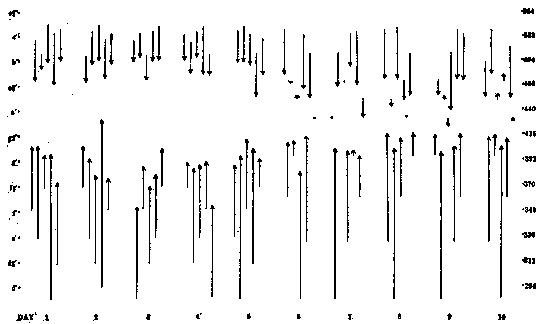 Figure 2 - Reactor A |
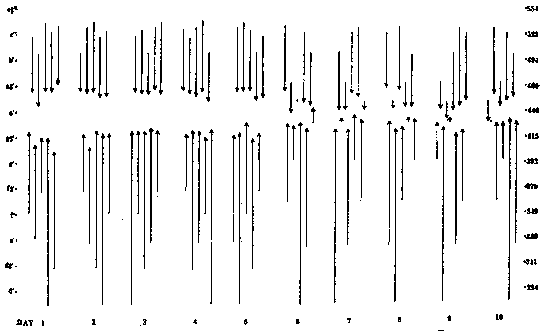 Figure 3 - Reactor B |
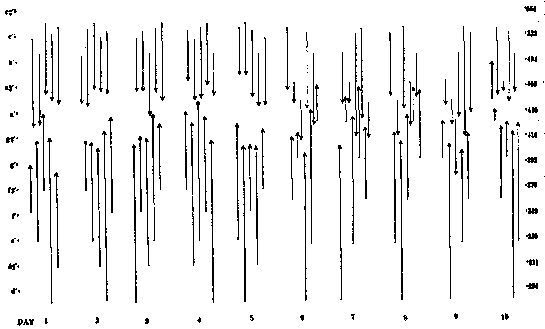 Figure 4 - Reactor C |
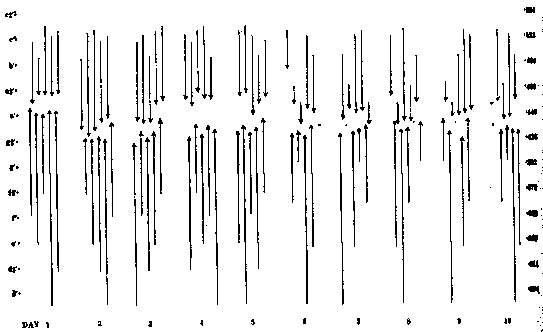 Figure 5 - Reactor D |
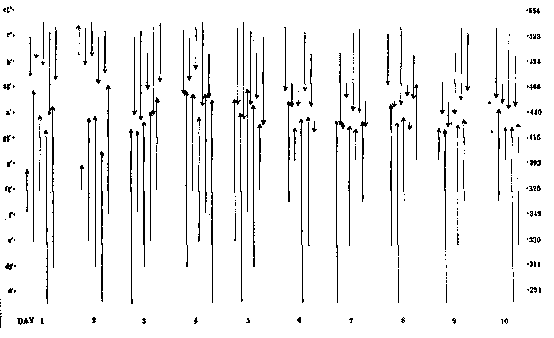 Figure 6 - Reactor E |
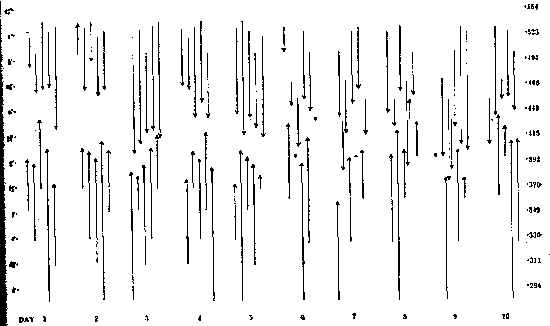 Figure 7 - Reactor F |
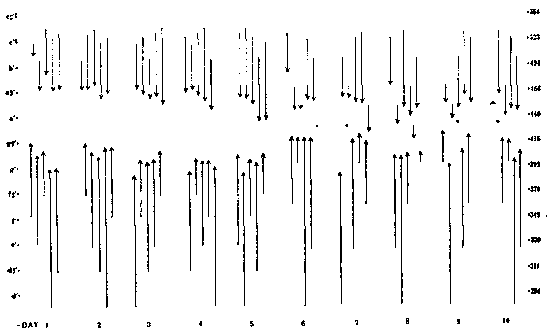 Figure 8 - Reactor G |
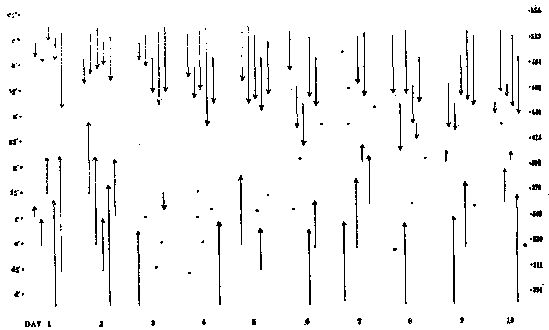 Figure 9 - Reactor H |
A has studied piano, harmony, and ear training regularly for two years. Previously he had some instruction in piano at irregular intervals. He practices piano an average of four hours a day. His threshold for pitch discrimination was under 2 v.s. at 435. He has played the Gluck-Saint-Satins Alceste variations and the first movement of the Brahms F minor Sonata in recital. In regard to his absolute pitch he reported that he could hear c, e, g, c, on the piano quite definitely, that these tones stood out. He hears a as going down to g, f, as going down to e, and the black keys as going down to white. His settings show comparatively large expectation errors, especially from below in the first five days, but a steadfastness in level from day to day.
B's voice is a coloratura soprano. She is a graduate of Maryland School for the
Blind but can see enough to do some reading and to conic to the laboratory alone.
She had studied piano twelve years, voice atine, piano three, and ear training
one. She practices singing from one to three or four hours a day and isolated
somewhat less. In the conservatory psychological tests she scored in the upper
decile in memory for isolated tones and memory for harmony, and in the upper
quartile in pitch discrimination and melodic memory. She has performed the
Strauss "Voce di Primavera" and Rossini's "Una voce porn fa" from the "Barber of Seville" in recital. She showed intense interest in tones of any sort
and music and was in the habit of ascribing pitch names to the tones of speaking
voices, sounds from automobiles, tones the like. She was unusually accurate at
naming piano and organ tones in series and in naming the %Ines in unusual
combinations. Her record in the experiment was one of the best: her final
settings are Practically always between G# and A#.
C has studied piano for twelve years and harmony for five. As a result of her
entrance examination at the conservatory she was not required to take ear
training. She practices the piano about five hours a day. She placed in the
upper quartile in pitch discrimination and harmonic memory, and in the upper decile in memory for isolated tones and melodic memory. She was unusually
accurate at naming prase tones. She has performed the Liszt B minor sonata and
the Schumann A minor concerto in recital. Her record is quite good, especially
after the first day, with only occasional errors of direction, and with less:;
habitual expectation error than A. C and M are the only ones whose arrows
interpenetrate to any extent.
D has studied violin for eight years, harmony for four, and ear training one. He practices the violin about two hours a day. He scored in the upper deciles in pitch discrimination and in memory for iso tones, and in the upper quartiles in melodic and harmonic memory. He has played the Cesar F A major sonata and the d'Ambrosio B minor concerto in recital. He reports that he often tunes violin a string to the correct pitch by memory. His record is one of the best; his settings fluctuate but within the G#— A# limit mainly, and the upper and lower settings are quite close.
E's voice is a dramatic contralto. She has studied piano for about seven years, voice for about two and a half, harmony for one, and ear training for one. She practices singing from two to four hours a day. She has sung "Ah, mon fils" from Meyerbeer's "Le Prophete," and Wolff's "Verborgenheit" and "Gesang Weylas" in recital. Her pitch discrimination threshold was within 2 and 3 v.s. She was able to sing rather accurately notes the experimenter called for. Her record shows that she took somewhat more time in preliminary orientation than some of the rest, but from day 5 on practically all her settings are within the G'-A' limit.
F was the only reactor of the absolute and relative pitch groups who had had training in psychology. F had taken an M.A. in psychology, and his thesis was in part a study of the identification of pianos by their pitches. His introspections and suggestions were especially valuable to the experimenter. F had studied piano for about eight or nine years, harmony four years, organ one year. He had never studied voice but had had about ten years' experience in glee club and choral work. Formerly he practiced on the piano about one and a half hours a day, but he has not practiced regularly for the past two years. He has played in recital the Brahms Intermezzo Opus 118, no. 3, the first piano part in the sky Polonaise for two pianos, and the piano part in the Sgambati Quintet for piano and strings. F felt that he was quite accurate at naming the key or individual notes in one tonality when these are played or sung. In this case the key (key-color or tonality) comes first and immediately afterwards places the tone. He felt that it was harder for him to name individual tones. He placed in the upper rtile in pitch discrimination and melodic memory, and in the upper decile in memory for isolated Es and in memory for harmony. His conception of a' seems to be about the lowest of the absolute pitch reactors, and the fluctuations in his settings are mainly in those from above.
G is proficient in both violin and voice. She is a coloratura soprano and is now concentrating her studies in voice. She studied piano seven or eight years, violin about eleven, voice four, and harmony and composition eight. She practices about an hour a day in singing. She has sung the waltz song:. ("Je veux vivre") from Gounod's "Romeo and Juliet" and the Strauss "Voce di Primavera" is concert. She reports tuning her violin to a' hundreds of times by memory, and later comparisons of this a' with the piano a' have shown her tunings to be correct. She can sing new songs exactly on pitch. Her record shows her to be consistent and fairly accurate, though somewhat cautious, in aiming at A', which for her is a trifle lower than for most of the others.
H is now specializing in pipe organ. He has studied piano for nine years off and on organ for twe years, harmony one and a half, and ear training one. He practices about two hours a day on the piano and about an hour and a half a day on the organ. His pitch discrimination threshold was between 2 3 v.s. at 435. He has played the Mulct " Carillon-Sortie" and the Finale from Widor's symphony in recital. He was quite accurate at naming piano and organ tones in series, but for, absolute pitch reactor made a poor showing on the variator test. His settings from above were fa' good but those from below are almost as scattering as chance settings would be. He made a great wrong acceptances: on day 5 he accepted an initial setting of about d' as a'.
Relative pitch reactors - Experiment I, initial and final settings.
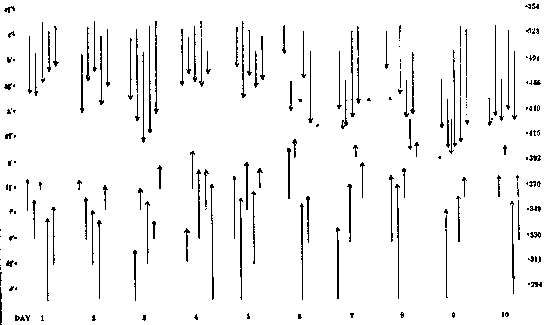 Figure 10 - Reactor L |
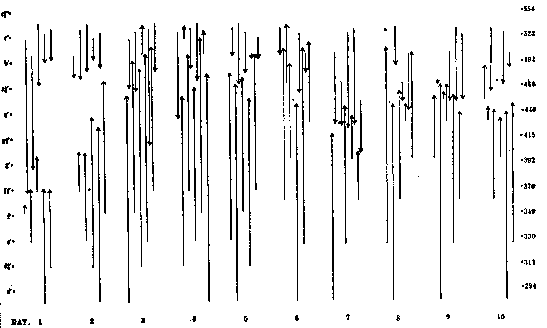 Figure 11 - Reactor M |
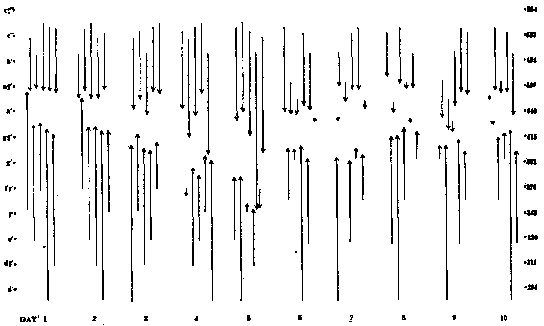 Figure 12 - Reactor N |
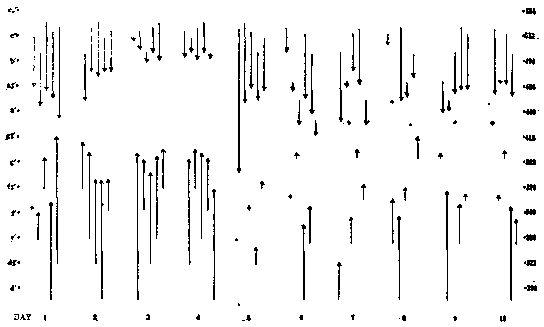 Figure 13 - Reactor O |
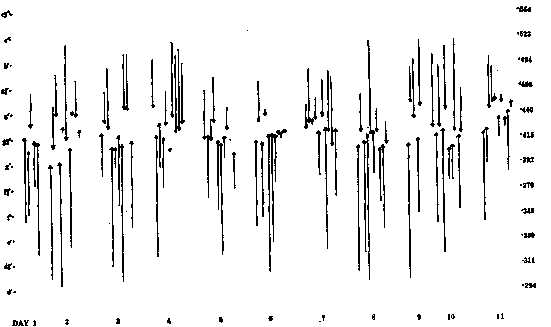 Figure 14 - Reactor T |
K has studied the violin for seven years, piano one, and harmony four. He practices the violin for about two hours a day. His pitch discrimination score was perfect and he placed in the upper quartiles in memory for an isolated tone, for melody, and for harmony. He has played the Mendelssohn E minor violin concerto and the Tartini "Devil's Trill" sonata in recital. As he was not able to complete more than half of the variator work no statistical or graphical statement of his performance is given, but some of his reactions were of especial interest and will be discussed later.
L is a lyric soprano. She has studied voice four years, piano fifteen, harmony three, and ear training one. She scored in the upper quartile in pitch discrimination. She has sung in recital Faure's "Clair de Lune," Debussy's "Mandoline," and Schubert's "Liebesbotschaft." Her settings are scattering and there seems to be a low point (about f:') about which her settings from below cluster. The settings from above travel a good deal from day to day.
M is a dramatic-lyric soprano. She has studied piano twelve years, voice three,
and harmony two. She was excused from attending ear training classes as a result
of her entrance examination at the conservatory. She practices piano about two
hours a day and voice about one. She has sung "Vissi d'Arte " from Puccini's "La Tosca" in recital. On the variator test her record shows that she was
somewhat lost at first, then aimed high for a long time but in an erratic manner
and with many of the settings from above lower than those from below, as shown
by the interpenetration of the arrows. There is a sudden descent on the seventh
day, and the ninth day is excellent.
N has studied piano about ten years, harmony two, and ear training one. She practices the piano about four hours a day. She scored in the upper quartiles in pitch discrimination, memory for isolated tones, memory for melody, and memory for harmony. She has played the Brahms Scherzo in E flat minor, Opus 4, in recital. She was very insistent at the beginning of the experimental work that she did not have absolute pitch and that her ear was not good, but during the time found that she could think of and hum a' when away from the piano and by subsequent testing found herself to be correct. Her record is erratic: the first two days are excellent, then come three bad days, and the last three day. are quite good again.
O is a violinist and has studied the instrument for about five and a half years, harmony for four months, and ear training not at all. He practices the violin an average of two hours a day. A former teacher states that this reactor has fair relative pitch and a better ear for intonation than the averse. He has played the Rode concerto in A minor and the Wieniawski " Legende " in recital. He was the only one of the above reactors not devoting his whole time to music. His variator record shows him to be quite cautious at first, and at his best on days 3 and 4 when his settings show large expectation errors' but are consistent and centered near 440; from then on they are lowering, scattered, and confused.
T (the experimenter) has studied piano for about twelve years, pipe organ for three, and harmony and composition for six. During the experimental period he used the piano only about one or two hours a week, the organ about three. His score in pitch discrimination was about at the median, and was in the highest decile in memory for isolated tones, for melody, and for harmony. He has played the Chopin "Fantasie" and the Cesar Franck "Variations Symphoniques" in piano recital, and the Bach "Prelude and Fugue in A minor " and the first movement from Widor's sixth symphony in organ recital. Because of his orientation in the variator test and the random initial settings given him his record can not be compared with the others; his settings are consistent and close with little expectation error, but markedly lower than they should have been.
Control reactors - Experiment I, initial and final settings.
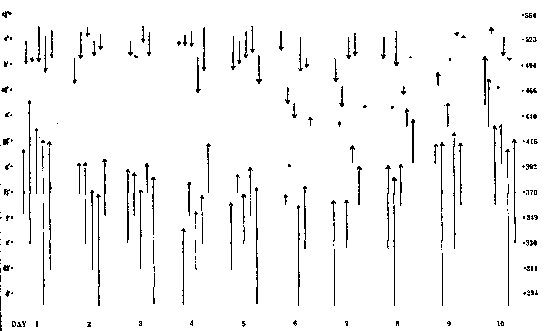 Figure 15 - Reactor W |
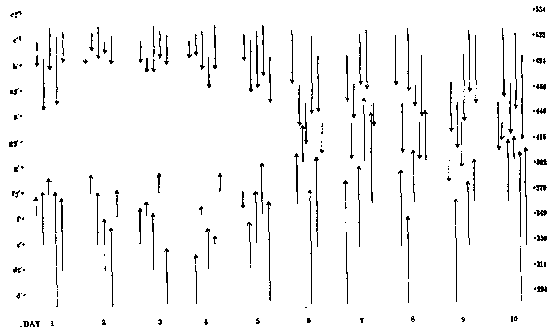 Figure 16 - Reactor X |
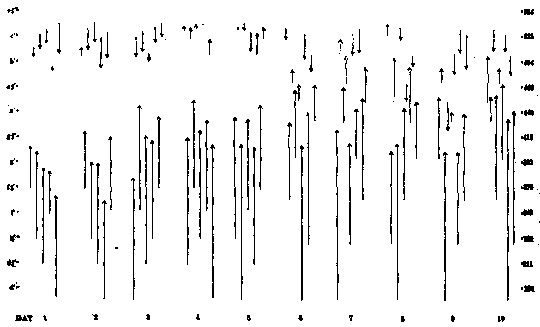 Figure 17 - Reactor Y |
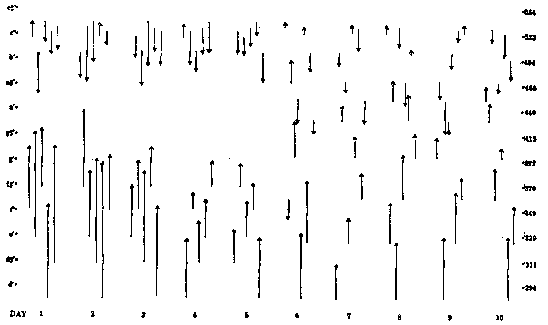 Figure 18 - Reactor Z |
W was the only control reactor who played frequently at the time of the experiment. He has studied piano for about eight years, harmony and counterpoint for about four, and now plays the piano about two or three hours a week. His settings show some preliminary exploration, then two days of fairly consistent aiming at 440, and from then on a tendency to scatter and travel upward.
X has studied the piano for about three years and the violoncello for about two
and a half. Her settings show caution at first, then some tendency to tune over
about the same distance each time. On
the last five days the center of her settings is low and near the center of the
tone continuum used.
Y had studied piano for about four or five years and had sung in a high school glee club. Her setting, , show a gradual and irregular ascent until the first setting on the eighth day, then a descent.
Z had studied piano for eight years. Her settings are very irregular; there is perhaps some regularity in the first days when the settings were wide apart, but thereafter she conies the closest of all reactors to total irregularity.
W and Y had seen the tone variator demonstrated two years before in a class in experimental psychology and recognized it on the first experimental day; all the others were unfamiliar with the instrument. A comparison of these figures shows that D., B, and E (excluding her first two days) have the best records; C, G, and A follow, and then N and F. The others show little trace of a fine or persisting sense of absolute pitch.
F and H show considerable variation from the norms established by the others of the absolute pitch group. F's conception of a', as shown by his settings, fluctuated a good deal from day to day and also within individual days. He made very few errors of direction, but since settings were always alternated and he was trained in psychology this lack of directional errors .might not be due to pitch sense alone. He accepted three times initial settings of 395 v.s. (about g') as a'. He gave perhaps the least naive judgments of all the reactors, as he reported a good deal of auditory imagery. He has had much practice in giving tonal psychological tests and perhaps his attention in this test was a good deal diverted by such considerations. H presents a puzzling case. He accepted a great many initial settings lower than a' as a'; one of these was below d', two about at d#', four below e', and several more not so far off. Only on the seventh day did he accept initial settings above a#' as a'. None of the relative or control reactors has a record like this. He shows a fair amount of uniformity in tuning down but not in tuning up. Yet he is greatly superior to the relative pitch reactors and certainly to the controls in the naming of heard pitches. If this test is a crucial and valid test of absolute pitch it may be necessary to consider F and H as those whose absolute pitch may depend not primarily on perception of local sign in the end organ, but on secondary criteria, such as key-color, or an orientation by means of some one or few remembered pitches.
Of the relative pitch reactors N, O, and K deserve special note. N was quite insistent at the beginning of experimental work that she did not have absolute pitch but later reported dreaming of a', and also thinking of a', humming it, and finding herself correct when comparing her a' with the piano a'. The conservatory psychological tests show that she has a very good ear, and this statement was emphatically confirmed by her ear-training instructor and her ear grades. On the first two days she made excellent records, better than many of the absolute pitch group. The third day, while not so good as the first, was good; but on the fourth and fifth days she tuned lower and more variably. Her last three days show an improvement over this but are not so good as the first two. It is notable that all of the reactors of the absolute pitch group (except F and H) hewed pretty close to the line every day without showing the variability that N did, although few of them made as excellent records on the first two days as she did.
Reactors O and K are both violinists and gave quite similar reactions in one respect. Both made quite indifferent showings in the variator test and felt keenly that this was the case; both complained that they could hear a' in their heads but could not find it on the variator; and both set the sonometer bridge on successive days so as to give pitches very much closer to 440 than their variator settings. At the first sonometer test they were asked to find a on the string with their eyes open. On subsequent days they were asked to close their eyes, then they were turned around a couple of times, then one hand was placed on the string and the other on the bridge. K gave two settings in this way on successive days and 0 four. All of these fell at points between 427 and 444 v.s. If some criterion from the end organ was of primary importance in determining this response, this criterion must have been limited to a more complex pattern than were the criteria of the successful absolute pitch reactors. K's variator settings are not given because he was unable to complete more than five days' work.
L's settings show an indefiniteness of localization of a which does not improve much towards the end of the series. M is indefinite at first and is the only reactor whose settings overlap to any extent. Her settings on the last four days when initial settings close to 440 were included show an improvement in consistency and accuracy. Her settings from below on the last day are all rather accurate. On day 5 O told the experimenter that the day before at his violin lesson it had suddenly swept over him that he was getting a' too high on the variator. His graph shows how this concept influenced his settings for that and the following day.
Perhaps the important difference between all the reactors of the absolute pitch group, including even F and H, and the other reactors is that the former, even when their settings are wide apart and inaccurate, do not show the fluctuations up and down from day to day that the others do. Thus M's concept of a' seemed to ascend continually for the first six days and then drop; the fluctuations of N and O have already been discussed. W, X, and Z all started with a comparatively narrow range between their upper and lower settings; this range widens for a day or two, then narrows. W and Y tended to tune to higher and higher points toward the end. Z's settings scatter rather aimlessly. From one point of view the relative and control reactors may be said to give much more individual responses than the six best absolute pitch reactors; the latter approximate a more fixed and definite range.
Figures 19 and 20 give only the first settings a day for each reactor. This shows the differences between the groups strikingly. In the absolute pitch group there is only one serious error in direction; that of C on her last day, and she recognized this immediately but did not tell the experimenter until after completing the setting. E's and F's errors on their second days are probably excusable as due to lack of orientation in the test, and G's last day error in direction did not take her more than half a tone from a'. M's last day error is the only important one in the relative group, but Y and Z tuned upwards nine times out of ten from the first initial setting. The differences between the groups in range inclosed by final settings are about the same as would be gathered from the graphs of all the settings, and it is quite likely that if reactors were to be separately ranked in order of excellence from the graphs of the first settings and from graphs of all the settings that the orders would be about the same.
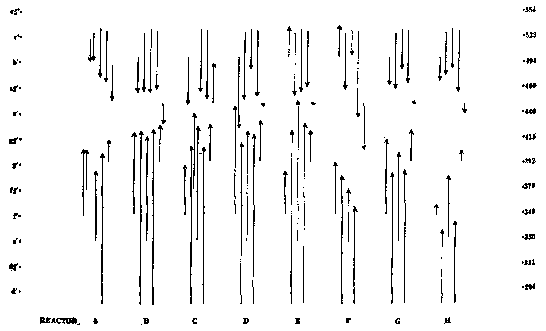
Figure 19. Experiment I, first settings a day only, absolute pitch
reactors.
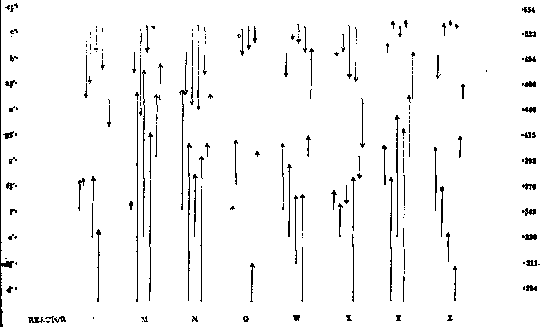
Figure 20. Experiment I, first settings a day only, relative and control
reactors.
Several interesting points came to light through an error of the experimenter. For A, L, and O he inadvertently gave the lower setting first on the second day, and to compensate therefor he gave the higher setting first on the third and fourth days. It will be noted from Figure 19 that on day 2 A tuned to almost exactly the same point in the first trial as on the first day, and on day 4 he tuned to almost the same point as on day 3. L's final settings for the first two days are almost identical; her first settings on days 3 and 4 are less close. O does not show this tendency at all. This points out interesting individual differences in memory for a certain variator tone, and also indicates the necessity for alternating the directions of successive first settings.
Means for each day's settings from above and from below for each reactor were worked out because it seemed that they, although inaccurate, would give the best available central measure. Since there were only five comparable values a day (those from settings either above or below 440) a median or a mode would not represent so small a group of values as well as would a mean. The means, however, are all slightly too high. because they were computed from vibration frequencies, which increase on a geometric, not on an arithmetic scale. No means were computed from settings which came from both above and below 440, but when means are computed from settings which come from one side of 440 the distortion is relatively slight. For example, if the vibration frequencies of g' (392) , g#' (415) and a' (440) and the quarter tones between them (404 and 428) are averaged the result is 415.8, only negligibly above the note of the musical scale which would be the true mean (g#', 415) . If d' (294), e' (330), f#' (370), g#' (415), and a#' (466) are averaged the result is 375, only 5 v.s. above the central note.. So wide a distribution of settings is found only occasionally among the relative pitch or control reactors.
The mean variation gives a measure of variability subject to the same distortion
as its mean, although, of course, to about half that extent. In interpreting the
mean variations, however, it must be remembered that a half tone amounts to
about 10 to 11 v.s. from e' to g' (330 to 392), to from 12 to 13 v.s. from g' to
a' (392 to 466), and to about 14 or 15 v.s. from a~' to cj$' (466 to 554). In
other words, a mean variation of 30 v.s. at 350 would mean about three half
tones; at 500 it would mean only two.
Means and mean variations of the final settings of all reactors for days 1 to 5 and 6 to 10 are given in Table 3. It will be noted that the means for the last five days are closer to 440 than are the means for the first five days for all reactors but D and E when tuning from below and N when tuning from above. These three have both means quite close to 440. This tendency to come closer to 440 as the experiment progressed can be attributed both to the changed distribution of the initial settings from day 6 on so as to have some of them much closer to 440, and to the decrease in amount of expectation error as a result of increasing familiarity with the variator tone and test procedure. There is no uniform change in variability as the experiment progressed as shown by the mean variations. In their settings from below six reactors show a decrease in variability from the first five to the last five days, and ten show an increase. In the settings made from above eight reactors show a decrease in variability, seven an increase, and one no change from the first half of the experiment to the last.
TABLE 2.
Experiment I, initial settings in vibrations per section
| Day | Settings | |||||||||
| 1 | 350 | 520 | 330 | 500 | 370 | 540 | 285 | 527 | 310 | 532 |
| 2 | 500 | 370 | 532 | 330 | 540 | 310 | 520 | 285 | 527 | 350 |
| 3 | 285 | 520 | 350 | 527 | 310 | 500 | 330 | 532 | 370 | 540 |
| 4 | 527 | 310 | 520 | 370 | 532 | 330 | 540 | 350 | 500 | 285 |
| 5 | 330 | 532 | 285 | 540 | 350 | 527 | 310 | 500 | 370 | 520 |
| 6 | 532 | 360 | 470 | 395 | 450 | 285 | 525 | 325 | 500 | 430 |
| 7 | 285 | 500 | 430 | 470 | 325 | 525 | 395 | 532 | 360 | 450 |
| 8 | 525 | 325 | 450 | 286 | 532 | 360 | 470 | 430 | 500 | 395 |
| 9 | 395 | 470 | 285 | 450 | 430 | 500 | 325 | 532 | 360 | 525 |
| 10 | 450 | 430 | 532 | 360 | 470 | 395 | 525 | 285 | 500 | 325 |
TABLE 3.
Experiment I, means and mean variations of final settings for days 1 to 5 and 6
to 10
| From below 440 | From above 440 | ||||
| Reactor | Days | Mean | M.V. | Mean | M.V. |
| A | 1-5 | 389.6 | 12.9 | 485.3 | 10.3 |
| 6-10 | 410.6 | 9.0 | 460.8 | 11.2 | |
| B | 1-5 | 418.3 | 3.8 | 458.4 | 3.5 |
| 6-10 | 429.2 | 4.1 | 447.6 | 7.0 | |
| C | 1-5 | 419.2 | 12.8 | 454.6 | 9.6 |
| 6-10 | 427.9 | 17.4 | 440.4 | 15.5 | |
| D | 1-5 | 427.6 | 8.6 | 447.3 | 12.1 |
| 6-10 | 425.7 | 4.1 | 442.7 | 8.8 | |
| E | 1-5 | 437.7 | 16.6 | 464.6 | 21.1 |
| 6-10 | 431.5 | 7.3 | 446.7 | 8.4 | |
| F | 1-5 | 395.5 | 11.7 | 444.7 | 25.3 |
| 6-10 | 405.0 | 17.4 | 429.9 | 22.2 | |
| G | 1-5 | 400.4 | 6.7 | 462.7 | 9.3 |
| 6-10 | 413.6 | 9.4 | 450.7 | 9.0 | |
| H | 1-5 | 356.8 | 26.0 | 473.8 | 19.0 |
| 6-10 | 380.1 | 28.8 | 450.1 | 16.2 | |
| L | 1-5 | 365.6 | 15.6 | 459.6 | 16.4 |
| 6-10 | 385.8 | 21.0 | 437.4 | 16.4 | |
| M | 1-5 | 450.7 | 41.7 | 475.6 | 27.8 |
| 6-10 | 458.1 | 24.8 | 461.1 | 24.1 | |
| N | 1-5 | 403.4 | 23.2 | 441.1 | 19.7 |
| 6-10 | 412.0 | 9.7 | 450.6 | 11.6 | |
| O | 1-5 | 376.1 | 23.8 | 473.4 | 23.8 |
| 6-10 | 378.5 | 29.3 | 458.2 | 14.9 | |
| W | 1-5 | 388.0 | 18.9 | 498.3 | 11.6 |
| 6-10 | 409.4 | 24.7 | 485.9 | 23.3 | |
| X | 1-5 | 360.5 | 14.8 | 485.4 | 14.1 |
| 6-10 | 399.3 | 18.4 | 438.0 | 18.0 | |
| Y | 1-5 | 409.5 | 19.4 | 514.3 | 14.3 |
| 6-10 | 438.8 | 19.0 | 492.7 | 17.0 | |
| Z | 1-5 | 378.0 | 24.5 | 497.0 | 16.9 |
| 6-10 | 383.0 | 36.3 | 487.0 | 30.8 | |
Table 4 brings together the means and mean variations for all settings for all reactors, gives the range between the means of settings from both directions, and a rough estimate of the midpoints between these settings. In this last figure additional decimal digits have been dropped off so that the figures would approximate more closely to the true midpoint. In general, reactors with smaller ranges and with midpoints closer to a' show less variability in their total settings, but there are notable exceptions. M has a narrow range but much variability and her midpoint (461) is closer to a# (466) than to a' (440). W and Z have midpoints very close to 440 (445 and 436) but wide ranges and much variability.
TABLE 4.
Experiment I, means and mean variations for all settings, days 1 to 10.
| From below 440 | From above 440 | |||||
| Mean | Mean variation | Mean | Mean variation | Range between means | Midpoint between means | |
| A | 400.1 | 14.0 | 473.1 | 14.5 | 73.1 | 436 |
| B | 423.7 | 6.0 | 453.0 | 7.5 | 29.3 | 438 |
| C | 423.6 | 15.5 | 447.5 | 13.6 | 23.8 | 435 |
| D | 426.6 | 6.4 | 445.0 | 11.0 | 18.4 | 436 |
| E | 434.6 | 12.8 | 455.6 | 16.5 | 21.0 | 446 |
| F | 400.2 | 14.8 | 437.3 | 23.5 | 37.1 | 418 |
| G | 407.0 | 9.9 | 456.7 | 9.6 | 49.7 | 432 |
| H | 368.5 | 29.3 | 462.0 | 19.3 | 94.0 | 415 |
| L | 375.7 | 19.2 | 448.5 | 20.2 | 72.8 | 412 |
| M | 454.4 | 32.4 | 468.3 | 28.0 | 13.9 | 461 |
| N | 407.7 | 16.8 | 445.8 | 15.5 | 38.1 | 427 |
| O | 377.3 | 26.4 | 465.8 | 20.8 | 88.5 | 421 |
| W | 398.7 | 24.2 | 492.0 | 18.3 | 93.3 | 445 |
| X | 379.9 | 23.2 | 461.7 | 26.1 | 81.8 | 421 |
| Y | 424.2 | 23.3 | 503.5 | 17.0 | 79.3 | 464 |
| Z | 380.5 | 30.0 | 492.1 | 24.4 | 111.6 | 436 |
For a rough comparison of the three experimental groups the rank orders given in
Table 5 were made up from Table 4. All reactors (except T) are ranked according
to the accuracy and variability of their settings in both directions, according
to the range between the means of their final settings from both directions, and
according to the midpoints between the means for the two directions. In Table 5
are also given the average ranks of the three groups of reactors. The absolute
pitch group ranks higher than both the others on all criteria, but the
differences in variability are the most impressive of all. This is a
verification of the differences between the groups in consistency of
localization of a' as shown on the graphs for each reactor. The differences
between the absolute pitch and relative pitch groups would be more striking if N
was transferred to the former, as the test results suggest should be done. The
averages of the averages given in Table 5 are not in themselves particularly
significant because there is no way of knowing how much each measure used in
computing the average should have been weighted. But these averages of the
averages indicate that this variator test does not distinguish the relative
pitch reactors from the controls used in this experiment as well as the absolute
pitch reactors are distinguished from both groups. As it is, our control group
does not constitute a true control group; rather its "controlness" is relative
and its ability lies somewhere between that of the relative pitch group and
another group having absolutely no musical training.
TABLE 5.
Experiment I, rank orders of reactors (from Table 4)
| Average of groups | ||||
| Criteria from below 440 | Rank order of reactors | AP | RP | Control |
|
Closeness to 440 |
E D M Y B C N G F A W Z X O L H | 7.1 | 9.8 | 10.0 |
|
Variability |
B D G E A F C N L X Y W O H X M | 5.3 | 11.5 | 12.0 |
| From above 440 | ||||
|
Closeness to 440 |
F D N C L B E G X H O M A W Z Y | 6.4 | 7.8 | 13.5 |
|
Variability |
B G D C A N E Y W H L O F Z X M | 5.6 | 11.3 | 11.5 |
|
Average range |
M D E C B F N G L A Y X O W H Z | 6.6 | 7.5 | 13.6 |
| Closeness of midpoint to 440 | B A/D/Z C/W E G N X/O M F Y H L | 6.9 | 11.9 | 8.3 |
| Average | 6.5 | 10.0 | 11.4 | |
The medians for the settings of each reactor for the directions from above 440
and from below 440 for the first five and last five days are given in Table 6.
Thus the median of A's 25
settings from below 440 for the first five days is 390 v.s., for the last five
days, 411 v.s. These medians are given because they are not subject to
distortion as are the means, and give a more orthodox measure for the analysis
of threshold test results. It will be seen that they vary little from the means
for the same days and directions.
TABLE 6.
Experiment 1, medians of reactors' settings
| Days 1 to 5 | Days 6 to 10 | All days | ||||
| Reactor | from below 440 | from above 440 | from below 440 | from above 440 | from below 440 | from above 440 |
| A | 390 | 491 | 411 | 461 | 402 | 472.5 |
| B | 419 | 460 | 430 | 446 | 423 | 456 |
| C | 415 | 454 | 425 | 443 | 420 | 448.5 |
| D | 425 | 452 | 426 | 441 | 425.5 | 444.5 |
| E | 439 | 463 | 429 | 446 | 432 | 450.5 |
| F | 395 | 436 | 402 | 434 | 398.5 | 435 |
| G | 400 | 463 | 417 | 452 | 406.5 | 457.5 |
| H | 349 | 474 | 380 | 452 | 362.5 | 459.5 |
| L | 368 | 464 | 384 | 432 | 375.5 | 448.5 |
| M | 465 | 483 | 447 | 458 | 455.5 | 469.5 |
| N | 407 | 453. | 412 | 455 | 408.5 | 453 |
| O | 382 | 481 | 367 | 457 | 376 | 462 |
| W | 387 | 500 | 413 | 492 | 394.5 | 499.5 |
| X | 362 | 492 | 398 | 440 | 377 | 463 |
| Y | 411 | 514 | 440 | 497 | 425 | 504 |
| Z | 382 | 499 | 381 | 486 | 382 | 497 |
Distributions of the final settings for all reactors are given in Table 7
(absolute pitch group) and Table 8 (relative pitch and control groups). To
obtain the steps in the distributions each half tone was divided into four
parts. The vibration numbers for the chromatic scale with a' equal to 440 v.s.
were taken from A. J. Ellis in his translation of Helmholtz' "Sensations of
Tone", p. 490. The eighth tone interval next above f#' (370) was called f#+,
the one next above that, f#++; the one right below f#' was called f#'-, the one
below that, f#--, etc. This scheme served to give a distribution without
distortion. As would be expected, the distributions of the best reactors are
centered rather close to a', those of the others are more spread out. In fact,
compactness of distribution at the correct point is the best criterion here,
since there are no consistent differences between the groups in extent of
overlapping of the two distributions. B, D, and E, who made the best records,
have the distributions for from below 440 a little more compact than those for
from above 440. Tables not given here show that with the exception of C, D, and
Z, the distributions for the second five days cover a smaller extent than those
for the first five days. In the first five days the distributions for the two
directions overlap little or not at all with A, B, G, H, L, O, W, X, Y, and Z;
in the last five days all overlap.
Figure 21 compares the distributions of the first settings of all reactors. Z's
settings are as near an approach as any to a, chance distribution and she
claimed she had no idea of a' whatsoever. W and X are not strictly control
reactors, since they had some idea of a', but they probably show reactions
characteristic of absence of any fine localization. According to this figure it
would seem that N should be classed with the absolute pitch
group and F and H with the relative. This figure shows again
that the best reactors with absolute pitch tend to group their
first settings consistently around a' and not at a lower point, as
the initial settings might tend to make them.
TABLE 7.
Experiment I, distribution of final settings.
b - from below 440; a - from above 440
| Reactors | A | B | C | D | E | F | G | H | ||||||||
| Range by eighth tones | b | a | b | a | b | a | b | a | b | a | b | a | b | a | b | a |
| D-- | 1 | |||||||||||||||
| D- | ||||||||||||||||
| D+ | ||||||||||||||||
| D++ | ||||||||||||||||
| D#-- | ||||||||||||||||
| D#- | ||||||||||||||||
| D#+ | ||||||||||||||||
| D#++ | ||||||||||||||||
| E-- | 1 | |||||||||||||||
| E- | 2 | |||||||||||||||
| E+ | ||||||||||||||||
| E++ | 3 | |||||||||||||||
| F-- | 4 | |||||||||||||||
| F- | 5 | |||||||||||||||
| F+ | 2 | |||||||||||||||
| F++ | 1 | 4 | ||||||||||||||
| F#-- | 3 | |||||||||||||||
| F#- | 1 | 3 | ||||||||||||||
| F#+ | 2 | 2 | 1 | |||||||||||||
| F#++ | 3 | 1 | 5 | 3 | ||||||||||||
| G-- | 3 | 1 | 1 | 4 | 1 | 3 | ||||||||||
| G- | 3 | 1 | 1 | 4 | 1 | 6 | ||||||||||
| G+ | 5 | 9 | 1 | 4 | 2 | |||||||||||
| G++ | 8 | 1 | 2 | 1 | 7 | 2 | 10 | 6 | ||||||||
| G#-- | 7 | 1 | 7 | 4 | 4 | 9 | 1 | 1 | ||||||||
| G#- | 10 | 4 | 8 | 5 | 2 | 3 | 4 | 6 | 2 | 1 | ||||||
| G#+ | 12 | 6 | 10 | 1 | 2 | 3 | 3 | 8 | ||||||||
| G#++ | 2 | 15 | 3 | 4 | 16 | 2 | 11 | 3 | 2 | 4 | 3 | 1 | 2 | |||
| A-- | 4 | 1 | 14 | 2 | 6 | 3 | 14 | 9 | 11 | 3 | 4 | 4 | 3 | 1 | 5 | 3 |
| A- | 1 | 2 | 1 | 7 | 2 | 3 | 9 | 8 | 6 | 1 | 5 | 5 | 2 | |||
| A+ | 1 | 1 | 12 | 2 | 6 | 4 | 5 | 2 | 8 | 2 | 3 | 1 | ||||
| A++ | 5 | 6 | 1 | 9 | 1 | 10 | 5 | 8 | 1 | 4 | 11 | 9 | ||||
| A#-- | 5 | 13 | 1 | 9 | 7 | 3 | 5 | 4 | 9 | 6 | ||||||
| A#- | 3 | 15 | 4 | 7 | 6 | 3 | 4 | 7 | 8 | 8 | ||||||
| A#+ | 10 | 1 | 2 | 2 | 4 | 9 | 2 | |||||||||
| A#++ | 8 | 2 | 2 | 4 | ||||||||||||
| B-- | 2 | 2 | 1 | 2 | 1 | |||||||||||
| B- | 6 | 1 | 1 | 2 | 1 | 3 | ||||||||||
| B+ | 8 | 2 | 4 | |||||||||||||
| B++ | 1 | 1 | 2 | |||||||||||||
| C-- | ||||||||||||||||
| C- | ||||||||||||||||
| C+ | 1 | |||||||||||||||
| C++ | 1 | 1 | ||||||||||||||
TABLE 8.
Experiment 1, distribution of final settings
b - from below 440; a - from above 440
| Reactors | L | M | N | O | W | X | Y | Z | ||||||||
| Range by eighth tones | b | a | b | a | b | a | b | a | b | a | b | a | b | a | b | a |
| D-- | ||||||||||||||||
| D- | 1 | |||||||||||||||
| D+ | ||||||||||||||||
| D++ | ||||||||||||||||
| D#-- | ||||||||||||||||
| D#- | 1 | 1 | ||||||||||||||
| D#+ | ||||||||||||||||
| D#++ | 1 | 1 | ||||||||||||||
| E-- | 1 | |||||||||||||||
| E- | 1 | 1 | 4 | |||||||||||||
| E+ | 1 | 1 | 3 | |||||||||||||
| E++ | 2 | 1 | 1 | 1 | ||||||||||||
| F-- | 3 | 1 | 2 | 2 | ||||||||||||
| F- | 1 | 1 | 3 | 2 | ||||||||||||
| F+ | 3 | 2 | 1 | 3 | 1 | 3 | ||||||||||
| F++ | 3 | 1 | 1 | 3 | 2 | 3 | 1 | 3 | ||||||||
| F#-- | 4 | 3 | 3 | 3 | 1 | 1 | ||||||||||
| F#- | 2 | 2 | 1 | 3 | 4 | 6 | 2 | |||||||||
| F#+ | 6 | 1 | 3 | 4 | 2 | 2 | ||||||||||
| F#++ | 6 | 3 | 3 | 1 | 4 | 1 | 2 | |||||||||
| G-- | 4 | 1 | 1 | 3 | 4 | 2 | 3 | |||||||||
| G- | 3 | 1 | 1 | 4 | 2 | 2 | 5 | |||||||||
| G+ | 2 | 4 | 5 | 6 | 4 | 1 | ||||||||||
| G++ | 3 | 2 | 4 | 1 | 5 | 2 | 8 | 1 | 4 | 1 | 4 | 1 | ||||
| G#-- | 3 | 2 | 8 | 1 | 2 | 2 | 2 | 5 | 4 | |||||||
| G#- | 1 | 1 | 4 | 1 | 3 | 7 | 3 | 2 | 4 | 2 | ||||||
| G#+ | 1 | 2 | 1 | 9 | 1 | 1 | 1 | 2 | 3 | 1 | 5 | 1 | ||||
| G#++ | 4 | 1 | 3 | 6 | 1 | 1 | 2 | 2 | 1 | 2 | ||||||
| A-- | 6 | 2 | 1 | 4 | 2 | 3 | 2 | 2 | 1 | 2 | 4 | 1 | ||||
| A- | 6 | 4 | 2 | 8 | 3 | 3 | 1 | 1 | 3 | 8 | 1 | |||||
| A+ | 2 | 5 | 6 | 1 | 1 | 4 | 4 | 1 | 1 | |||||||
| A++ | 5 | 2 | 6 | 1 | 4 | 8 | 2 | 5 | 4 | 3 | 1 | 1 | 1 | |||
| A#-- | 3 | 5 | 2 | 1 | 9 | 4 | 1 | 1 | 1 | 3 | 1 | 3 | ||||
| A#- | 4 | 2 | 4 | 13 | 8 | 2 | 5 | 2 | 2 | |||||||
| A#+ | 5 | 4 | 5 | 1 | 3 | 3 | 4 | 2 | 1 | 5 | ||||||
| A#++ | 3 | 1 | 2 | 1 | 2 | 1 | 1 | 1 | 2 | 2 | ||||||
| B-- | 4 | 3 | 6 | 4 | 4 | 2 | 5 | 4 | ||||||||
| B- | 1 | 1 | 3 | 1 | 3 | 5 | 1 | 4 | 2 | |||||||
| B+ | 1 | 2 | 7 | 4 | 13 | 8 | 8 | 8 | ||||||||
| B++ | 3 | 5 | 7 | 2 | 10 | 4 | ||||||||||
| C-- | 4 | 1 | 5 | 1 | 3 | 5 | ||||||||||
| C- | 2 | 1 | 1 | 6 | 2 | |||||||||||
| C+ | 2 | 3 | 2 | |||||||||||||
| C++ | 3 | 1 | 7 | 8 | ||||||||||||
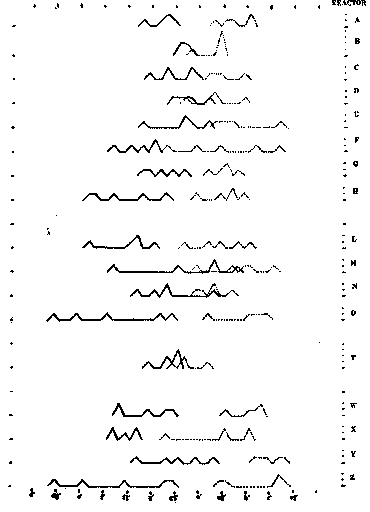
Figure 21. Experiment I, distribution of first final settings each day.
Solid = from below 440; dotted = from above 440.
The distribution of all 1699 settings (Figure 22) was made up primarily to see if it would give any indication of the effects of unevenness in the variator tone. The graph has several peaks, three of which are easily explained. The two central peaks on either side of 440 and their intervening dale are functions of the initial settings, the expectation errors, and the true conception of a'. The last one to the right, between c" and c#, comes from the tendency of a few reactors, mainly Y and Z, to tune upwards till they hit the top of the variator scale and could go no further. The peak intermediate to this and the other two, the peak at b'+, is puzzling. It does not come near any of the "intensity points" mentioned by reactors nor near the point at which the sympathetic buzzing was heard. Perhaps if the scale had been equal on both sides the right hand side of this graph would have been similar to the left hand side. But, for the reasons given above, it is important to have the pitch at which the reactors are to aim at a point to one side of the center of the initial settings or of the scale used.
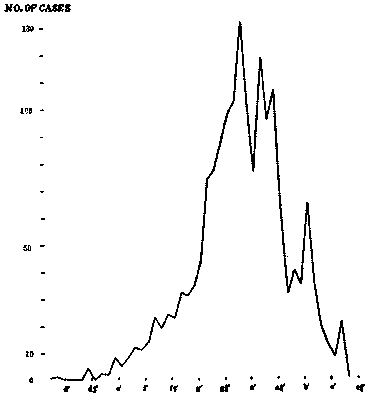
Figure 22. Experiment 1, distribution of all settings for all reactors.
T's reactions cannot be compared with the rest since the initial settings given him were taken at random. An assistant shook up in a bottle slips containing all the numbers on the dial, and ten of these were given to T as initial settings a day. T also when giving the test to the other reactors would tend to estimate their final settings and would have a check on his estimations when he read and recorded their final settings. His final settings converge around g#' and thus would place him in the relative pitch group if his initial settings had been the same as the others, but since his initial settings were random, this does not necessarily follow. Such a chance selection of initial settings would be advantageous for working with an individual reactor but would not be so useful if his performance was to be compared with the performances of others. Of the initial settings given him 56 were below 440 and 44 were above 440; 7 of his first settings a day were from below 440 and 4 from above 440; but these differences are hardly enough to account for the lowness of his a'. But the distribution of his total settings around g#' corresponds somewhat closely to the distribution of all settings for all reactors and may thus indicate an effect on his own settings of the more than a thousand settings to a' which he was continually hearing.
Three tabulations of significant data are given in Tables 9, 10, and 11. Table 9 gives the number of times that a reactor took the wrong direction in tuning. These are rather important because they indicate cases in which the reactor broke up the alternation of direction that he might have come to expect in successive tunings. Some of these errors are doubtless due to inattention, others to genuine confusion. Table 10 gives the number of times that reactors correctly and incorrectly accepted initial settings as a' and did not attempt to modify them at all or changed them not more than one-sixteenth of a tone. Usually there was a rather sharp differentiation between these very slight tunings and the next larger extents of tuning. That is, a reactor usually either " fixed " an initial setting he thought of as about a' just a trifle or, if he tuned over more than a very small distance, he usually traversed a quarter-tone or more. As a glance at this table and the graphs will show, there was a good deal of variation among the reactors in inclination to accept initial settings as a'. This table shows clearly that correct acceptance of initial settings as a' does not of itself indicate a high score in other respects. Neither C, who otherwise scored high, nor the three control reactors X, Y, and Z accepted any initial. settings as final, but changed them all. D and O, whose performances differed vastly in other respects, both accepted correctly six initial settings as a'. Table 11 gives the number of times that each reactor tuned into the range from g#' (415) to a#' (466) on his first setting each day. It seems that a range as large as this might be considered correct on account of the tendency noticeable in most reactors to make negative expectation errors. If the reactors are to be ranked in absolute pitch ability on any one criterion alone, this is the table which would logically show that ranking.
TABLE 9.
Experiment I, number of times that reactors took wrong direction in tuning.
| Reactor | A | B | C | D | E | F | G | H | L | M | N | O | W | X | Y | Z |
| Up from 440 | 4 | 0 | 1 | 0 | 1 | 1 | 0 | 0 | 0 | 6 | 1 | 0 | 1 | 0 | 17 | 12 |
| Down from 440 | 0 | 0 | 1 | 0 | 3 | 1 | 1 | 2 | 3 | 0 | 4 | 1 | 0 | 7 | 0 | 3 |
TABLE 10.
Experiment I, number of times that reactors accepted initial settings as A.
(Under these are included cases in which reactors tuned over less than one-sixteenth of a tone)
| Reactor | A | B | C | D | E | F | G | H | L | M | N | O | W | X | Y | Z |
| Correct (from G#-415 to A#-466) | 4 | 2 | 0 | 6 | 3 | 2 | 5 | 5 | 5 | 3 | 3 | 6 | 3 | 0 | 0 | 0 |
| Incorrect | 2 | 0 | 0 | 0 | 0 | 3 | 0 | 19 | 1 | 2 | 0 | 4 | 6 | 0 | 2 | 0 |
TABLE 11.
Experiment 1, number of first settings a day between G# (415) and A# (466)
| Reactor | A | B | C | D | E | F | G | H | L | M | N | O | W | X | Y | Z |
| Number | 1 | 10 | 6 | 8 | 7 | 2 | 3 | 2 | 3 | 4 | 5 | 1 | 0 | 0 | 3 | 0 |
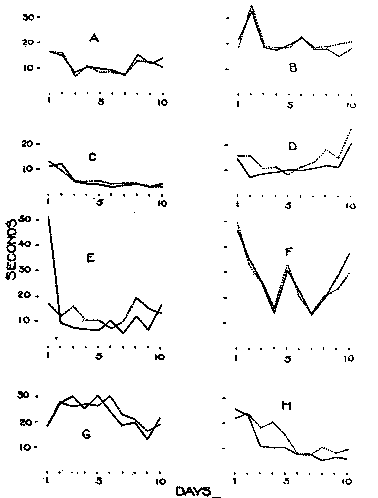
Figure 23. Experiment I, average time taken for settings each day, for
each absolute pitch reactor.
Solid = from below 440; dotted = from above 440.
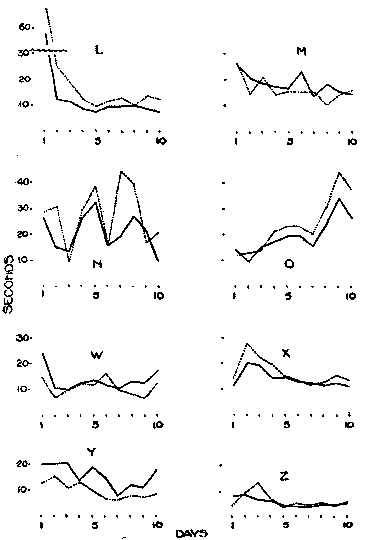
Figure 24. Experiment I, average time taken for settings each day, for
each relative pitch and control reactor.
Solid = from below 440; dotted = from above 440.
The average times for settings from above and below are shown graphically for each day for each reactor in Figures 23 and 24. The times show interesting differences between reactors, and fluctuations from day to day in the same reactor, and perhaps give an indication of the amount of caution present; but it is hard to see any widespread relation between accuracy and the quickness or slowness of tuning. Reactors C (good) and Z (indifferent) show the same type of curve—quick settings, constant from day to day. F and N showed the greatest fluctuation but there is nothing else about their reactions which they alone have in common. Perhaps it could be said that with the exception of a day or so each the most accurate reactors (such as B, C, D, and E) were quite uniform in their average times, but so are L, M, W, and X. In general the tuning from above seems to have taken longer than that from below, even though the pitch range covered was usually less. Perhaps this indicates that downward tuning was more unfamiliar and evoked more caution. Those quite familiar with the piano, A, B, C, F, and W, are most nearly equal in their average times, but H, organist, is not. Violinists D and O take less time tuning upward. E, F, and L have their maximum average times on the first day and this indicates a cautious Einfühlung; O and N have their peaks later, probably due to changes in attitude. But only in the cases of F and N is a relation observable between speed of tuning and accuracy. The former was much slower in making his settings on the last day and his graph shows considerable improvement in accuracy over immediately preceding days. The reverse is true for N. Her slow settings on day 5 are about her most inaccurate; her quick ones on day 6 are a great deal better.
The "outward manifestation" of a pitch recognition ability worthy to be called
absolute pitch is found to consist in the ability to locate closely and
consistently, day after day, a' or another goal tone on a tone variator when
starting from initial pitches scattered irregularly above and below the goal
tone. The fineness and steadiness of the localization of the goal tone may be
judged by the following criteria, listed in order of value:
1. High percentage of first settings a day lying within the range from g#' to a#', or within plus or minus half a tone of the goal tone.
2. Closeness to the goal tone and absence of wide variations up and down in a line drawn midway between series of successive settings from above and below the goal tone.
3. Absence of tendency to take the wrong direction in tuning.
The following traits may be considered corollaries to a performance judged good by the above criteria, but are not in themselves criteria:
1. A large number of correct acceptances of initial settings as a' (or other goal tone).
2. Tendency of settings from the same direction to stay in line, without wide fluctuations within one day or from day to day.
3. Lack of tendency to tune over the same extent of pitch every time a setting is made.
Six of the absolute pitch group showed the ability to locate a' in rather definite and narrow ranges. One reactor from the relative pitch group seemed to be in the stage of acquiring this ability. It is quite plausible that the primary basis of such fine and steadfast pitch localizations is a well established local sign criterion in the end organ, rather than the more vague and less stable criteria from various sorts of secondary associations.
The group tested is too small for further conclusions to be drawn. It is interesting to note, however, that the most proficient reactors were a violinist and a singer. Pianists, without practice on this test, seem to have a less narrowly localized conception of a'. No sex differences were discernible.
Since practically all of the experimental work which has set out to study absolute pitch in the past has made use of a long or short series of tones given at one time as test material, it seemed desirable to try to find out how much of the results of such studies can be accepted as really valid for absolute pitch. Experiment II was planned to get some indication of this. A series of notes was made up using the four central octaves of the piano (the great, small, once accented, and twice accented) . The notes from this range were arranged in a series so that any two successive notes were always more than an octave apart; the intervals being minor ninths, major ninths, augmented elevenths, minor fourteenths, and major fourteenths. These intervals were chosen for reasons advanced by Ortmann (73) , namely, that tones at these intervals from each other have less harmonic and melodic relationship to each other than do tones that are an octave and a third, fourth, fifth, or sixth apart. There were two exceptions to this at the very end: the interval between the forty-eighth and forty-ninth notes was a major third (there were five c's (C, c, c', c'', and c''') in the list and four of every other note and since the experimenter was unable to insert the extra c at any of the above intervals, he put it at the end) and between the forty-ninth and fiftieth (an extra added a') was a major sixth.
Sixteen reactors, all different from those in Experiment I, were used in this experiment. It would have been desirable, but was not feasible, to have the same group of reactors do both experiments. These sixteen reactors took the test material to their homes and there someone struck on the piano the notes from this list, one each morning before the reactor had heard any music or tones, and the reactor judged the pitch name of the tone. This. was recorded by the recorder on sheets prepared for this purpose. A keyboard chart comprising the four octaves and with a number from 1 to 50 written on each note beginning at the lower end' was included with the test material. Following is the series. of notes:
| 1. 34 a' | 18. 43 f#'' | 35. 44 g'' |
| 2. 16 d# | 19. 13 c | 36. 9 G# |
| 3 38 c#'' | 20. 27 d' | 37. 39 d'' |
| 4. 12 B | 21. 5 E | 38. 4 D# |
| 5. 42 f'' | 22. 47 a#'' | 39. 46 a'' |
| 6. 19 f# | 23. 24 b | 40. 21 g# |
| 7. 1 C | 24. 6 F | 41. 8 G |
| 8 35 a#' | 25. 20 g | 42. 26 c#' |
| 9. 17 e | 26. 7 F# | 43. 49 c''' |
| 10. 3 D | 27. 37 c'' | 44. 31 f#' |
| 11. 45 g#'' | 28. 23 a# | 45. 18 f |
| 12. 32 g' | 29. 41 e'' | 46. 36 b' |
| 13. 2 C# | 30. 15 d | 47. 11 A# |
| 14. 40 d#'' | 31. 33 g#' | 48. 29 e' |
| 15. 22 a | 32. 10 A | 49. 25 c' |
| 16. 48 b'' | 33. 28 d#' | 50. 34 a' |
| 17. 30 f' | 34. 14 c# |
The instruction sheets given the reactor and recorder follow:
To the Recorder:
The following notes of the piano are to be given to the reactor one each morning before he or she has heard any music. It is important that they be given in the order named. Have the reactor fairly close to the piano and facing away from it. Then say "Ready " and after a brief interval strike the note for the morning with moderate intensity and hold it for approximately one second. If you can time this by a watch so much the better. Have the reactor tell you what note he thinks it is and have him point it out on the chart, to make sure he has the right name and octave. Do not in any way suggest to him whether his judgment is right or wrong and do not allow him to hum or sing the note nor to try the piano immediately afterward to see how close his judgment was. Give a' (No. 34) the first morning, (16) the next and so on till all 50 notes have been given. Record for each reactor the date and number of the note judged. If the reactor judges the note to be above or below those on the chart, record the judgment in the following form: "octave below 8" or "two octaves above 47", etc. There is a separate record sheet for each reactor. If two or more reactors are judging the same note have them tell you their judgments secretly, so as not to influence each. other.
If several reactors are judging the same note every morning and one of them is absent for a morning or so, record "absent" on his sheet after the days concerned. When he returns have him judge the same notes as the others, and at the end of the whole series give him on successive mornings the notes missed in the order missed. Be sure to record the date with each judgment.
To the Reactor:
When the note is played to you judge the name of it as accurately as you can and show the recorder which note it is on the chart. Be sure to tell him both what letter name it has and in which octave it lies. Do not sing or hum the note to yourself before or after judging. Do not try to find out if you are right by questioning the recorder or looking for that particular note on the piano at any time afterward. Please do not discuss the matter with anyone else, and try not to think about it between times. Please avoid during the experimental period any practice specifically designed at locating tones at the piano or any musical instrument.
After each judgment write down your introspections as to your method of judging any special difficulties, etc., on your introspection sheet, and be sure to date each introspection. You need not do this every time if you feel that you have made the judgment in the same way as on previous occasions, but be sure to note down anything unusual in your way of judging or any change from previous methods.
If you are unable to complete the series I would be glad to have data on as much of it as you are able to cover.
If the note given is not on the chart, report it to the recorder as "two octaves below No. 3" or "one octave above No. 43".
When the series was completed the experimenter went to each reactor's home and on the same piano gave the reactor all fifty notes to judge separately in series. In this way a comparison between the two test methods was obtained.
This procedure lacks the rigor of laboratory conditions, but there is hardly any other way of getting the desired information from a considerable number of reactors.
Bi, Ca, Co, Da, Ko, Ma, Me, Mi, and Sm were students in the advanced department of the Peabody Conservatory; all were studying piano and in addition Ca was studying violin and Sm organ. DS and RS were formerly students at Peabody: DS being a soprano and RS a pianist. Fe was a teacher and AP and LP students in the music departments of Florida. State College for Women. Be and Li had formerly studied music but had not been actively engaged in music for some time. All the group were women excepting Fe, Ko, and Me. It will be noted from the tables that this group covers a wide range of pitch estimation ability, from poor to excellent, as was desired. Reactors with excellent absolute pitch obviously could do as well judging notes individually as they could judging notes in series; reactors with relative pitch alone obviously could not. At that, the intervals between successive notes were chosen purposely to make relative pitch judgments in the series test difficult and uncertain, and thus to cause all reactors in this " unselected " group to fall back on what absolute pitch ability they had, however slight. With the series test made as close an approximation to an absolute pitch test as was possible in a series and with the range of notes used, a comparison between the two test methods in themselves is made possible, and discrepancies in the results would point rather to differences inherent in the test methods than to differences in methods of judgment in individual reactors.
The results from this experiment are summarized in Tables 12 to 16. Table 12 gives for each reactor, each method: (1) the total number of notes judged, (2) the number of correct judgments, (3) the number of judgments correct within one semitone (i.e., including judgments of a half tone lower, of the tone itself, and of a half tone higher), (4) the number of overestimations, (5) the sum of the overestimations in terms of semitones, (6) the average of overestimations in terms of semitones, (7), (8), and (9) the number, sum, and average of underestimations in terms of semitones. In all the tables the letter I is used for the test with individual notes and the letter S for the test with notes in a series. It will be seen that neither method is uniformly the better in any one item of scoring. Since seven of the reactors did not complete all the fifty notes in the individual note test it was necessary to weight some of their scores on this test so that these reactors could be compared with the others. Thus Ca completed 38 notes of the individual test; her raw score for number of notes correct was 8; in order that she could be compared with the other reactors in this item her probable score for 50 notes was found by the proportion 38:50::8:x; x=11. This weighting amounts to the same thing as taking the average and multiplying by 50. It will be noticed that all such weighted scores are based on raw scores from 37 or more judgments except in the case of Ma, who completed 30 individual note judgments. No results are included from reactors who completed fewer than 30 notes.
The weighted scores for number of notes correct, number of notes correct within one semitone, and total errors are given in Table 13. While as a whole the reactors were more accurate with the individual notes, there is no great uniformity in their showings. If number of notes correct is chosen as a criterion, ten reactors out of sixteen (Be, Bi, Ca, Da, Ko, Ma, Mi, DS, RS, and Sm) were more accurate with the notes individually than with the series. If number of notes correct within one semitone is the criterion, twelve reactors out of sixteen (the ones above plus Me and LP) were more accurate with the individual notes. If totals of all errors is the criterion, just half (Ca, Co, Fe, Li, Mi, AP, RS, and Sm) of the reactors are more accurate; but this includes three of the best-- AP, Fe, and Sm.
TABLE 12.
Experiment II, correct and erroneous judgments, both test methods.
| Overestimations | Underestimations | ||||||||||
| Reactor | Test method | number of notes judged | number correct | number correct within one semitone | Number | Sum | Average | Number | Sum | Average | Total errors in semitones |
| Be | I | 50 | 3 | 18 | 33 | 165 | 5.0 | 14 | 19 | 1.4 | 184 |
| S | 50 | 1 | 8 | 41 | 259 | 6.4 | 8 | 21 | 2.6 | 280 | |
| Bi | I | 50 | 3 | 15 | 23 | 86 | 3.7 | 24 | 78 | 3.3 | 164 |
| S | 50 | 2 | 11 | 28 | 112 | 4.0 | 20 | 53 | 2.7 | 165 | |
| Ca | I | 38 | 8 | 16 | 17 | 64 | 3.8 | 13 | 47 | 3.6 | 111 |
| S | 50 | 10 | 18 | 25 | 110 | 4.4 | 15 | 35 | 2.3 | 145 | |
| Co | I | 50 | 10 | 16 | 25 | 126 | 5.0 | 15 | 78 | 5.2 | 204 |
| S | 50 | 15 | 18 | 15 | 69 | 4.6 | 20 | 112 | 5.6 | 181 | |
| Da | I | 49 | 23 | 28 | 11 | 35 | 3.2 | 15 | 53 | 3.5 | 88 |
| S | 50 | 13 | 21 | 17 | 43 | 2.5 | 20 | 85 | 4.3 | 128 | |
| Fe | I | 50 | 20 | 34 | 23 | 62 | 2.7 | 7 | 13 | 1.9 | 75 |
| S | 50 | 23 | 39 | 23 | 41 | 1.8 | 4 | 4 | 1.0 | 45 | |
| Ko | I | 40 | 7 | 17 | 10 | 39 | 3.9 | 23 | 127 | 5.5 | 166 |
| S | 50 | 4 | 5 | 23 | 123 | 5.3 | 23 | 104 | 4.5 | 227 | |
| Li | I | 50 | 2 | 8 | 23 | 91 | 4.0 | 25 | 104 | 4.2 | 195 |
| S | 50 | 6 | 19 | 14 | 34 | 2.4 | 30 | 127 | 4.2 | 161 | |
| Ma | I | 30 | 4 | 11 | 18 | 69 | 3.8 | 8 | 20 | 2.5 | 89 |
| S | 39 | 3 | 11 | 21 | 124 | 5.9 | 15 | 46 | 3.1 | 170 | |
| Me | I | 38 | 20 | 26 | 8 | 19 | 2.4 | 10 | 24 | 2.4 | 43 |
| S | 49 | 28 | 30 | 10 | 43 | 4.3 | 11 | 66 | 6.0 | 109 | |
| Mi | I | 37 | 7 | 12 | 18 | 64 | 3.6 | 12 | 82 | 6.8 | 146 |
| S | 50 | 5 | 13 | 18 | 65 | 3.6 | 27 | 92 | 3.4 | 157 | |
| AP | I | 50 | 37 | 48 | 5 | 27 | 5.4 | 8 | 8 | 1.0 | 35 |
| S | 50 | 39 | 50 | 5 | 5 | 1.0 | 6 | 6 | 1.0 | 11 | |
| LP | I | 50 | 15 | 26 | 22 | 68 | 3.1 | 13 | 24 | 1.8 | 92 |
| S | 50 | 16 | 22 | 21 | 190 | 9.0 | 13 | 116 | 8.9 | 306 | |
| DS | I | 50 | 10 | 18 | 25 | 109 | 4.4 | 15 | 39 | 2.6 | 148 |
| S | 50 | 6 | 12 | 31 | 195 | 6.4 | 13 | 45 | 3.5 | 240 | |
| RS | I | 49 | 11 | 20 | 18 | 78 | 4.3 | 20 | 64 | 3.2 | 142 |
| S | 50 | 8 | 19 | 27 | 97 | 3.6 | 15 | 31 | 2.1 | 128 | |
| Sm | I | 54 | 27 | 31 | 14 | 63 | 4.5 | 9 | 54 | 6.0 | 117 |
| S | 50 | 21 | 30 | 15 | 64 | 4.3 | 14 | 31 | 2.2 | 95 | |
| Total | I | 731 | 207 | 344 | 295 | 1166 | 3.9 | 229 | 834 | 3.6 | 2000 |
| S | 788 | 200 | 326 | 339 | 1574 | 4.6 | 249 | 974 | 3.9 | 2548 | |
TABLE 13.
Experiment II, weighted scores for number of notes correct, number correct
within one semitone, and total errors.
| Correct | Correct within one semitone | Total errors | ||||
| I | S | I | S | I | S | |
| Be | 3 | 1 | 18 | 8 | 184 | 280 |
| Bi | 3 | 2 | 15 | 11 | 164 | 165 |
| Ca | 11 | 10 | 21 | 18 | 148 | 145 |
| Co | 10 | 15 | 16 | 18 | 204 | 181 |
| Da | 23 | 13 | 29 | 21 | 90 | 128 |
| Fe | 20 | 23 | 34 | 39 | 75 | 45 |
| Ko | 9 | 4 | 21 | 5 | 208 | 227 |
| Li | 2 | 6 | 8 | 19 | 195 | 161 |
| Ma | 7 | 4 | 18 | 14 | 148 | 218 |
| Me | 27 | 29 | 35 | 31 | 57 | 111 |
| Mi | 9 | 5 | 16 | 13 | 195 | 157 |
| AP | 37 | 39 | 48 | 50 | 35 | 11 |
| LP | 15 | 16 | 26 | 22 | 92 | 306 |
| DS | 10 | 6 | 18 | 12 | 148 | 240 |
| RS | 11 | 8 | 20 | 19 | 145 | 128 |
| Sm | 27 | 21 | 31 | 30 | 117 | 95 |
A comparison between number and amount of overestimations and underestimations can also be made from Table 12. Seven of the reactors (Co, Da, Fe, Li, AP, RS, and Sm) made a greater average of overestimations on the individual notes and one, Mi, made the same as on the series. Seven (Bi, Ca, Fe, Ko, Mi, RS, and Sm) made a greater average of underestimations on the individual notes, and Li and AP made the same average on both. This indicates that there is no general tendency to either overestimate or underestimate with either method.
TABLE 14.
Experiment II, difference in judgment on same notes when given in series and
individually
| Notes judged higher in series test than in individual test | Notes judged lower in series test than in individual test | |||||||
| Reactor | Number of notes judged the same | Number | Sum in semitones | Number | Sum in semitones | Average difference in judgment in semitones | Percent judged differently | Total number of notes judged twice |
| Be | 8 | 28 | 155 | 14 | 64 | 4.4 | 84 | 50 |
| Bi | 6 | 26 | 141 | 18 | 90 | 4.6 | 88 | 50 |
| Ca | 7 | 17 | 78 | 14 | 46 | 3.3 | 82 | 38 |
| Co | 6 | 21 | 88 | 23 | 203 | 5.8 | 92 | 50 |
| Da | 12 | 21 | 62 | 16 | 85 | 3.0 | 75 | 49 |
| Fe | 12 | 17 | 40 | 21 | 52 | 1.8 | 76 | 50 |
| Ko | 1 | 27 | 167 | 12 | 64 | 5.8 | 97 | 40 |
| Li | 5 | 13 | 53 | 32 | 133 | 3.7 | 90 | 50 |
| Ma | 2 | 15 | 68 | 13 | 42 | 3.7 | 93 | 30 |
| Me | 17 | 12 | 45 | 9 | 35 | 2.1 | 55 | 38 |
| Mi | 2 | 16 | 97 | 19 | 92 | 5.1 | 95 | 37 |
| AP | 32 | 10 | 11 | 8 | 31 | 0.8 | 36 | 50 |
| LP | 9 | 23 | 181 | 18 | 151 | 6.6 | 82 | 50 |
| DS | 6 | 27 | 142 | 17 | 62 | 4.1 | 88 | 50 |
| RS | 2 | 30 | 123 | 17 | 74 | 4.0 | 96 | 49 |
| Sm | 17 | 17 | 96 | 16 | 72 | 3.4 | 66 | 50 |
If the average of the whole group is taken it will be seen that the group was more accurate with the individual notes than with the notes in a series. For the whole group the average of the overestimations is 3.9 semitones for the individual notes as against 4.6 semitones for the series; the average of the underestimations is 3.6 semitones for individual notes as against 3.9 for the series; and the average of all errors (including the correct notes as having zero error) is 2.7 semitones for the individual note test and 3.2 semitones for the series.
In Table 14 there has been worked out the differences in judgment on the same notes by the two tests. Thus for Be the judgment on a given note in the series test was at an average of 4.4 semitones from the judgment on the same note given individually. This average difference in judgment ranges from 0.8 to 6.6 semitones with a mean of 3.8 semitones, which seems very high. The per cents of notes judged differently by the two methods are also high, only two being below 75 per cent. To be conclusive an experiment of this sort would have to be done again with at least as many reactors and with both tests, individual and series, given at least twice and preferably four or five times and with at least fifty notes. Then it could be ascertained whether the amount of change of judgment would be larger between an individual note test and a series test than it would be between two series tests or two individual tests. But the average amount of change of judgment in this experiment is so large as to indicate the folly of calling a series test a test of absolute pitch.
Product moment correlations between the two test methods for three ways of scoring are given in Table 15. The first scoring method was to give a reactor as his score the number of notes correct, disregarding all errors. The second method was to give a score equal to the number of notes correct within one semitone, a criterion recommended by some writers but again neglecting the larger errors. The third method was to give as a score the total in semitones of the errors of a reactor. The third method is the most reliable and includes the other two, since it gives proper weight to the correct and nearly correct judgments. The first two are less representative because they can be unduly influenced by lucky judgments or judgments on some few familiar tones and would not indicate whether the reactor did fairly well or fell down badly on the others. The correlations by the first two scoring methods are very high and very reliable (.931 ±.023 and .856 ±.045) but cannot be said to represent the data adequately. The correlation between the test methods by the errors score (.558 ±.116) is more than four times its probable error but is low.* If there were excluded those few reactors with excellent absolute pitch who obviously could name notes about as well in a series as alone and the correlation confined to the remainder, whose absolute pitch ability is a more doubtful quantity, it would be lower yet. As it is, there is no way of telling how much absolute pitch any of the reactors in the literature, who were tested by a series of notes, actually had.
TABLE 15.
Experiment II, means, standard deviations, and correlation coefficients of
scores of all reactors on series and individual tests.
| Scoring method | Correct | Correct within one semitone | Total errors | |||
| I | S | I | S | I | S | |
| Mean | 14.0 | 12.6 | 23.75 | 20.6 | 137.8 | 162.4 |
| Standard deviation | 9.7 | 10.4 | 9.8 | 11.4 | 53.0 | 76.9 |
| Coefficient of correlation (r) | .931 | .856 | .558 | |||
| Probable error (P.E.r) | .023 | .045 | .116 | |||
It will be noticed that the means in Table 15 indicate that the general tendency is toward more correct judgments and fewer errors when individual notes are being judged. The coefficient of alienation for this correlation would be .83; hence, statistically speaking, predictions based on this r would be only about seventeen per cent better than guessing.
Table 16 gives the average amount of error for all the reactors on each stimulus note when given individually and in series, and the average difference in judgment between the tests' on the same note. The results from this tabulation are surprising. The order of notes from the most accurate to the least accurate is:
| Individual | a | f# | g# | g | f | c# | c | d# | e | b | d | a# |
| Series | d# | b | a | g# | g | f | a# | f# | e | d | c# | c |
TABLE 16.
Experiment II, average error and average change of judgment on each test note.
Note Average error Average change
I S
| Note | Average error | Average change | |
| I | S | ||
| C | 4.7 | 4.9 | 4.9 |
| C# | 3.1 | 5.8 | 3.7 |
| D | 5.0 | 4.1 | 4.4 |
| D# | 2.0 | 2.9 | 2.6 |
| E | 3.2 | 3.8 | 4.1 |
| F | 2.2 | 3.4 | 2.5 |
| F# | 2.8 | 4.9 | 5.6 |
| G | 2.9 | 2.8 | 3.9 |
| G# | 2.6 | 3.9 | 4.8 |
| A | 2.8 | 4.8 | 4.9 |
| A# | 3.3 | 3.1 | 3.6 |
| B | 4.8 | 3.0 | 4.8 |
| c | 3.5 | 5.4 | 5.9 |
| c# | 3.1 | 3.1 | 3.4 |
| d | 3.1 | 4.9 | 3.3 |
| d# | 4.4 | 3.6 | 3.6 |
| e | 2.7 | 5.1 | 5.2 |
| f | 2.8 | 2.8 | 3.5 |
| f# | 3.2 | 4.7 | 4.6 |
| g | 1.3 | 5.3 | 5.8 |
| a | 2.4 | 4.2 | 3.6 |
| a | 1.4 | 3.9 | 4.4 |
| a# | 3.9 | 4.0 | 6.6 |
| b | 3.1 | 2.9 | 3.7 |
| c' | 0.5 | 1.9 | 1.6 |
| c#' | 1.8 | 2.7 | 2.7 |
| d' | 2.3 | 2.0 | 3.7 |
| d#' | 3.2 | 3.1 | 4.2 |
| e' | 2.8 | 2.4 | 2.8 |
| f' | 3.8 | 2.5 | 4.8 |
| f#' | 1.6 | 1.6 | 2.4 |
| g' | 2.9 | 1.2 | 3.1 |
| g#' | 2.5 | 1.8 | 3.3 |
| a' | 1.4 | 0.9 | 1.4 |
| a#' | 5.8 | 2.6 | 6.9 |
| b' | 1.8 | 2.8 | 3.1 |
| c'' | 2.8 | 3.8 | 6.2 |
| c#'' | 2.8 | 4.3 | 5.7 |
| d'' | 2.1 | 3.9 | 3.7 |
| d#'' | 1.9 | 1.6 | 2.7 |
| e'' | 2.9 | 2.4 | 4.6 |
| f'' | 1.4 | 3.9 | 4.0 |
| f#'' | 1.8 | 1.8 | 1.8 |
| g'' | 2.9 | 3.1 | 4.4 |
| g#'' | 2.4 | 2.4 | 3.1 |
| a'' | 2.9 | 2.4 | 2.8 |
| a#'' | 1.7 | 3.1 | 3.8 |
| b'' | 2.2 | 3.2 | 2.9 |
| c''' | 2.5 | 2.6 | 3.5 |
These orders have little in common with those of other investigations and practically nothing in common with each other. (A rank gains
correlation gives —.02.) The black notes are not judged any less accurately than
the white, in contradiction to the generally accepted conclusion. The octave
order is equally surprising. In the individual note test the twice-accented
octave is judged the most accurately, then the once-accented, the small, and
great octaves in a quite regular descending order of accuracy. In the series the
once-accented octave is judged most accurately, in accordance with other
investigations, the next most accurate is the twice-accented, then the great,
and finally the small.
Table 16 also gives the average difference in judgment between the two tests on the same notes. The order of notes from the least amount of change to the greatest is:
d# a f# b f d c# e g c a# g#
The black notes occupy no definite position and two prominent notes of the scale, a and c, occupy the positions next to the two ends. There is least change in the once-accented octave, as would be expected, but it is strange that there should be less change in the great octave than in the small octave.
This experiment indicates that many of the conclusions concerning absolute pitch which have been found by previous investigators who used series of notes as test material are not validated by a test in which the stimulus tones are given the reactors one each morning before other tones or music are heard. There is a fairly large average difference between the judgments given by the two methods. There is a tendency towards greater accuracy with the individual notes, and when judging notes given in a series reactors seem to be more often confused by the series than helped. The findings of most previous investigators that the white keys are judged more accurately than black is not verified, nor is there found as regular a diminution of accuracy from the once-accented octave outwards as that found by Weinert and others. The correlation between the two test methods, using the most representative scoring, is +.558 t.116, indicating that in a very general sense those that do well on one test may be expected to do well on the other, but by no means indicating that the two test methods are equivalent.
There is nothing, however, in the results of this experiment that would indicate that a series method might not have usefulness in a scheme for acquiring absolute pitch ability. This experiment is concerned rather with the final testing of such ability.
The experimental part of this study indicates first of all that there is no gifted group of people who have a perfect absolute pitch, that is, who can tune a tone variator exactly and invariably to 440 from memory alone. However, some come rather close to such perfection, others are so far from it that their a"s have a distribution equivalent to what would be expected from chance settings of the variator, and those between these two groups range themselves in a fairly regular gradation from very poor to very good. Some reactors may be found who can identify piano notes fairly well but who cannot find a' on the variator as well as others who make no claims to absolute pitch. It is quite possible that those who fall down on the variator test but can identify heard notes of richer timbres have the letter name of a note associated with a more complex end-organ stimulation pattern or with more secondary criteria than do those who succeed on the variator test. This is very likely the case with the two violinists K and O, who could find a' more successfully on the sonometer than on the variator. The most expert reactors possess a highly specialized ability based upon stimulation patterns for each note in which theovertones and other secondary criteria have lost importance, leaving as the determining factor the pitch of the fundamental of the note. This dropping out of irrelevant factors is in accord with the usual course of the learning process. With even the most expert reactors a given note is not associated with one point in the pitch series and that point only, but rather with a small range.
Of the two major theories of hearing which allow for the possibility of local sign in the end organ, the extensity theory gives a somewhat more plausible explanation than the resonance theory for the characteristics of absolute pitch brought out in this research. On the resonance theory, a stimulation of a quite narrow range in the basilar membrane would be associated with a'; this range is always stimulated when a' is heard no matter what overtones or other tones may also be heard, and this range alone is stimulated when a pure tone of the pitch of a' is heard. Hence, rather fixed, definite associations of this range with the name a' would tend to be set up in those persons much conversant with music. On the extensity theory, when a' is heard the whole tectorial (or basilar) membrane from the vestibular end up to a certain point is stimulated; this point furnishes the local sign by which a' is distinguished from other pitches; it is never stimulated alone but always as a part of a larger extent,—as one point of a long series of points. Hence the a' point would be less focal on the extensity theory than on the resonance theory; fewer people would notice and individualize it, and it would naturally become less narrowly and definitely localized. The above is, of course, merely a weighing of probabilities.
B. Conclusions about tests for absolute pitch.
A test in which the reactor, after a half hour or more of hearing no tones, tries to find from memory alone a given note on the tone variator several times a day for several days is found to be a test in which the physical sources of error can be practically eliminated and of which the results are reliable and capable of differentiating reactors about as finely as anyone could desire. One setting a day does not give as complete a picture as do several, and any one day's work is in no way a reliable index of the performances of other days. Some reactors (as N and W) may do very well on the first day but be consistently poorer on other days. This fact casts doubt on a great many of the published researches on absolute pitch, which have tested reactors on only one day.
In the experiment in which the reactors were tested for absolute pitch with a
list of notes given the first time separately one each morning and the second
time all in one period in a series, the discrepancies between the results by the
two methods are such that no justification can be found for calling the second
method a
120 LAURENCE A. PETRAN
test of absolute pitch. Hence the results of all previous investigations using
that method have little value, since there is no way of knowing how much
absolute pitch the reactors had or used, and. in consequence no way of grading
those reactors in degree of absolute pitch ability nor any way of telling how
far the conclusions arrived at concern absolute pitch, relative pitch, or
anything else. The value of such investigations for present day research is in
their development of certain phases of testing technique, in the questions they
have raised, and in the suggestions which have come from them for further study.
In further work on absolute pitch projected by the author the following improvements in technique will be sought for: (1) better and more random initial settings, (2) more experimental periods (say 20) with more settings a day (say 15) for each reactor, (3) more even spacing of the experimental days, (4) a larger number of very expert reactors and also a group of very unmusical reactors, (5) new and more satisfactory statistical` measures free from distortion. A learning experiment is also planned.
The author wishes to express his gratitude to Professor Knight Dunlap for his guiding interest in and encouragement of this research; to Director Otto Ortmann of the Peabody Conservatory of Music for access to psychological test data on some of the reactors; to all those who served as reactors and especially to Miss Magda Skalet, Miss Roberta White, Miss Willie Mae Cook, and Mr. Dwight Miles for their cooperation as control reactors in Experiment I; to Mr. Joseph Morsh for assistance in calibrating the apparatus and for putting the experimenter through the test series of Experiment I; and to his sister for valuable assistance in preparing the graphs for publication.
BIBLIOGRAPHY
When a book or monograph is listed as a reference the page numbers are given of
only those sections which treat of matters specifically discussed in this
monograph.
1. ABRAHAM, O.: Das absolute Tonbewusstsein. Sainmelbande d. Internat..
Musikgesellsch., 1901, 3, 1-86.
2. ABRAHAM, O.: Das absolute Tonbewusstsein and die Musik. Sammelbdnde d.
Internat. Musikgesellsch., 1907, 8, 486-491.
3. ALTMANN, G.: Das absolute Gehor. Neue Musik-Zeitung, 1908, 29, . 493-494.
4. ANGELL, F., and HARWOOD, H.: Experiments on discrimination of clangs for
different intervals of time. Am. J. Psychol., 1899, 11, 67-79.
5. ANGELL, F.: Discrimination of clangs for different intervals of time. Am. J.
Psychol., 1900, 12, 58-79.
6. ANSCHUTZ, G.: Untersuchungen zur Analyse musikalischer Photismen.. Farbe-Ton
Forschungen, Leipzig, 1927, 1-65.
7. AUERBACH, F.: Das absolute Tonbewusstsein and die Musik. Sammelbande d.
Internat. Musikgesellsch., 1906, 8, 105-112.
8. AUERBACH, F.: Tonkunst and bildende Kunst. Jena, Fischer, 1924, 34-35.
9. BAiRn, J. W.: Memory for absolute pitch. Studies in psychology,. Titchener
commemorative volume, Worcester, Wilson, 1917, 43-78.
10. BARSS, W. R., and BASTILLE, J. E.: The effect of humidity on the velocity of
sound in air. J. of Math. and Phys., Mass. Inst. of Technol., 1923, 2, 210-215.
11. BARTHOLOMEW, W.: A study of absolute pitch ability. M. A. thesis,. George
Washington University, 1925, 1-23.
AN EXPERIMENTAL STUDY OF PITCH RECOGNITION 121
12. BENNEDIK, F.: Die psychologischen Grundlagen der musikalischen
Gehiirsbildung mit Beziehung auf die padagogische Bedeutung der Tonwortmethode
von Eitz. Langensalza, Beltz, 1914, 1-48.
13. BoGos, L. P.: Studies in absolute pitch. Am. Psychol., 1907, 18, 194-205.
14. BRAINE, R.: Correct pitch. Etude, 1928, 46, 550.
15. CAMERON, E. H.: Effects of practice in the discrimination and singing of
tones. Psycho!. Monog., 1917, 23, no. 100, 159-180.
16. CHILOFF, C. L.: Des elements de l'ouie absolue. Acta oto-laryngol., 1930,
14, 382-392.
17. COPP, E. F.: Musical ability. J. of Hered., 1916, 7, 297-305.
18. Cox, C.: Early mental traits of 300 geniuses. Genetic Studies of Genius,
Palo Alto, Stanford University Press, 1926. 2, 289.
19. DUNLAP, K.: The extensity theory of pitch. Psychol. Bull., 1909, 6, 58-59.
20. DUNLAP, K.: A system of psychology. New York, Scribners, 1912, 143-145, 215.
21. DUNLAP, K.: The elements of scientific psychology. St. Louis, Mosby, 1922,
92-93, 119, 151.
22. EsrEanuEs, J.: Psychologische Beobachtungen fiber die Anfangsstadien des
Melodienlesens. Mfinster, 1927, 9-11.
23. GERHARDT, M.: Beitrag zur Erforschung des absoluten GehOrs im
vorschulpflichtigen Kindesalter. Arch. f. d. ges. Psychol., 1929, 68, 273294.
24. GOUGH, E.: The effects of practice on judgments of absolute pitch. Arch. of
Psychol., 1922, 47, 1-93.
25. GUTTMANN, A.: Die Genauigkeit der Intonation beim Gesange. Ztsch. f.
Sinnesphysiol., 1927, 58, 209-246.
26. GUTTMANN, A.: Die Genauigkeit der Intonation beim Instrumentalspiel. Ztsch.
f. Sinnesphysiol., 1927, 58, 247-262.
27. HAECKER, V., und ZIEHEN, T.: tYber die Erblichkeit der musikalischen
Begabung. Ztsch. f. Psychol., 1922, 90, 237-247.
28. HANCOCK, C.: The effect of the intensity of sound upon the pitch of low
tones. Psychol. Monog., 1914, 16, no. 69, 161-165.
29. HARRIS, C. A.: Can I develop absolute pitch? Etude, 1926, 44, 721-722.
30. HEIN, H.: tYber die MOglichkeit eines allgemeinen latenten absoluten
Tonbewusstseins. Ztsch. f. Musikwissensch., 1929, 11, 414-419.
31. HENNEMAN, A.: How the busy teacher can develop his hearing. Etude, 1925, 43,
316.
32. HORNBOSTEL, E. v.: -Ober vergleichende akustische und musikpsychologische
Untersuchungen. Ztsch. f. angew. Psychol., 1910, 3, 465-487.
33. HORNBOSTEL, E. v.: Uber ein akustisches Kriterium ffir Kulturzusammenh~nge.
Ztsch. f. Ethnologie, 1911, 43, 601-615.
34. HUGHES, P.: Methods of testing relative pitch. Psychol. Rev., 1902, 9,
603-609.
35. JADASSOHN, S.: A practical course in ear training, translated by Campbell.
Leipzig, Breitkopf u. Hartel, 1899, 1-5.
36. JAQUES-DALCROZE, E.: Rhythm, music, and education, translated by Rubinstein.
New York, Putnam's, 1921, 47-49, 132.
37. jODL, F.: Lehrbuch der Psychologie. Stuttgart, Cotta, 3te Aufl., 1908, I,
376-377.
38. JOHNSON, H. M.: Audition and habit formation in the dog. Behay. Monog.,
1913, 2, no. 3, 4-13, 15-17, 19-46.
122 LAURENCE A. PETRAN
39. KAZz, D.: Ober einige Versuche im Anschluss an die Tonwortmethode von Karl
Eitz. Ber. ii. d. VI Kong. f. exper. Psychol., 1914, 86-87.
40. KERPPOLA, W., and WALE, D. F.: Vber die Genauigkeit eines nachgesungenen
Tones. Skand. Arch. f. Pliysiol., 1916, 33, 1-27.
41. KRAMER, A. W.: To teach absolute pitch by color sense; Musical America, Nov.
4, 1916, 25, 19.
42. KoBELT, J.: Das Dauergedachtnis fur absoluten Tonhohen. Arch. f.
Musikwissensch., 1920, 2, 144-174. Quoted by Weinert.
43. Kota, H., and MJ¢EN, F.: Die Erblichkeit der Musikalitat. Ztsch. f.
Psycho!., 1931, 121, 104-136.
44. Koar.ER, W.: Akustische Untersuchungen III. Ztsch. f. Psychol., 1915, 72,
159-177.
45. Koxic, A.: Die Entwicklung des musikalischen Sinnes bei Kindern. Die
Kinderfehler, Ztsch. f. Kinderforsch., 1903, 8, 49-61, 97-110.
46. K6NIG, H.: Zur experimentellen Untersuchung der Musikalitat. Wurzburg, 1925,
7-8.
47. KOVACS, S.: Untersuchungen uber das musikalische Gedachtnis. Ztsch. f. angew.
Psychol., 1916, 11, 113-135.
48. KRJEs, J. v.: tThber das absolute Gehor. Ztsch. f. Psychol., 1892, 3,.
257-279.
49. KRrEs, J. v.: Allgemeine Sinnesphysiologie. Leipzig, Vogel, 1923, 166, 267.
50. KRies, J. v.: Wer ist musikalisch? Berlin, Springer, 1926, 32-37.
51. KULPE, 0.: Outlines of psychology, translated by E. B. Titchener. London,
Sonnenschein, 1901, 104-105.
52. LARD, G., and WoonwoRTH, R. S.: Elements of physiological psychology. New
York, Scribners, 1911, 317-318.
53. LjERscEER, A.: Zur Diskussion caber das Thema "Absolutes Gehar ". Neue
Musik-Zeitung, 1908, 29, 494-495.
54. LorzE, H.: Medicinische Psychologie. Leipzig, Weidmann, 1852, 480481.
55. MALTZEw, C. v.: Das absolute Tonbewusstsein. Psychotechn. Ztsch.,. 1928, 3,
108-111.
56. MEUMANN, E.: Vorlesungen zur Einfnhrung in die experimentelle Padagogik and
ihre psychologischen Grundlagen. Leipzig, Engelmann, 1911, 2te Aufl., I,
248-249.
57. MEYER, M.: Die Tonpsychologie, ihre bisherige Entwicklung and ihre Bedeutung
fur die musikalische Padagogik. Ztsch. f. pad. Psycho!.,. 1899, 1, 180-189.
58. MEYER, M.: Is the memory of absolute pitch capable of development by
training? Psycho!. Rev., 1899, 6, 514-516.
59. MEYER, M.: On the attributes of the sensations. Psycho!. Rev., 1904, 11,
83-103.
60. MEYER, M.: Review of Revesz: Zur Grundlegung der Tonpsychologie. Psycho!.
Bull., 1914, il, 349-352.
61. MEYER, M.: The musician's arithmetic. Boston, Ditson, 1929, 124.
62. Mn.Es, W. R.: Accuracy of voice in simple pitch singing. Psycho!. Monog.,
1914, 16, no. 69, 13-66.
63. M7¢Ex, J.: Zur psychologischen Bestimmung der Musikalitat. Ztsch. f angew.
Psycho!., 1926, 27, 217-233.
64. Miiia.ER, F.: Das absolute Gehor. Neue Musik-Zeitung, 1908, 30, 57-58.
65. Muia,, H. K.: The acquisition of absolute pitch. Am. J. Psycho!., 1925, 36,
469-493.
AN EXPERIMENTAL STUDY OF PITCH RECOGNITION 123
66. MYERS, C. S.: The ethnological study of music. Anthropological essays
presented to Edward Burnett Tylor, Oxford, Clarendon Press, 1907, 235-253.
67. MYERS, C. S.: A textbook of experimental psychology. Cambridge, University
Press, 1911, I, 46-47.
68. MYERS, C. S.: The beginnings of music. Essays and studies presented to
William Ridgway, Cambridge, University Press, 1913, 560-582.
69. NAUBERT, A.: Das Tonbewusstsein, seine Entwicklung und seine Pflege. Der
Klavierlehrer, 1898, 21, 117-118, 129-131.
70. OGDEN, R. M.: Hearing. Psychol. Bull., 1918, 15, 76-85.
71. OGDEN, R. M.. Hearing. New York, Harcourt, Brace, 1924, 161-165.
72. ORTMANN, O.: The sensorial basis of music appreciation. J. Comp. Psychol.,
1922, 2, 227-256.
73. ORTMANN, O.: On the melodic relativity of tones. Psychol. Monog., 1926, 35,
no. 162, 1-47.
74. PERFIELD, E. E.: Absolute pitch. Musician, 1917, 22, 413.
75. PLANCK, M.: Die natfirliche Stimmung in der modernen Vokalmusik.
Vierteljahrsschrift f. Musikwissensch., 1893, 9, 418-440.
76. PREYER, W.: Farbenunterscheidung und Abstraktion in der ersten Kindheit.
Ztsch. f. Psychol., 1897, 14, 321-328.
77. REDFIELD, J.: Music, a science and an art. New York, Knopf, 1926, 209.
78. RtvEsz, G.: Zur Grundlegung der Tonpsychologie. Leipzig, Veit, 1913, 90-101.
79. RkvEsz, G.: -Ober die beiden Arten des absoluten GehOrs. Ztsch. d. Internat.
Musikgesellsch., 1913, 14, 130-137.
80. RAvEsz, G.: Priifung der Musikalitat. Ztsch. f. Psychol., 1920, 85, 163-209.
81. Rkvtsz, G.: The psychology of a musical prodigy. London, Kegan Paul, 1925,
8, 66-73. Published in German in 1916.
82. REvksz, G.: Review of C. Eitz, Das Tonwort. Ztsch. f. Psychol., 1929, 112,
235-236.
83. RICH, G. J.: On the variation with temperature of the pitch of whistles and
variators. Am. J. Psychol., 1915, 26, 411 149.
84. RIEMANN, H.: TonhOhenbewusstsein und Intervallurteil. Ztsch. d. internat.
Musikgesellsch., 1912, 13, 269-272.
85. RIEMANN, H.: Musiklexicon. Berlin, Hesse, 1929, llte Aufl., 1, 6.
86. RIEMANN, L.: Das absolute Geh8r. Neue Musik-Zeitung, 1908, 29,- 515-516.
87. RUPP, H.: Ober die Priifung musikalischer Fahigkeiten. Ztsch. f. angew.
Psychol., 1915, 9, 1-76.
88. SEASHORE, C. E.: The psychology of musical talent. New York, Silver Burdett,
1919, 248-251.
89. SCHAFER, K. L.: in Nagel: Handbuch der Physiologic des Menschen.
Braunschweig, Vieweg, 1904, III, 541-542.
90. SCHOEN, M.: The validity of tests of musical talent. J. Comp. Psychol.,
1923, 3, 101-121.
91. SLONIMSKY, N.: Absolute pitch. Am. Mercury, 1930, 21, 244-247.
92. SOKOLOWSKY, R.: 'Ober die Genauigkeit des Nachsingens von TOnen bei
Berufssfingern. Beit. z. Anat. d. Ohr., 1912, 5, 204-214.
93. STEwArr, R. M.: The effect of intensity and order on the apparent pitch of
tones in the middle range. Psychol. Monog., 1914, 16, no. 69, 157160.
94. arocKuAusEN, J.: Gesangsmethode. Leipzig, Peters, 1884, 1.
95. STUMPF, C.: Tonpsychologie. Leipzig, Hirzel. Vol. I, 1883. 25-26, 138-140,
157-160, 279, 286, 305-312. Vol. I1, 1890, 369-370, 408, 553556.
96. STUMPF, C.: Akustische Versuche mit Pepito Ariola. Ztsch. f. angew.
Psychol., 1909, 2, 1-11.
97. STUMPF, ,C.: Die Anfange der Musik. Leipzig, Barth, 1911, 10-13.
98. SYLVESTER, R. H.: Some standardizing tests on Stern's tone variator.
Psychol. Monog., 1914, 16, no. 69, 173-177.
99. TRIEPEL, H.: Falsche Beurteilung gehorter Tone. Arch. f. d. ges. Psychol.,
1928, 66, 497-500.
100. TRUMAN, S. R., and WEVER, E. G.: The judgment of pitch as a function
of the series. Univ. Calif. Publ. Psychol., 1928, 3, 215-223.
101. URBACH, 0.: Das absolute Gehor. Neue Musik-Zeitung, 1908, 29,
425-428.
102. URBACH, 0.: Schlusswort zum "Absoluten Gehor ". Neue MusikZeitung, 1908,
30, 58-59.
103. WALLACE. W.: The musical faculty. London, Macmillan, 1914, 104-108.
104. WALLASCHEK, R.: Das musikalische Ged.achtnis and seine Leistungen bei
Katalepsie, im Traum, and in der Hypnose. Vierteljahrsschrift f. Musikwissensch.,
1892, 8, 204-251.
105. WARREN, H.: Human psychology. Boston, Houghton Mifflin, 1919, 191-192.
106. WATT, H. J.: The psychology of sound. Cambridge, University Press, 1917,
84-85, 92, 236-237.
107. WEINERT, L.: Untersuchungen fiber das absolute Gehor. Arch. f. d. ges.
Psychol., 1929, 73, 1-128.
108. WELLEK, A.: Das absolute Gehor and der Charakter der Tone and Tonarten.
Ztsch. f. Musik., 1927, 94, 267-270.
109. WELLEK, A.: Das Farbenhoren im Lichte der vergleichenden Musikwissenschaft.
Ztsch. f. Musikwissensch., 1929, 11, 470-497.
109a. WELLEK, A.: Zur Typologie des Gehors and des Musikerlebens iuberhaupt;
neuestes uber das absolute Gehor. Ztsch. f. Musikwissensch., 1930, 13, 21-28.
110. WHIPPLE, G. M.: An analytical study of the memory image and the process of
judgment in the discrimination of clangs and tones. Am. J. Psychol.. I and II,
1901, 12, 409-457; III and IV, 1902. 13, 219-26&
111. WHIPPLE, G. M.: Studies in pitch discrimination. Am. I. Psychol., 1903, 14,
289-309.
112. WILKINSON, G., and GRAY, A. A.: The mechanism of the cochlea. London,
Macmillan. 1924, 195.
113. WlLUoosF-, F. L..: Absolute pitch and its attainment. Etude, 1929, 47, 144.
:114. WILSON, C. W.: The gift of absolute pitch. Musical Opinion and Music Trade
Review, 1911, 34, 753-754.
115. WISSLER, C.: The correlation of mental and physical tests. Psychol. Monog.,
1901, 3, no. 6, 5, 33-34.
116. WOLFE, H. K.: Untersuchungen fiber das Tongedachtnis. Phil. Stud., 1886, 3,
534-571.
117. WuNDT, W.: Grundzuge der physiologischen Psychologie. Leipzig, Engelmann,
6te Aufl., 1911, 2, 79-80.
118. ZWAARDEMAKER, H.: Sur la sensibilite de l'oreille aux differentes hauteurs
des sons. L'annee psychologique, 1903, 10, 161-178.
