Originally published in The American Journal of Psychology, 30(2), 121-64, 1919
Gilbert J. Rich, Psychological Laboratory of Cornell University
Introduction
I. Historical Review
II. Observers, Apparatus and Procedure
III. VocalityPreliminary Training
Method of Paired Comparisons
Vocal Limens
DiscussionIV. Pitch
V. Volume
VI. Brightness
VII. Tonality
VIII. Criticism of Previous Experimental Work
Conclusions
The pendular vibrations which form the simplest sound-waves of physics, and which are correlated with the tonal sensations of psychology, have the characteristics of amplitude and frequency. We were formerly taught that the amplitude of the wave corresponds, on the side of sensation, to the single attribute of intensity, and the frequency of the wave to the single attribute of pitch. But if we examine tonal sensations closely, we find a number of psychological characteristics. One may say, for example, that a given tone is high or low, large or small, bright or dull; that it is the musical note c or d, or that it resembles the vowel O or the vowel U. Is every one of these judgments based on a separate attribute of the tonal sensation? Do some among them represent different attitudes taken up toward the same attribute? Or are certain of them made upon an integrative or associative rather than upon an attributive basis? These questions constitute the problem of the present study.
The problem, as such, is of recent date. The observations that give rise to it are, to be sure, much older. Stumpf[1] shows that the similarity of tones standing an octave apart is recognized both in music and in the earlier psychologies. The similarity of certain tones to vowels also receives early recognition. Willis[2], in 1828, says that "vowels are a different affection of sound from both pitch and quality, and must be carefully distinguished from them." Hensen[3], in 1891, is another observer who notices the specific vowel-qualities of certain tones. It is a common observation that low tones are large and massive as compared with higher tones. Mach[4] holds that all tones are composed of varying proportions of two elements, the one bright and the other dull.
The systematic treatment of these characteristics in relation to attributes starts with Stumpf. In the first volume of his Tonpsychologie, he discusses the characteristics of volume[5] and brightness (Ibid., 221), denying that either is an attribute, and holding that both are matters of association only. But in the second volume of the same work (Ibid, 2, 1890, 56; 336; 535; 539), some seven years later, he takes the position that tones possess an attribute of extension or volume, parallel to pitch. Volume, pitch, and intrinsic intensity (with which we are not here concerned) form together his Tonfarbe. Brightness, however, he does not consider a separate attribute. Nor does he admit any attributive basis for the similarity of the octave, which is for him based on degree of fusion[6].
McDougall[7] separates pitch into two attributes. The one of these, quality, is common to the given tone and to all its upper and lower octaves; so that all the qualities of tonal sensation are contained within a single octave. The other attribute, which distinguishes the same tone in different octaves, is "of the same order as differences of extensity in the case of visual, tactual, or temperature sensations."
M. Meyer[8], in 1903, postulates two attributes of tones, that change with the physical frequency. These he calls Tonhöhe and Tonfarbe (pitch and quality, in English). Tonhöhe is lacking in noises. In the following year, he enlarges upon the difference between the two attributes.[9] The difference between tones and noises, he holds, can be understood only if we assume that one attribute, namely pitch, is lacking in noises; for if we can say that one noise is higher than another, we cannot name the interval between them. Similarly, very high and very low tones, which are often called noises, can be judged only in terms of quality. Music, then, depends upon pitch, to which unmusical persons are deaf. The similarity of the octave, Meyer further says, can be explained by the assumption of two attributes of tone; but the details of such an explanation are not worked out. Later, after Révész and Köhler have published their work, Meyer[10] insists that his pitch and quality are identical with Révész' Qualität and Höhe respectively, and his quality with Köhler's Vokälitat.
Dunlap[11] (1905, amplified 1912) calls attention to the common observation that low tones are large or voluminous. "Differences in pitch," he says, "are directly comparable to differences in planar linear extent." He therefore designates pitch as the extensive attribute of tone, excluding any attributive multiplicity.
Brentano[12] (1907) posits two tonal attributes. The one, Qualität, recurs at every octave; the other, Höhe, is composed of bright and dull factors, which unite in continuously varying degrees to form every tone in the scale.
In 1908, Titchener[13] distinguishes two Qualitätive attributes of tones, pitch and volume. Tones vary in volume, the low tones being large and massive, the high tones shrill, thin, and sharp. This difference is not spatial. Volume is not an intensive attribute, but a Qualitätive attribute, moving between the extremes of mild and shrill. Volume and pitch, moreover, are independently variable, in the sense that at the two ends of the scale volume changes more quickly than pitch, while over the middle region it changes more slowly.
The next contribution to the problem is that of Köhler (1909, 1910, and 1913), who deals with vocality. We are not ourselves concerned with the vowel-theories with which he principally deals. In his first paper[14], Köhler records the observation that the tones of certain tuning-forks sound like the different vowels. His second paper[15] reports a continuation of experimental work along the line thus suggested. In the preliminary experiments the observers are required to report what vowels the tones of various tuning-forks resemble. They find that some resemble the pure vowels U, O, A, E, and I, while others stand between two of these vowels. This similarity appears to be something given directly in the tones and not due to association; but the introspective data are scanty. In the main experiment, the observers make similar reports of the vocality of 30 forks presented 15 times in haphazard order. The reports show, on the average, a regular progression of the vowel qualities up the scale in the order U, O, A, E, I, though sometimes an Ä is found between A and E. Tones lying between two of the pure vowels are like both of the adjacent vowels. On the basis of these results, Köhler postulates a Qualitätive attribute of tones, alongside of pitch, which he calls Qualität, Vokalqualität, and later Vokalität (vocality). He next attempts to find the turning points (die ausgezeichneten Punkte) of the phenomenological system of vocalities. Working with pure tones, he starts with a "mixed" vowel and changes the frequency of vibration until the observer reports a pure vowel, continuing until a trace of the vowel next beyond is heard; a number of series is taken in both directions. The whole set of turning points from the semi-vowel M, which Köhler finds below U, to I are in almost exact octave relations. In a third paper[16], Köhler considers the vocality of very high tones. At succeeding octaves above I he hears S, F, and Ch, and insists that these sounds are tones, not merely noises. (It would seem that Köhler means by "tone" any sensation aroused by a regular periodic sound wave, and not a particular form of experience.)
Révész, in 1912 and 1913[17], observes that there are two ways of taking the tones which stand an octave apart. If we take them in the one way, they are the most dissimilar tones within the octave; if we take them in the other way, they are the most similar. This latter similarity he calls "octave-similarity." He therefore presents to his observers series of pure tones, asking them which are the most similar, and finds that the octaves are so judged. Treating these phenomenological observations on the systematic side, Révész posits two attributes of tonal sensation. That which recurs at every octave he calls Qualität (quality) ; that which is different in different octaves he terms Höhe (pitch). He then proceeds to show that these two attributes are independently variable. In the first place, two tones can be judged as different when their physical frequencies differ so slightly that the direction of the difference cannot be stated, Since such a judgment is a judgment of quality but not of pitch, the differential limen is lower for quality than for pitch. Secondly, the same quality occurs with different pitches in the case of two tones standing an octave apart. Thirdly, Révész has discovered a pathological subject for whom quality is displaced in the one ear for a certain range of the scale, without any corresponding displacement of pitch. Fourthly, tones near the upper and lower limits of hearing, as well as the sensations of melody-deaf persons, lack quality though they possess pitch; for it can be said that one such tone is higher than another, but not that it is the octave of the other. Révész accepts Köhler's attribute of vocality, but does not identify it either with his pitch or with his quality.
Stumpf reviews the work of Révész and Köhler before the Sixth Congress for Experimental Psychology.[18] He accepts Révész' distinction of quality and pitch as attributes of tone, and specifically identifies the impressions of pitch and brightness. But he criticizes a number of the proofs brought forward by Révész in the attempt to show independent variability. The conclusions drawn from the pathological case, as well as the statement that the differential limen is lower for quality than for pitch, go further than the facts justify. Other interpretations are possible; for an observer should be able to tell the direction of a quality-difference as well as the direction of a pitch-difference. Stumpf tries some of the experiments of Köhler for himself, and fails to find a regularity of judgment. Some of the observers cannot distinguish any pure vowels in tones, while others can hear only U and I. As all of Köhler's pure vowels come at the note c, Stumpf thinks it possible that Köhler's observers came to call the quality c a pure vowel, a turning point in the tonal system. The different vowels, then, are simply the same quality with different pitches or brightnesses; O is a bright U, and so on. Thus Stumpf declines to admit vocality to his list of attributes, of which he now has three: namely, Qualität, Helligkeit (brightness), and volume.
Watt[19] (1914) is unwilling to accept Köhler's work on the vowel-qualities, which he considers as apart from the tonal series. He does, however, accept Révész' distinction of two attributes, which he calls pitch and volume. His pitch is equivalent to the Qualität of Révész; his volume is an attribute which changes continuously over the scale, and which he identifies with the Hdhe of Révész. He supports it by citing the usual phenomenological observations of the voluminous character of the tonal series. In his last paper[20] (1915), Köhler takes up the problem of the tonal attributes as such, and starts with a series of definitions. Tonhöhe (which we shall translate as "musical pitch") is that attribute by which tones are named and intervals judged. "Brightness" is used for auditory phenomena which give the impression of brightness; a further characterization is not possible. "Vocality" is used as in his earlier works. Brightness and vocality taken together are designated as Tonkörper (tone-body). Volume and intensity also belong to the tone-body, but are irrelevant to the discussion. Köhler now cites instances to show that musical pitch and tone-body are independent. In the upper range of the musical scale judgments of interval are displaced, while the turning-points of the vocality-series are not. In the pathological subject on whom Révész experiments, the octave-relation of the pure vowels is normal within the affected region, so that only musical pitch (and not tone-body) is displaced. Moreover, very high tones, very low tones, and the tonal sensations of unmusical subjects lack musical pitch, while tone-body is present.
Köhler's main experiment (1910) on vocality is repeated by Modell and Rich[21], with the variation that a serial instead of a haphazard order is used for presentation of the stimuli. The results are similar to those of Köhler, save that the exact octave-relation between the pure vowels is not found. Weiss[22] reports similar experiments with variable results. He attempts to identify vocality with Titchener's attribute of volume.
In 1916, Rich[23] publishes a study of the attribute of volume. His method of attack is a determination of the differential limen for volume-judgments at six points on the tonal scale. The results show that judgments of volume can be made with ease and readiness, and that they appear to be made upon an attributive basis. The limen for volume is everywhere higher than the pitch-limen; moreover, it tends to follow Weber's Law. Volume, therefore, satisfies the two criteria of inseparability and independent variability. The results, however, are obtained with tones from variators, and require verification with pure tones.
Watt, in 1917[24], attempts to build up tonal psychology on a new basis. He rejects vocality, as lying outside the tonal series, and octave-quality as being unnecessary for purposes of explanation. He accordingly postulates but two attributes that vary with the physical frequency, pitch and volume. Neither of these is a Qualitätive attribute; for all sounds have one and the same "quality." Watt conceives of pitch as an ordinal attribute, an attribute of position, and of volume as an extensive attribute. Every phenomenological tone (except the very highest) is the sum of a large number of orders. The tonality of these orders constitutes the volume of the tone, while the predominant order gives the tone its characteristic pitch. The volume of any tone includes the volumes of all tones above it, for the volumes are planar and have, longitudinally, a common starting-point at the order of the highest audible tone. In support of his admission of volume as an attribute, Watt quotes the common observation that low tones are large and high tones sharp and thin; notes that the discrimination of pitch is finer than that of volume in the middle of the scale and coarser at the extremes; cites the implication of an extensive attribute inherent in his concept of pitch as order; and states the need of such an attribute for the explanation of fusion. Watt further holds that the judgment of intervals is based on the ratio of the volumes of the two tones. In particular, a given tone has twice the volume of its octave, so that as we go up the scale by octaves the volumes of the tone do not decrease by equal amounts, but are approximately halved. (The idea that the volume of a tone decreases by halves as the tone becomes an octave higher implies, mathematically, that volume cannot follow Weber's Law: a direct contradiction of the results obtained by Rich. It is worth noting that the whole of Watt's treatment of the attributes is in the interest of their explanatory value for fusion, not in the interest of tonal analysis.)
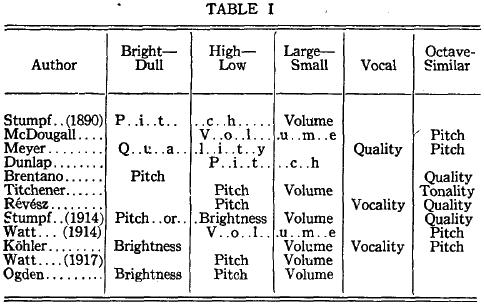
Table I shows how the attributes postulated by the various writers fit together, those attributes which are similarly defined being listed in the same column. In the first column are to be found the attributes resulting from the judgments "brighter" and "duller," or identified with such judgments. The second column contains the attributes described by the terms "higher" and "lower." The attributes listed in the third column are typified by the judgments "larger" and "smaller." In Column 4 are attributes characterized by the similarity of their tones to some vowel or vowels, as well as proposed attributes later identified by their author with this characterization. Finally, in the last column is the attribute which has been defined only as being constant for a given note in different octaves. In recent works in English this characteristic has been called tonality.[25]
Nine observers took part in our experiment: Dr. R. M. Ogden (O), professor of education; Dr. H. P. Weld (W), assistant professor of psychology; Dr. K. M. Dallenbach (Da), instructor in psychology; Mr. F. L. Dimmick (Di), assistant in psychology; Miss J. M. Gleason (G), Miss C. L. Friedline (F), Mr. P. T. Young (Y), and Mr. C. M. Clark (C), graduate students in psychology; and Mr. E. de Laski (L), an undergraduate "majoring' in psychology. Of these observers, O, W, and Da were highly trained in psychological observation; Di, G and Y were relatively well trained; while the remaining three, F, C, and L had had comparatively little training. O, W, Y and C were markedly musical; the others, except F, were sufficiently musical to play some instrument or to sing. F turned out to be a typically "unmusical" or "pitch-deaf" subject. This fact was not discovered for some time. Special work was then undertaken, but unfortunately could not be completed. The results obtained with F in the regular series are, of course, valueless: most of the differences employed were considerably below her limen for any form of tonal discrimination. L was peculiar in that he seldom gave judgments of equality, even when the stimuli were objectively equal. The results obtained from him are valueless for our purposes, since they do not fit the phi-gamma hypothesis; they were therefore discarded. All the observers knew the general nature of the problem and were acquainted with earlier theories on the subject. Not all were utilized in every set of determinations; considerations of time frequently prevented.
As sources of tone we had three Stern variators: No. 2, 150-300 vs; No. 4, 300-600 vs; and No. 7, 650-1200 vs. The bottles were blown from a compressed-air system kept at a pressure of 14.6 mm. of mercury. This pressure was too great for use at the mouths of the bottles, and was reduced by a system of valves and pinch-cocks. The actual pressure at the mouths differed from time to time, as it was found necessary to reset the mouths and the pressures (accompanied by a retuning) to meet the needs of different parts of the experiment. The variators were tuned, by comparison with standard Koenig forks, for a temperature of 25° C. The maximal deviation of the experimental room from this temperature was only 5°, giving a maximal temperature-error of 1%. The average error was, of course, much smaller.
To obtain pure tones a set of 24 interference-tubes was employed. Krueger[26] has shown that maximal interference is obtained when the interference-tubes are so placed along the conducting tube that they stand at the nodes of the tone to be eliminated, an integral number of half wave-lengths apart. Most interference-tubes are built to satisfy this requirement only for one region of pitch and its octaves. We desired, however, a more generally serviceable piece of apparatus, that could be adapted for any pitch by adjustment of the distance between the interference-tubes. Accordingly, every interference-tube was mounted separately on a short section of conducting tube (10.1 cm.). Any length of pipe could then be laid between two of these units. The junctions between the sections of the conducting tube were formed by hardwood blocks, bored exactly to accommodate the pipe. The blocks ran upon a hardwood track, and could thus be set readily in the required positions. The conducting tubes and interference-tubes were of brass, of the same diameter, 19 mm. The interference-tubes were fitted with pistons, the maximal length obtainable being 55 cm. (The apparatus was made to Dr. Titchener's specifications by the C. H. Stoelting Co., of Chicago.)
In setting up this apparatus, we tried at first to use only two rooms, but found it impossible to do so because the brass piping tended either to absorb or to give out sound-waves. When the interference-tubes were placed in the same room with the variator, they absorbed sound-waves from the air of the room; so that a tone eliminated by the earlier tubes might be picked up and transmitted by those further along. On the other hand, when the tubes were placed in a separate room from the sources of sound they gave off sound-waves to the air of this room; so that it was impossible to keep the observers and the tubes in the same room.
Three rooms were therefore used in the experiment. The variators were placed in the first room, before the open end of the tube, over which was fitted a paper funnel, 17 cm. in diameter and 21 cm. long The sounding variator was about 2 m. from the wall through which the tube passed, and about 1.5 m. from the nearest side-wall. On both the side-wall and the wall behind the variator curtains were hung to minimize reflection. The conducting tube ran from this room through a stone wall approximately 55 cm. thick to the middle room, which contained the interference-tubes. The track mentioned above was placed on long tables, and the interference-tubes were set in blocks running along the track. Beyond the interference-tubes the conducting tube passed through a double plaster wall to the room in which the observers sat, and ended flush with the further surface of this wall. Since it was desirable to work with several observers at the same time, three booths were built in the observers' room. The observers sat facing the wall through which the pipe came. A three-way distributor, set in a rubber stopper, was placed in the end of a conducting tube, and the sound was led to the observers by rubber tubing, which terminated in pairs of ear-tubes of the type furnished with the dictaphone. The "ready" and "now" signals were given by a muffled bell, fastened to one of the booths, which was readily heard by the observers when the ear-tubes were in position.
All the stimuli of the experiment were drawn from three regions whose limiting tones were octaves of one another. If, now, the interference-tubes were so placed along the conducting tubes as to lie an integral number of half wave-lengths apart for the overtones of the lowest region we were using, then they must also be at the same time an integral number of half wave-lengths apart for the overtones of octaves of our lowest fundamentals. It was, therefore, not necessary to change the distances between the interference-tubes during the course of the experiment. The first interference-tube was 244.5 cm. from the end of the conducting tube next the variators (these measurements are from center to center of the interference-tubes). The first twelve interference-tubes, set alternately to cut out the second and fourth partials, were 16.2 cm. apart. They were followed by six tubes, 21.7 cm. apart, set for the third partial. The remaining six tubes, set for the fifth partial, were 21.6 cm. apart. From the last interference-tube, the pipe ran 242.2 cm. to the rubber stopper in which was set the three-way distributor.
TABLE II.
Lengths of interference-tubes in cm.
| Tube number | Set for partial | 235-295 vs. | 470-590 vs. | 940-1180 vs. |
| 1 | 2 | 14.3 | 7.1 | 3.1 |
| 2 | 4 | 7.1 | 3.1 | 1.4 |
| 3 | 2 | 15.0 | 7.4 | 3.35 |
| 4 | 4 | 7.4 | 3.35 | 1.5 |
| 5 | 2 | 15.8 | 7.7 | 3.6 |
| 6 | 4 | 7.7 | 3.6 | 1.6 |
| 7 | 2 | 16.5 | 8.0 | 3.8 |
| 8 | 4 | 8.0 | 3.8 | 1.7 |
| 9 | 2 | 17.3 | 8.3 | 4.05 |
| 10 | 4 | 8.3 | 4.05 | 1.8 |
| 11 | 2 | 18.1 | 8.6 | 4.3 |
| 12 | 4 | 8.6 | 4.3 | 1.9 |
| 13 | 3 | 9.2 | 4.5 | 2.05 |
| 14 | 3 | 9.7 | 4.75 | 2.2 |
| 15 | 3 | 10.2 | 5.0 | 2.35 |
| 16 | 3 | 10.7 | 5.25 | 2.5 |
| 17 | 3 | 11.2 | 5.5 | 2.65 |
| 18 | 3 | 11.7 | 5.75 | 2.8 |
| 19 | 5 | 5.5 | 2.4 | .95 |
| 20 | 5 | 5.75 | 2.6 | 1.05 |
| 21 | 5 | 6.0 | 2.75 | 1.15 |
| 22 | 5 | 6.25 | 2.9 | 1.3 |
| 23 | 5 | 6.5 | 3.1 | 1.4 |
| 24 | 5 | 6.75 | 3.3 | 1.5 |
We took advantage of the finding of Köhler[27] that it is possible to set a series of interference-tubes in such Wise as to secure pure tones over a considerable range. To accomplish this result, six interference-tubes designed to absorb the same partial were set at slightly different lengths. Our tubes were set to give pure tones throughout the three ranges: 235 to 295 vs., 470 to 590 vs., and 940 to 1,180 vs. The various lengths of the interference-tubes are shown in Table II. (The zero-point for these measurements is the point at which the flat piston-head of the interference-tube is flush with an element of the inner surface of the conducting tube.) The method of their determination can best be shown by an example, e.g., the second partial of tones in a range 235 to 295 vs. The second partial ot 235 vs. is 470 vs. A tone of this frequency was sounded, and one of the interference-tubes was shifted in and out until the point of maximal absorption was found. A number of trials was made, and the results were averaged. The same procedure was followed with a tone of 590 vs., the second partial of 295 vs. The two lengths thus found were 18.1 and 14.3 cm. The distance between them was then divided into five approximately equal parts (equal to the nearest integer). The four values thus obtained, together with the two extreme values experimentally determined, constituted the lengths at which the six interference-tubes for this partial were set. A similar procedure was followed for the fundamental in the other two regions, and for the third, fourth and fifth partials. All the sixth partials were also eliminated, since their frequencies were odd multiples of the frequencies of the second partials.
Some difficulty was found in keeping constant, throughout any one of these ranges, the intensity of the tone heard by the observers. There are two principal causes of variation. In the first place, the intensity of the tone produced by the variator may not remain constant. We were able to eliminate this source of error, over the relatively small ranges used, by careful adjustment of the air-pressure and the position of the mouth-pieces of the bottles. A second possible cause of differences in intensity lies in the existence of reflected waves, either in the apparatus-room or in the conducting tube, which would intensify certain frequencies and weaken others. Standing waves in the same room with the apparatus were eliminated by curtains hung on the walls of the room, and by the placing of the variators as far from the surrounding walls as conditions would permit. Reflection inside the tube was not stopped; but the conducting tube was made of such a length that reflection did not affect intensity within our range of frequencies. This length (between the last interference-tube and the rubber stopper) was determined empirically.
The sounding of the stimuli was automatic. The supply of air to the variators was controlled by a pinch-cock operated by a solenoid; it was thus possible to regulate electrically the turning on and off of the air. This was done by a rotating commutator, which also made connections for the "ready" signals, single strokes of a muffled bell. The commutator made three revolutions in a minute. The "ready" and "now" signals were separated by 5.2 sec. The first tone came 1 sec. after the "now" signal, and lasted 2.4 sec. After a pause of 2.0 sec., the second tone followed, also with a duration of 2.4 sec. (These times are not exact. They are the times during which the electric current operating the solenoid was flowing. There was undoubtedly some lag in the starting of the variators after the opening of the pinch-cock.) The complete cycle occupied 9 sec., and the observer was allowed ix sec. to record his judgment before the signal for the next pair of stimuli.
The observers all gave written reports. Every observer was furnished with a board-clip containing a mimeographed sheet with space for 90 reports, and blank paper for introspective records. He was also furnished with typewritten instructions.
Our general procedure was a differentiation of the attributes on the basis of their difference-limens. The plan was to put the observer under instructions to judge now one, now another, of the characteristics postulated as attributes, and to determine in every case the least noticeable difference. We hoped by this method to discover, first, whether the various characteristics of pure tones could be admitted to the attributive classification on the basis of independent variability, and secondly, whether the judgments of these characteristics were made upon an attributive or an associative foundation.
The method of constant stimulus differences was used to determine the limen. The instructions, and the pitches employed as stimuli, will be stated under the various attributes. Five comparison stimuli were used in every case, objective equality and two steps above and below. Fifty series (in addition to the preliminary series) were taken for every determination, except with the observers Da and W, who completed thirty-three series only. The stimulus-pairs were given half in each time-order, and the results for the two time-orders were computed together. The order of the stimuli, as well as of the time-orders, was determined by chance; but the same order was followed for all determinations. The limens were computed from the crude data by the phi-gamma hypothesis, Urban's tables being used and the computations checked. Six values were found for every determination, three for the upper limen and three for the lower limen. These were the limen proper (L), the measure of ptecision (h), and the value c h X L, This latter value, since it is independent of the units employed, forms a measure of relative precision, comparable to the "coefficient of variability" of statistical work. L and h are, of course, in terms of vibrations. In addition, the mean difference-limen (half the "interval of uncertainty") was computed for every determination, as average of the upper and lower limens (L) ; as well as the relative difference-limen, which was obtained by dividing the mean difference-limen by the standard stimulus.
Preliminary Training. Most of our observers had never made judgments of vocality before this experiment was undertaken. It was therefore necessary to train them in vocality, to teach them what they should look for when they observed the vowel-qualities. The training was accomplished by requiring the observers to give absolute judgments of the vocality of single tones-- much as Köhler did in his early experiments. For this preliminary work, variators were used without the interference-apparatus. The observer sat in the same room with the experimenter, a few feet away and with his back to the variators, and gave his reports orally. A series of 35 tones was made up, ranging by half-tones from 150 to 1,200 vs. During the first few hours of work with every observer, these tones followed one another in ascending or descending serial order; toward the end of the practice a haphazard order was used. Two, three, and occasionally four series were run in the course of an hour's work.
The first set of instructions was as follows:
You will hear a relatively simple tone. Report any resemblance to any vowel or vowels (or semi-vowels), and roughly the degree of that resemblance. This is your main task: but if anything else that is relevant catches your attention, report it also. A tone will be repeated if necessary. The successive tones will run in order up or down the scale, as announced by the experimenter.
We found that under these instructions the observers tried to fit different vowel-sounds to a tone, and to determine which vowel was most appropriate, rather than to listen for a characteristic of the tone. After a few days, the following instructions were therefore substituted for the original formula:
You will hear a relatively simple tone. Regard it as singing or speaking a vowel (or vowel-like consonant) to you. Report what vowel or vowels you thus hear. This is your main task: but if anything else that is relevant catches your attention, report it also.
The practice was continued until the observer was able to recognize and name the vowel-qualities of the tones with a fair degree of consistency. The time required to reach this stage varied from observer to observer.
One observer, W, was not given any preliminary practice. He had been a subject in the experiment of Modell and Rich, and was able to give vowel-judgments very readily.
Two other observers had had some practice with vowel-qualities, and gave consistent judgments from the first. Di had set up apparatus for the demonstration of vocalities in Dr. Titchener's lecturecourse often enough to be familiar with this character, and to have no difficulty in hearing the vowel-qualities in the tones. He found the pure O and U lower than we had expected from previous investigations, but remained consistent in his reports through some four hours' practice. He says in his reports that "the vowels are very self-evident." C, on the other hand, was acquainted with vowels from the practical rather than the theoretical point of view. Although he had little psychological experience, he had been trained in singing vowels, and was thus able to give judgments that were consistent; they were also in accordance with the findings of Köhler.
Y was also able to make fairly consistent judgments from the first, so that three hours of practice were sufficient in his case. His success in this form of observation was due not so much to his previous training as to the manner in which he went about the task set him. He reports: "I retain the tone, and then catch myself trying to shape my lips and throat so as to form a vowel. Sometimes I hit upon it; sometimes I am very doubtful. When I think of vocality, I think of a spoken vowel, E, I, etc., a voiceness." He had thus followed the instructions implicitly, and had come immediately to the correct method of observing vocality.
Three observers, Da, G, and O evidently relied to some extent upon their theoretical knowledge of vowels. They knew the order in which the vowels should come, in an ascending or descending series; and having given the first judgment, they would report successive vowels less than an octave apart, sometimes only a few notes apart. G, for example, would start with a judgment of M (in an ascending series), and report successively the vowels to I in a little over an octave. Her difficulty is explained in the following report: "Vocality does not 'mean' to me. I judge the vowel spatially by pitch ...I keep unintentionally falling back on what I know from the lectures." It was necessary to demonstrate to her, through speaking and singing the vowels (Professor Weld was kind enough to assist us in demonstrating the vowels to the observers), what is meant by vowel-quality, before her report became even moderately consistent. 0 also seems to have made use of his theoretical knowledge; but as he is musically trained, he judged the octave-relations correctly in the majority of cases, so that his reports were on their face consistent from about the second hour of practice on. Da started to judge in about the same manner as G, but corrected himself when shown by the experimenter what he was doing.
F and L, the two observers whose results are utilized only in the preliminary work, at first gave scattering judgments; they reported practically every vowel in every part of the scale. Neither had any notion of vocality; and even after some hours' practice it was possible to get consistent judgments only after the vowels had been demonstrated afresh by singing and speaking.
Method of Paired Comparisons. Our next step was to determine the pure vowels, the turning-points of the system of vocalities. Köhler (Ibid, p.111), it will be remembered, had in his experiment determined these points by a limiting procedure. He started with the tone on the one side of a given vowel, and varied it by small steps until the observer first noted a trace of the next vowel beyond. We desired, however, to avoid the errors of expectation which are inherent in such a method, and to make it as difficult as possible for our observers to judge some particular tonality as representing the pure vowel in each octave. In order to overcome this possible tendency (to call a certain tonality the pure vowel), we used the method of paired comparisons with a haphazard arrangement of the pairs. The observers were instructed as follows:
After two bells as "ready" and "now" signals, you will hear two tones near U in vocality. Report whether the second tone is nearer to U or farther from U than the first. Record your reports in order upon the sheet provided, indicating a report of 'nearer' by + and a report of 'farther' by -. Any further observations you may care to make should be written out at the end of the series on the blank paper provided.
These instructions were varied for the other vowels by inserting O and A in place of U.
The stimuli were pure tones obtained through the interference-tubes ifi the manner described. In the regular series there were 90 pairs. These gave all the possible combinations of ten tones in both time-orders. The stimuli were as follows: for U, 240 to 280 vs. by 5 vs. steps; for O, 480 to 570 vs. by 10 vs. steps; and for A, 960 to 1,140 vs. by 20 vs. steps. The order in which the pairs were given was arranged by lot, and was the same for the three regions. In making up these series, we were guided by Köhler's figures. The stimuli cluster about the values obtained by him for the pure vowels, and spread over as large a range as the interference-tubes would permit. With a view to equalizing the effects of practice, parts of each one of the three series were given in every observation hour. These parts varied in length from 30 to 40 pairs. With observers Da and W, however, halves of each of two series were given in every hour. Every observer had two hours of preliminary practice, with short series of 21 pairs, to accustom him to receiving the stimuli through the ear-tubes and to making written reports.
The results of the experiments by this method are the frequencies with which the different stimuli were judged as "nearer" to the pure vowels. These can be treated mathematically by averaging the stimuli, multiplying every one by the number of times it is judged as "nearer" (judgments of = being counted as a frequency of one-half for each stimulus). The values so obtained, together with their mean variations, are shown in Table III. It would seem from these figures that an approximate octave-relation obtains between the pure vowels: an approximation which is very close if we average the values (and also the my) for the individual observers. But the averages obtained by experimentation also approximate equally well the averages that may be obtained by applying the laws of chance to these stimuli.
TABLE III.
Positions of the pure vowels by paired comparisons.
| Vowel | Observer | ||||||||
| C | Da | Di | F | G | L | W | Y | ||
| U | Av. | 261 | 261 | 258 | 259 | 270 | 269 | 256 | 267 |
| Mv. | 11.2 | 9.5 | 10.7 | 11.1 | 7.8 | 11.6 | 8.6 | 12.1 | |
| O | Av. | 533 | 512 | 520 | 522 | 519 | 518 | 529 | 540 |
| Mv. | 22.3 | 24.1 | 22.9 | 24.9 | 20.9 | 22.3 | 22.7 | 18.8 | |
| A | Av. | 1084 | 1085 | 1077 | 1043 | 1022 | 1059 | 1085 | 1069 |
| Mv. | 38.2 | 36.4 | 39.6 | 47.9 | 36.3 | 47.3 | 36.4 | 36.5 | |
| U | O | A | |||||||
| Average of 8 observers | 262.5 | 524.0 | 1065.5 | ||||||
| Average Mv | 10.3 | 22.4 | 39.8 | ||||||
| Octave relation | 262.5 | 525 | 1050 | ||||||
| Mv | 10.3 | 20.6 | 41.2 | ||||||
| Average by mere chance | 262.5 | 525 | 1050 | ||||||
| Mv by mere chance | 12.5 | 25 | 50 | ||||||
If, as Köhler holds, the turning-points for vocality are sharply defined, we should expect that a curve showing the frequency with which every stimulus is judged as "nearer" would come to a sharp peak at the pure vowel, and fall away regularly on either side. The curves did not, however, behave in this way. Eleven of the 24 curves obtained showed two distinct peaks. We might remark, parenthetically, that these curves are not curves of any mathematical functions, since every stimulus is compared, not with the same set of stimuli, but with a different set of stimuli. It seems possible that these double predominances may be due to a shift in the attitude of the observer from day to day. We therefore considered separately the two halves of the results obtained from Da and W for the vowel 0: results which, it is to be remembered, were obtained at two sittings. The fractionation showed that for Da the point of maximal judgments shifted from 500 vs. on the first day to 540 vs. on the second day, while for W the shift was from 560 vs. to 510 vs. Since these changes were in opposite directions, they cannot be due to any unnoticed variation in the stimuli, but clearly show a change in the attitude adopted by the observer in judging a pure vowel. The other cases are doubtless similar.
In 8 of the 13 curves which did not exhibit bimodality, the frequency of judgments of "nearer" increases steadily toward either the upper or the lower end of the series of tones with which we worked. This fact would imply that the purest vowel lay either at or beyond the end of our series. Yet the averages for such a set of judgments are still well inside our range. This result was to be expected. It proceeds from the fact that the stimuli throughout the middle of our range are naturally preferred to tones still further from the pure vowel than they are themselves. These preferences, of course, operate to pull the average away from the point of purest vocality and toward the center of the region in which we are working.
Our mathematical averages, therefore, are of little value. The close octave-relation between the averages of eight observers for the three vowels is a result, not necessarily of the positions of the pure vowels, but more directly of the octave-relations existing between the stimuli used. A very similar result would have been obtained had the judgments been scattered among the pairs by mere chance, as is shown at the bottom of Table III. We were getting out of the experiment only so much of an octave-relationship as we had previously put into it.
On the other hand, the very variability of the results is significant. We were not using a serial procedure in which the observers could stop when they came to a certain tonality. It would have been far more difficult in our experiment for the observers to pick out such a tonality, and to call it the pure vowel, than it was under the procedure followed by Köhler. His subjects may have noted some particular change, and have continued to report that change as the turning-point; while our observers could not do this, because the stimuli varied continuously throughout the region, instead of passing the significant point in regular progression; and because this significant tone, even if it actually were one of the tones of our series, occurred in only one pair out of ten. But if the figures obtained by Köhler were in reality the results of judgments of change of vowel-quality, then there is no reason why equally regular results should not have been secured by our method. Our observers had less opportunity than Köhler's to judge anything save vocality; and the very regularity of Köhler's figures would seem, therefore, to show that they are not the results of purely vocal judgments.
Vocal Limens. We next desired to find the differential limens for vocal judgments of the pure vowels. The method of paired comparisons did not furnish us, as we had expected, with definite values for this purpose. It was therefore necessary to adopt another method of determining approximately the turning-points. A single tone, repeated several times, was presented to the observer, who was asked to report whether or not it was a certain pure vowel; and, if it was not, to give the direction in which it differed from the pure vowel. On the basis of this report, the experimenter then sounded another tone, slightly different in frequency; and this process was continued until a tone was found which the observer was willing to accept as a good vowel. A short series of liminal judgments was then run (under the instructions given below) ; if the observer reported differences on both sides of the pure vowel, we considered that an approximation sufficient for our purposes had been attained. The same position was not always found by a given observer on different days. A tone that was, for instance, reported on a certain day to be on the A side of O would be reported the next day on the U side. Nor was it always possible to obtain a good vowel within the limit of tones produced by our apparatus. We were unable to get tones high enough to give a good A for Da, Di, and W, or a good O for C and Y. In these cases we went as near to the pure vowel as we could. The positions for pure vowels obtained by this method constituted the standard stimuli for the determination of the vocal limens. These standards are given in Table IV. The comparison stimuli differed by 5 vs. for U, by 7.5 vs. for O, and by 15 vs. for A. The general procedure described in an earlier part of this paper was followed.
TABLE IV.
Standards for vocal limens.
| Observer | Vowel | ||
| U | O | A | |
| Da/W | 250 | 530 | 1145 |
| Di/G | 250 | 580 | 1120 |
| C/Y | 250 | 580 | 1150 |
The observers were instructed:
After two bells as "ready" and "now" signals, you will hear two tones, both of which are near U. You are to report the vocality of the tones (disregarding their pitch) as same or different; if you judge different, you are to give the direction of the difference, i.e., to say that the one tone is nearer to O or nearer to M than the other. Your report will then take the form: 1 O, 2 O, 1 M, 2 M, or --. Enter your reports in order upon the sheet provided. At the end of the series, you are to make an introspective report, upon the blank paper provided, covering the processes upon which your judgment is based."
Similar instructions were used for the other vowels. When judging tones in the neighborhood of O, the observers made their reports in terms of U or A, while tones near A were reported as towards O or E.
The numerical results are shown in the accompanying tables: V, VI and VII. An examination of these tables shows that, without exception, the limen increases with progress up the scale. The relative difference-limen, on the other hand, shows a decrease from the vowel U to the vowel O; from that point to A the change is less certain, there being an equal number of cases of increase and decrease, so that no general statement of direction is possible.
TABLE V.
Vocal limens: Values of L, h, and c.
| Standard | |||||||
| U | O | A | |||||
| Observer | Value | Lower | Upper | Lower | Upper | Lower | Upper |
| L | 6.79 | 6.08 | 11.86 | 8.82 | 18.31 | 16.70 | |
| C | h | .114 | .096 | .093 | .057 | .057 | .083 |
| c | .774 | .586 | 1.099 | 5.01 | 1.048 | 1.382 | |
| L | 1.80 | 2.23 | 4.74 | 3.52 | 8.59 | 6.43 | |
| Da | h | .130 | .121 | .127 | .455 | .060 | .466 |
| c | .234 | .269 | .602 | .346 | .513 | .305 | |
| L | 6.45 | 8.33 | 11.40 | 11.87 | 23.55 | 22.50 | |
| Di | h | .109 | .299 | .180 | .190 | .128 | .102 |
| c | .703 | 2.486 | 2.053 | 2.257 | 3.029 | 2.291 | |
| L | 2.42 | 2.95 | 4.17 | 4.92 | 12.05 | 9.94 | |
| G | h | .262 | .373 | .250 | .212 | .064 | .052 |
| c | .663 | 1.099 | 1.043 | 1.043 | .774 | .520 | |
| L | 3.51 | 2.92 | 4.15 | 4.15 | 5.23 | 5.32 | |
| W | h | .223 | .456 | .396 | .137 | .067 | .496 |
| c | .783 | 1.329 | 1.645 | .567 | .351 | 1.645 | |
| L | 5.56 | 5.56 | 4.53 | 6.98 | 13.81 | 11.45 | |
| Y | h | .223 | .283 | .139 | .137 | .090 | .041 |
| c | 1.242 | 1.573 | .628 | .957 | 1.238 | .467 | |
TABLE VI.
Vocal limens: Mean difference-limens
| Standard | Observer | |||||
| C | Da | Di | G | W | Y | |
| U | 6.08 | 2.02 | 7.39 | 2.69 | 3.22 | 5.56 |
| O | 10.34 | 4.13 | 11.64 | 4.55 | 4.15 | 5.76 |
| A | 17.51 | 7.51 | 23.02 | 11.00 | 5.28 | 11.45 |
TABLE VII.
Vocal limens: Relative difference-limens
| Standard | Observer | |||||
| C | Da | Di | G | W | Y | |
| U | .0247 | .0081 | .0296 | .0108 | .0129 | .0214 |
| O | .0178 | .0078 | .0201 | .0078 | .0078 | .0099 |
| A | .0152 | .0065 | .0206 | .0098 | .0047 | .0110 |
We may next inquire what sort of judgments our observers were making, as shown by their introspective reports. Statements that vocality is introspectively a part of the tone are rare:
"There seems to me to be no doubt that the vowelness is intrinsic to the tone" (Di).
"Vowels seem objective, i.e., not added by me but an intrinsic part of the tone" (Di).
"Vowelness seems an intrinsic part of the tones as they come. Often, perhaps usually, the two tones are distinctly diiferent as totals, but the same vowel sounds out from the different settings" (Di).
"The vocality is in the tone" (Y).
Slightly less positive are the reports which say that the tone seems to "sing" or "speak" the vowel.
"Listened passively; tone sang the vowel-quality" (Da).
"Attended passively; tones sang the vowels. ....The tones came as O, U-ish, or A-ish" (Da).
"Each of the tones seems to say its vowel to me" (Di).
"I hear the tone uttering the vowel, as vocalized" (O).
"Some tones shout A and others shout U" (Y).
"The tone says O or OU or OA; I record what the tone speaks" (Y).
Imagery of various types is frequently mentioned:
"The vowel quality of O lies around 70-80 series in my 'number-form.' I am vaguely aware of this 'number-form,' but do not use it in making judgments" (Da).
"This morning, for the first time, I had visual imagery. O was accompanied by a rough outline; A by a black streak. But I think that these did not affect my judgment" (G).
"In judging M, there is often an auditory image of the hum for comparison" (W).
"Kinaesthesis is accompanied in many cases by an auditory image of the vowel" (Y).
More important to the judgments, however, are the almost universal reports of kinaesthesis, either imaginal or actual:
"In listening for the vowel quality, I had distinct kinaesthesis when there was much difference. I suppose the thinking of the quality into the tone is the setting of the throat and other muscles to a position that gives the vowel-quality I am attending to" (C).
"I doubt if I have any kinaesthesis from the throat, but I have an image (kinaesthetic) of the sensations produced by the articulation process for the vowel I hear" (C).
"Repeated the vowel 'sung' in verbal kinaesthesis so as to 'fix' the image in mind. Judgment then made with •the sensation of second tone and image of the first" (Da).
"Passively attended to sounds; verbal kinaesthesis of pronouncing vowel quality" (Da).
"In making judgments, especially when the tones are close together, I often find myself forming the corresponding vowel in my throat. This is for the purpose of making the judgments more accurate; when the throat forms the same vowel for both, the judgment is "equal.' This method is not invariably applied" (Di).
"I judged the vocality on the basis of motor tendencies to form the vowels of the tones with my lips" (G).
"Tendency to form vowels of tones given, sometimes in lips, usually in throat. At other times merely a more widespread 'set' meaning E or A" (G).
"Here again I get different kinaesthesis for the pure vowel, i.e., I usually judge OU or OA when I get the unstable sensation. On the other hand, E often comes with its own kinaesthetic set, and I immediately get verbal-motor E" (G) (A-series).
"After the tone I form the vowel incipiently with my throat muscles, sensations of strain localized in the throat. Always this throat kinaesthesis is the surrogate. It retains the U-ness of the first tone for me, and comparisons are always made in terms of it. The kinaesthesis is accompanied in many cases by an auditory image of the vowel" (Y).
"A kinaesthetic complex from the set of my throat, together with an auditory image (noticed in some cases) is the basis of judgment" (Y).
For some observers, however, the kinaesthesis eventually dropped out, and the judgments came to be made immediately, though for the majority this change did not occur:
"Judgments made to a greater degree than previously on auditory impression; they come almost immediately, sometimes without the usual kinaesthesis" (G).
"Judgments more immediate than usual and based on auditory impression. Motor tendencies are less articulate than they have been, and play less part in my judgment, often not coming to clearness until after it is made" (G).
"The kinaesthetic feel in my throat is frequently there, but this morning the vocality judgment was immediate. I was often ready to write the judgment before the second tone was completed" (W).
"Verbal kinaesthesis played practically no part. Judgments were immediate; the one had an M or O or U quality" (W).
Our observers were not at all times sure that the judgments they gave were purely vocal and uninfluenced by other attributes, as the following reports show:
"Pitch has some influence on the judgment, I think" (C).
"Several times noted pitch. Once the pitch seemed equal and the vowel-sounds O and U'ish. Another time, the pitches were different and the vowel qualities seemed equal" (Da).
"A few times there was kinaesthesis only in my larynx, but in those cases I was not sure that my judgments were purely 'vocal,' i.e., that pitch was not also a factor" (G).
"I find a tendency to take the first tone as standard, modifying it subjectively to the utterance of the vowel. The second tone, then, because of its difference, is more apt to be judged less like the vowel. If it is higher, it becomes in this case A; if lower U. The A and U qualities are not so much recognized as inferred" (O).
"Judgments easier than usual. I fear that this is partly a result of recognition of the standard, and that pitch judgments cut across" (N).
We also find a number of descriptions of vocal differences in terms that are ordinarily used to describe other attributes:
"Sometimes there is a more widespread kinaesthesis which seems to have the meaning 'more open' or 'more closed'" (G).
"The E is the most definite vocality; it shrieks" (G).
"The tones I judged as like A were more open and more like A in this sense. They seemed too open for O, but they have very little A quality (whatever that is) aside from the openness" (W).
"The tones I judged as E were 'harder' ...E has this 'hard' quality as compared with the softness of a good A" (W).
"Vowel is given immediately. E-ness is hard, small, cramped up, 0-ness is more diffuse, large, open, and soft " (Y).
At the opposite pole to the statements that vocality is intrinsic to tones, stand the reports that an observer found it necessary to "think' the vowels he heard into the tones:
"In judging the vowel, I seem to think the vowel into the experience" (C).
"The tone does not speak the vowel to me. I rather think the quality into the tone. I expect the vocality and interpret the tone as that, within the limits of suggestion" (C).
"The A and U qualities are not so much recognized as inferred" (O).
"Tried to try out on the first tone the peculiarities of O, UO, and OA, and reach a tentative judgment before the second tone" (O).
Discussion. We may now ask what evidence these facts adduce with regard to the status of vocality as an attribute. In the preliminary work it was found that only those observers who had had some sort and amount of previous training with vowels were able at once to give judgments of vocality. Of the others, several tried to make judgments on the basis of theoretical knowledge. When they did this, they were able to fit the complete vowel-series into a very short range, and to make vocal reports very different from those they learned to give later on. It was, it will be remembered, necessary to show three observers, by speaking and singing the vowels, which vocalities were to be heard at various parts of the scale. There are two possible interpretations of such teaching. We may have been pointing out to our observers what they were to look for in observing vocality; or we may have been building up perceptions of the vowels (perceptions that already existed for the observers accustomed to vocality) ; it was then to be expected that these perceptual judgments should, with practice, become as immediate as attributive judgments.
The outstanding results of our experiments by the method of paired comparisons were the extreme variability of the results and the lack of octave-relations between the pure vowels (save such octave-relations as were due to our choice of stimuli). The latter result is at variance with that obtained by Köhler with a limiting procedure. It echoes the suggestion made by Stumpf[28] that Köhler's observers were judging some particular tonality as the turning-point, a judgment which our observers were not so liable to make.
The quantitative figures for the vocal limens of themselves tell us little. They show a high degree of consistency between the observers with respect to the course of the limen, although the values themselves show considerable individual differences. The introspective views, however, exhibit a number of important features. Statements that the vowels seem to be inherent in the tones are balanced by reports that other observers have to "think" them there. It would seem that the latter are the more significant, since a report of inherence might have its roots only in the observer's adaptation to a particular type of perceptual judgment.
Kinaesthesis, together with verbal and auditory imagery, was prominent in most of the observers. It always tended to drop out, and in several cases completely disappeared. The presence of such surrogate imagery, however, is only a very weak implication that the judgments are not attributive. Those observers who lacked auditory imagery were forced to adopt some other means of remembering the first tone in order to compare it with the second.
Not only did our observers occasionally find pitch influencing their vocal judgments, but they give descriptions of differences in vowel-quality in terms of other attributes, speaking of vocalities as open, closed, hard, soft, cramped up, and shrieking. These terms seem more akin to descriptions of volume or brightness than of vocality.
On the whole, it would appear that vocality has not, in these experiments, shown its right to be classed as an attribute. The judgments of vowel-quality seem rather to be judgments of perceptions, perceptions which we found ready-made in some observers, and built up in others. A long series of studies in the theory of vowels has shown that a given vowel-sound always contains a predominating tone or tones in a certain region of the scale, and that the regions are approximately an octave apart. These predominating tones form the core of the perception of vowels. If, as in our experiment, the core is presented to an observer who is instructed to hear the vowel, the remaining elements are supplied in some individual fashion, and the vocal judgment is rendered.
The experimental work on pitch consisted of a determination of the differential limen by the standard method. The instructions were as follows:
After two bells, as "ready" and "now" signals, you will hear two tones. You are to report the relative pitch of the tones, judging the second in terms of the first. Your report will then take the form: "higher," "equal," or "lower." Enter your reports in order upon the sheet provided. At the end of the series, you are to make an introspective report, upon the blank paper provided, of the processes upon which your judgment is based.
No provision was made in the instructions for "doubtful" judgments. The instructions used in determining limens for vocality were already so complicated that it was not considered wise to add any further categories; and since we wished to make the instructions for the different attributes comparable, we must needs omit mention of "doubtful" judgments throughout all the instructions. The observers did, nevertheless, occasionally give judgments in this category (as well as judgments of the "or" type). George[29] has shown that such judgments, when they occur, involve a shift in the attitude of the observer toward the impressions, and that they should, so far as possible, be eliminated in psychological work. We accomplished this end by discarding all "doubtful" or "or" judgments, and repeating the stimuli in a later series. We did not, of course, eliminate all judgments in which the observer was doubtful, for the instructions would tend to make him neglect to report as such judgments that were in reality of this type. Whatever bad effect our procedure may have had upon the psychometric functions was the same for all determinations.
TABLE VIII.
Pitch limens: Values of L, h, and c
| Standard | |||||||
| U | O | A | |||||
| Observer | Value | Lower | Upper | Lower | Upper | Lower | Upper |
| L | 2.76 | 2.81 | 3.65 | 3.50 | 8.09 | 6.85 | |
| C | h | .580 | .681 | .242 | .452 | .178 | .259 |
| c | 1.601 | 1.915 | 1.306 | 1.583 | 1.440 | 1.771 | |
| L | .61 | 1.10 | .84 | .67 | 1.18 | 1.49 | |
| Da | h | .430 | .468 | .276 | .491 | .325 | .255 |
| c | .260 | .517 | .231 | .334 | .383 | .380 | |
| L | 1.65 | 1.57 | 1.92 | 2.22 | 3.19 | 3.80 | |
| Di | h | .433 | .536 | .319 | .375 | .263 | .282 |
| c | .715 | .829 | .612 | .796 | .838 | 1.071 | |
| L | 1.30 | 1.43 | .82 | 1.08 | 1.80 | 1.89 | |
| G | h | .437 | .376 | .206 | .388 | .263 | .254 |
| c | .568 | .556 | .171 | .419 | .473 | .481 | |
| L | .59 | .56 | 1.22 | .89 | 3.18 | 3.17 | |
| O | h | .636 | .782 | .411 | .639 | .304 | .282 |
| c | .378 | .396 | .499 | .574 | .967 | .898 | |
| L | .40 | .32 | .39 | .42 | .49 | .90 | |
| W | h | .620 | .741 | .437 | .806 | .383 | .331 |
| c | .250 | .259 | .171 | .345 | .188 | .299 | |
| L | .37 | .41 | .60 | .49 | .69 | 1.51 | |
| Y | h | .694 | .969 | .383 | .708 | .431 | .366 |
| c | .254 | .392 | .230 | .345 | .305 | .538 | |
The standard stimuli used were 275, 550, and 1,100 vs. These values were obtained by averaging the standards of the vocality series. The distances between the comparison stimuli (determined in the preliminary work) were, for all observers except C, 1.0, 1.0, and 1.5 vs., respectively, for the three standards; for observer C they were 2.0, 2.0, and 3.0.
A number of preliminary series were run through to overcome the effects of initial practice, and to determine the size of steps in the further work. This preliminary practice amounted to three hours for Da and W, and to about six hours for the other observers.
The numerical results are given in Tables VIII, IX, and X. Consideration of these figures shows us that the DL for pitch always increases from 550 to 1,100 vs. Between 275 and 550 vs. there are changes in both directions, although the limen is always larger at 1,100 than at 275. The relative difference limen decreases from 275 to 550 vs., and tends to remain constant in the next octave. Its course is thus similar to that of the relative DL for vocality, though the decrease is less marked. The absolute limens are in every case much smaller for pitch than for vocality. It will be noted that the limens for two observers, C and Di, are unusually high. In the case of Di, we have no reason to suspect anything anomalous about the judgments, both because of the introspective evidence and also because the limens obtained from him are habitually large. He represents a very cautious type of observer, and reports a difference only when he is thoroughly convinced of its existence: this attitude naturally results in large values for the limens. C, on the other hand, was certainly judging something other than pitch, and will be separately considered.
TABLE IX.
Pitch limens: Mean difference-limens
| Standard | Observer | ||||||
| C | Da | Di | G | O | W | Y | |
| 275 | 2.79 | .85 | 1.61 | 1.37 | .58 | .36 | .39 |
| 550 | 3.65 | .75 | 2.07 | .95 | 1.06 | .41 | .54 |
| 1100 | 7.47 | 1.34 | 3.50 | 1.85 | 3.17 | .67 | 1.10c |
TABLE X.
Pitch limens: Relative difference-limens
| Standard | Observer | ||||||
| C | Da | Di | G | O | W | Y | |
| 275 | .01015 | .00309 | .00585 | .00498 | .00211 | .00131 | .00142 |
| 550 | .00664 | .00136 | .00380 | .00173 | .00192 | .00074 | .00098 |
| 1100 | .00680 | .00122 | .00327 | .00168 | .00288 | .00061 | .00100 |
Reports that pitch is intrinsic to the tones were rendered as in the work on vocality, and by the same observer. There are, however, no conflicting statements that the judgment has to be "thought" into the experience.
"There is a difference which I am willing to call highness, and which occurs in small gradations. ...It seems fundamental" (Di).
"So far as I can find, the judgments are sensory and not perceptual. The difference is intrinsic" (Di).
The immediacy of pitch judgments is also testified to:
"Judgments easy and usually given immediately" (Da).
"Pitch iudgments not difficult to make, hut I do not know, as yet, the basis for them. ...All I can say is that the tones are qualitatively different; I do not know the difference" (Di).
"Judgments made automatically; I try to describe afterwards" (G).
"Judgment comes immediately after the sounding of the second tone" (Y).
"The judgment is made immediately after the sounding of the second tone, and is made automatically. I merely write the judgment" (Y).
Kinaesthesis plays a part in the judgments of all observers:
"Judgments made in terms of kinaesthesis ...Kinaesthesis seemed to be sustained during the period between the stimuli, and it would have a tendency to 'let down' on the perception of the second tone. When it 'let down,' I reported tone as lower; when it 'stepped up' a step, I would report as higher" (Da).
"Kinaesthesis aided to retain memory of first tone. Have no other method, apparently, of retaining first tone (to my satisfaction). Memory after-image is no good, and I cannot get a positive after-image" (Da).
"There is some kinaesthesis, but it is not essential, I think" (Di).
"I cannot find any kinaesthesis which does not seem to be unnecessary" (Di).
"I 'hold' the first tone by a general, i.e., widespread, body-set; if at the second tone this relaxes (it seems to 'drop'), I call it lower; if the tension gets higher (the strain sometimes rises higher in my throat), I say higher" (G).
"Very frequently I recognize the interval as a musical interval in sol-fa, hut usually a bit sharp or flat. In these cases throat kinaesthesis is present as if singing the tone" (W).
"Judgments immediate; only in cases of doubt did I refer to kinaesthesis. I suspect, however, that the 'sharpness' or 'flatness' I have been reporting is at bottom kinaesthesis" (W).
"During the first tone I adjust the throat muscles as if singing the tone; I hold my breath. This kinaesthetic set retains the first tone for me until the second sounds" (Y).
"I attend to the straining in my throat. This steadies the tone and is the basis of judgment" (Y).
The kinaesthesis, however, tends to drop out, so that the judgments are more immediately based on auditory imagery:
"Judgments easy and usually given immediately, in terms of 'higher' or 'lower'; at times of doubt judgments are made in terms of kinaesthesis. Kinaesthesis is not playing the important role it did at first" (Da).
"I cannot find any kinaesthesis which does not seem to be unnecessary" (Di).
"I tried to inhibit the organic strain and relaxation, and I can still make pitch judgments" (G).
"As the series progresses, I come to rely less and less upon the kinaesthesis and sometimes become quite inattentive to it, and make the judgment on the basis of the quality of the auditory impression" (G).
"Kinaesthesis does not form a basis for the judgment. The judgment is made on some qualitative difference" (G).
"Judgments immediate. Occasionally, in cases where impression did not touch off judgment with certainty, I vocalized in internal speech " (W).
"I often listen for second tone with auditory image of first tone; judgment of higher, lower, or equal is immediately touched off. Sometimes there is a distinct organic or muscular accompaniment which may be a cue, but the judgment comes so quickly that I doubt whether the organics are necessary to it" (W).
"Judgments come immediately. In this series, the auditory image was frequently present when the second tone sounded, and the throat kinaesthesis played less part than usual" (Y).
"Auditory image of first tone is the basis of judgment. Occasionally, there is a trace of throat kinaesthesis (imagery) " (Y).
Several observers are at times in doubt as to the basis of their judgments, or are unable to give any description of pitch differences:
"All I can say is that the tones are qualitatively different. I do not know the difference" (Di).
"Still fishing for adjectives. 'High' and 'low' are all right for the gross differences, but I do not like them for the small differences here" (Di).
"Most that I can say positively is that the tones are different, and that they arrange themselves according to these differences. I do not know how to describe this difference" (Di).
"I have not the slightest idea what pitch is" (G).
"I find it very difficult to say what my criterion is. When the difference is considerable, the judgment is immediate" (W).
Sometimes the pitch-difference is described in terms which we should expect to find used for brightness rather than for pitch:
"The attribute seemed to differ along a "far-near' continuum" (G).
"High tones are clearer and brighter. They seem harder, too" (G).
"'High' tones are sharper; 'low' are more diffuse" (G).
"Higher tones seem more closed, perhaps; lower tones more open" (G).
"The lower tones are duller, the higher are brighter; the lower are blunter, the higher are sharper. I do not know, when I judge pitch, whether these so-called qualities are the basis for my judgment" (W).
Observer C, it will be remembered, gave a pitch-limen markedly different from that of the other observers. His introspections show unmistakeably that he was judging something other than pitch:
"Difference in pitch appears to be in relation to the key base created by the first tone."
"I do not get that higher or lower quality that generally characterizes pitch. I just get a hint of it in the tones that are far apart relative to the series. When they are near together, I get the 'out of tune' business."
"I still hear the tones as dependent upon some key."
"Today I did not get a discord effect with change in pitch. At least I did more than say the criterion of difference in pitch was discord. This occurred on two occasions. When I particularly paid attention to the last tone, and when I tried to look for the cause of the difference, my attention immediately shifted to my throat. The effect was like that obtained in reaching for a high note in one's register. ...It seems to me that this discord is relative to the first tone of the presentation."
Another observer, O, gave similar reports of musical characteristics:
"Judgments made on basis of musical steps ...a definite tonality often apparent, though unnamed."
"At the lower pitches there seem to be two tones, individuals in a musical sense perhaps. At the higher pitches, there may seem to be one tone varying in its purity."
"Tonality established near beginning of series and seemed to persist throughout. That is, initial tone was of the tonality; others were 'off.'"
"Tonality played a prominent part.... The second tone was a different tone, higher or lower, or mistuning of the first, or a trend in one direction or the other."
"Judgments on the whole easy and assured. Usually on the basis of tonality, that is, difference of a semitone or in that direction."
It would seem, then, that these two observers were not giving purely pitch-judgments, but were concerned with some musical feature of the tones. O felt that he was often judging tonality, and it is quite possible that C was doing the same sort of thing. We must, therefore, disregard the numerical results obtained from these two observers, so far as our study of pitch is concerned-- keeping them in mind, however, as possible limens of tonality. W also gave a few reports of "flatness" and "sharpness," but he was able to find a basis in kinaesthesis for these two terms, so that there is no warrant for believing that he was giving other than pure pitch-judgments.
Pitch appears to have justified its place among the tonal attributes. Several observers declared that judgments of pitch were immediate and fundamental, that the attribute was intrinsic to the tones. Similar reports were, to be sure, made about vocality. But in the case of the latter characteristic there were opposing statements, to the effect that it had to be "put into" the experience by the observer, while no such statements were made concerning pitch. Where the judgments were not immediate, kinaesthesis was used in forming the judgment. The presence of such surrogate imagery need not be a bar to the view that the judgments were made on an attributive basis. Some observers lack auditory imagery, or can use it only with difficulty, so that they must necessarily use kinaesthesis in order to hold the first tone in memory long enough to compare it with the second tone. Moreover, our observers found that the kinaesthetic accompaniments of their judgments tended to drop out. It is noteworthy that pitch was not described in its own terms, and indeed seemed difficult to describe. When description was forthcoming, it was in terms of brightness. We must, therefore, leave open the status of pitch as an independent attribute until we have considered the work on brightness.
The attribute of volume has already been investigated by the methods that are used in this study[30]. These earlier experiments showed that judgments of volume are made upon an attributive basis, and that the DL for volume is approximately proportional to the stimulus. If the above results, obtained without the use of interference-tubes, could be verified with pure tones, it would be possible to take them over bodily for our purposes.
Taking as a basis the volume-limens that had already been determined, we made up series for volume with steps of 6, 12, and 25 vs. for the standards 275, 550, and 1,150 vs., respectively. (It was found that with the large differences employed it was not possible to keep the intensity of tones centering about 1100 vs. constant. A shift of the standard to 1150 vs. removed this difficulty.) The steps were thus proportional to the standard stimuli. The observers were instructed as follows:
After two bells, as "ready" and "now" signals, you will hear two tones. You are to report the relative size or volume of the tones (disregarding their pitch), judging the second in terms of the first. Your report will then take the form: "larger" ("greater"), "same" ("equal "), or "smaller" ("less"). Enter your reports in order upon the sheet provided. "At the end of the series, you are to make an introspective report, upon the blank paper provided, of the processes upon which your judgment is based."
Eighteen series were obtained from each one of the six observers. Inasmuch as, for five of the six, the results were nearly the same as those previously worked out with impure tones, the experimentation was not continued further with these five observers. Not sufficient data were secured for formal computation of the results; but, by plotting the frequencies graphically, it was possible to arrive by inspection at the approximate limens shown in Table XI.
TABLE XI.
Approximate volume-limens (18 series).
| Standard | Observers | ||||
| Da | Di | G | W | Y | |
| 275 | 5 | 6 | 7 | 5 | 4 |
| 550 | 13 | 12 | 13 | 9 | 10 |
| 1150 | 24 | 30 | 25 | 22 | 24 |
It must be remembered that these limens are the merest approximation made from scanty data, and that the observations upon which they are based were performed without any preliminary practice. The figures do, nevertheless, approach very closely to a doubling of the limen for each octave, verifying the results obtained without interferences. The absolute values, however, are slightly smaller than the limens found in the earlier experiment; this discrepancy, which may be accounted for by the difference between pure and slightly impure tones, is here of no importance. Turning now to the introspections, we find that reports of kinaesthesis as a basis of judgment occurred, although they were much rarer than under either of the previous instructions:
"The basis is usually kinaesthetic and tactual: 'large' notes make my mouth muscles contract. I get tactual imagery in my mouth, too. The 'small' tones are more sharply localized; the 'large' tones seem to have a setting, definite and deep" (C).
"Occasionally I get kinaesthesis" (G).
"There is strain and relaxation kinaesthesis in the throat" (Y).
"A large tone is one that causes relaxation of chest muscles " (Y).
"At times, judgments are made without kinaesthesis, I think" (Y).
As was the case with pitch, our observers found considerable difficulty in describing the basis of volume-judgments:
"I have not the least idea of the basis of judgment. It is not pitch, for I sometimes perceive a difference of pitch and still report 'equal.' I think it is empathy" (Da).
"I do not think empathy is the basis as I did the last time; in fact, I am sure it is not" (Da).
"Do not know what my criteria are. Do not really know what a difference in volume is" (Da).
"I should like to know what I. am supposed to judge. Volume is an indefinite something. I am fishing around to find something that I can reasonably call volume" (Di).
"I do not know what or how I am judging" (Di).
"Cannot describe the difference accurately yet. Judgments come fairly easily, but I cannot determine what my criteria are" (G). "I do not know what basis of judgment is" (Y).
"Largeness seems to be something in the tone, although I cannot say what" (Y).
Descriptions of volumic differences, when given, are in terms of volume itself, rather than of some other attribute:
"Judge in terms of size of resonance in my ears. Sometimes it is deep or full; at other times it is high and thin" (Da).
"Large tones are heavier, more spread out, and seem more unified than the smaller" (G).
"The small tones are thin. The large tones are diffuse, and seem to have more texture" (G).
"I find the judgments fairly easy. The larger tones are more roomy or diffuse; the smaller are tighter or more compact" (W).
"The diffuseness and compactness of the tones were my criteria" (W).
"It seems as if one tone is more thread-like than another. The other tone is blunter and thicker" (Y).
"Apart from vocality and pitch, the tone seems cramped up, pinched together, if small and open, spread out, if large" (Y).
"The judgment is on the basis of something in the tone itself. The large tones are round, resonant, and the small tones are thin, weak, more flimsy. The judgments are easier now than before; they are made immediately" (Y).
O gave results that were markedly different from those of the other observers. We therefore made a special determination of his volume-limen by the regular method (33 series), after seven hours of preliminary work. The steps between stimuli were 1, 2, and 5 vs., for the standards 275, 550, and 1,100 vs., respectively. The quantitative data are given in Table XII. The introspections were as follows:
"The judgments were not all of equal merit. It proved easy to abstract from pitch, but the impressions of 'volume' that I got in the pitch series did not recur in the same way. It appeared as if they wanted the 'pointing' the pitch attribute gave them. Lacking this, there was difficulty in comparing the 'volumic outlines' of the successive tones."
"The volume seems to be in the head, a kind of spread-outness of the tone; and in the deeper ones reverberation was noted."
"There is an apparent difficulty in that some tones are ragged about the edges; wave-like fluctuations seem to surround the nuclear tone. I was aiming at a judgment of the tone itself, because these fringes seemed adventitious."
"I have not yet satisfied myself as to the criteria of difference in volume. The most important factor in this series seemed to be a kind of resonance. Some tones were remarkably lull, and seemed to be localized in sensation about the eardrums, and in the forehead between the eyes."
"The volume-attribute is elusive. I am not sure that I distinguished it clearly from pitch in this series."
"The method of comparison seems to be the holding of the pattern of the first until the second occurs, and then by an overlapping of the two the impression is immediate."
"These judgments are made directly on the basis of resonance. The tones seem to spread over the face from both ears to the nose, and the difference of feel constituted the difference judged."
TABLE XII.
Volume-limens for observer O.
| Value | Standard | |||||
| 275 | 550 | 1100 | ||||
| Lower | Upper | Lower | Upper | Lower | Upper | |
| L | 2.0 | 1.65 | 1.13 | 1.03 | 4.56 | 4.35 |
| h | 2.71 | .507 | .364 | .345 | .109 | .121 |
| c | .555 | .835 | .413 | .353 | .497 | .527 |
| Mean DL | 1.85 | 1.08 | 4.45 | |||
| Relative DL | .00337 | .00193 | .00405 | |||
It seems clear that O approached the task of judging volume-differences in an attitude different from that taken by the other observers. Indeed, we may doubt if his attitude was constant enough, or his judgments homogeneous enough, for the figures obtained from him to be considered limens of any single attribute. The kinaesthetic reaction (which, for the other observers, is least marked in the case of volume) suggests a possibility of pitch or brightness judgments. It is also worthy of note that, shortly before O took part in these experiments, he had read Watt's latest work on tonal attributes[31], and had been impressed by the theories there set forth. He had in mind the idea of tonal volumes as represented in Watt's diagrams; and he spoke in his reports of "volumic outlines," and of "wave-like fluctuations" that surround the "nuclear tone." We cannot, therefore, accept the figures obtained from O as volume-limens in the sense in which the term "volume' is used by the other observers.
The majority of the observers found that volume-judgments are given directly and immediately. The kinaesthesis always at work in the judgments of some observers was indeed present, but in a less degree than in any other type of report we have thus far considered. So immediate were some of the judgments that the observers could not even say "what' they were judging. They could not find terms in which to characterize their criteria; the volume simply was there, and was judged. Yet the limens obtained were, even in a short series, nearly alike for all observers. And when the criteria are finally described, the terms used (full, thin, sharply localized, diffuse, spread out, compact, round, flimsy) refer directly to volume, without involvement of any other attribute. We may accept, then, the earlier conclusions, that judgments of volume are made upon an attributive basis, and that .the volume-limen tends to follow Weber's Law, as equally valid for pure and for slightly impure tones. In short, volume must be admitted to our list of attributes on the grounds both of inseparability and of independent variability.
VI. BRIGHTNESS
Brightness was attacked by the same method as the other purporting attributes. The instructions were as follows:
After two bells, as "ready" and "now" signals, you will hear two tones. You are to report the relative brightness of the tones, judging the second in terms of the first. Your report will then take the form: "brighter" ("lighter"), "same" ("equal"), or "duller" ("darker"). Enter your reports in order upon the sheet provided. At the end of the series, you are to make an introspective report, upon the blank paper provided, of the processes upon which your judgment is based."
The stimuli differed by steps, for Da and G, of 2.0, 2.0, and 3.0 vs., and for W, of 1.0, 1.0, and 1.5 vs., for the three standards, 275, 550, and 1,100 vs., respectively. The size of the steps was determined by two or three hours of practice which preceded the regular series.
The numerical results for four observers are shown in the accompanying tables: XIII, XIV, and XV. As the observers fall into several distinct groups with regard to the basis of their judgments, we can best consider these data in connection with the introspections. (Unfortunately, all data obtained from 0 have been lost, with the exception of the figures for the mean DL, and certain introspective statements which he includes in a published paper to which we refer below.)
Di found himself unable to make brightness judgments. He writes of his difficulty:
Brightness has two meanings for me. (1) Used to describe visual sensations, it means the qualitative difference which I perceive between greys. (2) It may also be used to describe a relatively simple affectively-toned perceptual pattern. In this use, the mode of the process does not seem to matter: bright picture, bright face, bright music, bright talk, etc. I might use the word in this last sense, but I take the instructions to imply an attribute of the tone. This is where I am at a loss. Introspectively, I do not find anything that cannot be described as vowel or pitch.
TABLE XIII.
Brightness-limens: Values for L, h, and c
| Standard | |||||||
| U | O | A | |||||
| Observer | Value | Lower | Upper | Lower | Upper | Lower | Upper |
| L | 2.78 | 2.18 | 2.86 | 3.40 | 3.72 | 4.02 | |
| Da | h | .212 | .289 | .204 | .429 | .269 | .154 |
| c | .592 | .629 | .604 | .727 | 1.000 | .619 | |
| L | .82 | .97 | 1.27 | .83 | 1.55 | 1.43 | |
| G | h | .408 | .420 | .262 | .248 | .224 | .277 |
| c | .336 | .407 | .343 | .412 | .348 | .398 | |
| L | .34 | .49 | .43 | .22 | .82 | .66 | |
| W | h | .672 | .314 | .521 | .561 | .448 | .427 |
| c | .226 | .639 | .227 | .123 | .367 | .270 | |
TABLE XIV.
Brightness-limens: Mean difference-limens
| Standard | Observer | |||
| Da | G | O | W | |
| 275 | 2.48 | .90 | .79 | .42 |
| 550 | 3.13 | 1.05 | .69 | .33 |
| 1150 | 3.87 | 1.49 | 2.06 | .74 |
TABLE XV.
Brightness-limens: Relative difference-limens
| Standard | Observer | |||
| Da | G | O | W | |
| 275 | .00901 | .00327 | .00290 | .00153 |
| 550 | .00569 | .00191 | .00126 | .00060 |
| 1150 | .00352 | .00135 | .00187 | .00067 |
Two observers, G and W, definitely identified pitch and brightness. They found, indeed, that kinaesthesis came in as surrogate imagery; but it appears to have played only the same part, and to drop out in. the same way, as in other types of judgment:
"I feel that I am making judgments as I was making them at the end of the pitch-series, i.e., the pointed, focused tones are brighter, as they are higher. Here, however, the visual imagery which came with my old notion of pitch does not cut across, and the judgments are easier, simpler things" (G).
"These judgments are the easiest I have yet made" (G).
"I really think that, if I had not been brought up on pitch, ...pitch-judgments would have been made from the first in terms of pointedness or brightness instead of being cut across, as they were, by visual schema and kinaesthetic processes" (G).
"The criteria are the same as those in my final pitch-judgments. There is occasional kinaesthesis; it is not clear or defined in this series, and I am not sure that it is relevant" (G).
"Kinaesthesis with some tones, but the judgments brighter and duller are based, as before, on something intrinsic in the tones" (G).
"There is no doubt in my mind that pitch and brightness, when the former is stripped of its nasal and kinaesthetic contexts, are the same thing" (G).
"Find it a bit difficult, at first, to avoid pitch-judgments. As the series progresses, the judgments become more immediate.... I occasionally get slight sense-feeling components, depression for duller and excitement for brighter" (W).
"I am getting away from higher-lower. There were a number of times when I gave brightness-dullness judgments without any knowledge that the tone was higher or lower. The sense-feeling thing still persists, however" (W).
"Judgments more immediate.... The sense-feeling is usually there, though I do not always observe it. The tone itself seems to be brighter, darker, or duller; and also sharper or blunter" (W).
"It seemed to me several times that the difference I have heretofore called pitch is brightness or dullness, i.e., several times when I made the judgment it seemed to me that there was nothing more to say about the tone" (W).
"Judgments immediate. Some tones are brighter ...but brighter may be sharper. Other tones are darker, duller, blunter, flatter, all of which mean the same thing" (W).
"It seems to me, now that this series has come to a close, that differences in pitch are differences in brightness-dullness. In the pitch-series there was always a qualitative something which, at the time, seemed brighter-duller; but I was afraid to set myself for brightness-dullness for fear I should spoil the pitch-series. In the brightness-series, time and again, the brightness-judgment came immediately and was followed by a recognition of the pitch-difference (the tone was higher or lower), but I could find no qualitative difference between the two tones other than the brightness or dullness" (W, in statement written after the last series under these instructions).
The limens obtained for pitch and brightness with these two observers are shown in Table XVI for purposes of comparison. While they are not exactly the same, it will be seen that the correspondence is very close, especially in the case of W.
TABLE XVI.
Comparison of mean difference-limens.
| Standard | Observer | |||
| G | W | |||
| Pitch | Brightness | Pitch | Brightness | |
| 275 | 1.37 | .90 | .36 | .42 |
| 550 | .95 | 1.05 | .41 | .33 |
| 1150 | 1.85 | 1.49 | .67 | .74 |
The observers came to the judgments of pitch and of brightness in a different attitude, due to the different instructions. This fact alone would be sufficient to cause a difference in the resulting limens, even though they were limens of the same attribute; for it has been pointed out by George (op. cit.) that any shift in attitude may have an effect upon the psychometric function. Moreover the introspections bear witness to the change of attitude. W stated that, in the pitch-series, he was afraid to let himself notice brightness and dullness for fear of spoiling the series. And G, with whom the difference is more marked, reported that visual and kinaesthetic processes were constantly cutting across her pitch-judgments, but bothered her little under the instructions for brightness. Here, very plainly, is a change in attitude.
While introspective reports from O are lacking, we have his statements made when he is discussing the attributes of sound some time after the conclusion of this experiment.[32]
In listening to a pure tone I was impressed by the pitch predominance of which Watt speaks, and also by the surrounding aura of volume. I also felt that I could detect differences in emergence of the pitch salient from its surrounding volume. This latter effect I designate as brightness. ...Brightness is the emergence of the salient from the volumic mass.
This was, of course, a new attitude toward judgments of brightness, and was obviously a result of the observer's concept of tones according to the schema proposed by Watt. There is, however, a point of contact between this description of brightness-differences and the descriptions given by G and W, in that the latter two observers spoke of brightness as "pointedness" and dullness as "flatness." A tentative identification of the brightness-judgments of O with those of the other observers can be made on this basis, especially since the numerical results for 0 do not differ radically from the figures obtained from G and W. Comparisons cannot, of course, be made with O's pitch-limens, since he seems to have given judgments not of true pitch, but of some musical quality.
The limens obtained for Da are much higher than those for any other observer under the same instructions. His introspections make it evident that his judgments were also of a different nature:
"Judgments of whatever I am making come very easily and rapidly. I think 'dull' means flat; at least I have so interpreted it in this series. 'Bright' means active, sharper. I try to abstract from pitch-- but with these concepts and this interpretation of your directions I do not see how I can."
"Tried to inhibit kinaesthesis so as to keep from making my judgments in terms of pitch."
"My criterion for judgment, I think, is pitch. I do not try to inhibit throat kinaesthesis, but I do try to attend away from it to the qualities of dullness and brightness. I do not know what these qualities are, but I set myself for them."
"Very successful in attending away from pitch; could not have told pitch in half-a-dozen tones."
Da could not be expected to identify brightness with pitch, because he definitely interpreted the instructions as meaning that he should judge something other than pitch. Hence his concern as to whether he was attending away from pitch or not. If the two observers who gave themselves up to the instructions, and found brightness to be identical with pitch, were giving true judgments of brightness, it is clear that Da was not doing so. He was, rather, reporting the next difference he could find beyond pitch, whatever it might be, and calling it brightness.
So far as observers G, O, and W are concerned, brightness seems to have established its place as an attribute. We cannot, however, consider it a separate attribute, but must identify it with pitch, for a number of reasons. In the first place, two observers themselves specifically identify these characteristics. Moreover, the majority of descriptions of pitch were couched in terms of brightness, and when the observers turned their attention to this latter attribute they found the judgments to be both easy and fundamental. One observer, indeed, was unable to give brightness-judgments. It is noteworthy, however, that this same observer did not, at any time, characterize pitch in terms of brightness. The new instructions, then, could not mean pitch to him, and there was nothing left upon which he could report. In addition, the limens for pitch and brightness differ only so much as might be expected from the different attitudes set up by the instructions.
We cannot say that either the brightness or the pitch concept of this joint attribute is fundamental. Although brightness may be the easier judgment for one observer, it is a meaningless term for another. A middle course may, therefore, be steered with regard to nomenclature by using the designation pitch-brightness.
The most usual description of the purporting attribute for which we are using the term tonality is that it recurs in every octave, so that two notes lying exactly an octave apart have the same tonality but different pitch. This description, however, does not lead to a treatment of the characteristic by our regular method. If we were to ask our observers to judge octave-similiarity, we must needs present to them, for purposes of comparison, a tone differing from the standard by about an octave. The necessary multiplication of stimuli, from two to three or four, would put the resulting judgments upon a very different basis from that provided for the other tonal characteristics, and would make them incomparable with the others. Moreover, reports~ of the relations of two tones to some third tone in another octave would tend to become judgments of interval rather than of the tones themselves. Finally, it would be physically impossible with our apparatus to present in rapid succession two tones an octave apart, and at the same time eliminate the second partial of the lower tone. It was therefore necessary to find another mode of attack.
It has been suggested (Revesz, op. cit.) that, inasmuch as it is possible for an observer to say that two tones are different when the separation is so slight that he cannot tell the direction of difference, the report of mere difference is a judgment of tonality and the report of direction a judgment of pitch, so that the differential limen is lower for tonality than for pitch. Acting upon this suggestion, we ran a series with W in which he was asked to judge merely whether the two tones were the same or different. On the numerical side, we could not compute any limens, since the procedure under the phi-gamma hypothesis requires that judgments other than "equal" be classified on the one or the other side of equality. On the introspective side, the experiment was equally negative. W found that every difference which he reported could be definitely classified as a difference in brightness. There was, then, no reason to believe that tonality was involved.
Tonality has also been defined as that attribute by which (musical) tones are named[33]. If, then, we could have our observers judge whether or not two stimuli gave the same "tone," in a musical sense, without regard to any other characteristics, we should have judgments of tonality under this definition. At his own suggestion, W set himself the task of disregarding brightness and of judging only whether the two tones were or were not the same, and a determination of the DL (25 series) was made under this "Aufgabe." The mean difference-limens so obtained are shown in the last column of Table XVII (The data for this work with W, both numerical and introspective, have been lost, with the exception of what is here given). In his introspective reports, W was confident that his judgments were of a type different from anything he had heretofore experienced in this experiment. Not only was he certain that brightness did not enter into the judgments, but in addition he was often able to state whether stimuli which he reported as "the same tone' were equal or different in brightness; so that reports of the type "same, brighter," or "same, duller" were frequent. It is evident, therefore, that we have here limens of musical individuality (W is a trained musician); and, according to one definition, limens of tonality.
TABLE XVII.
Tonality-limens.
| Standard | Observers | |||
| C (Pitch) |
Da (Brightness) |
O (Pitch) |
W | |
| 275 | 2.79 | 2.48 | .58 | 1.44 |
| 550 | 3.65 | 3.13 | 1.06 | 2.75 |
| 1150 | 7.47 | 3.87 | 3.17 | 3.85 |
Three other observers gave judgments which seemed to be concerned with the musical identity of the tones; C and 0 in the pitch-series, and Da under instructions for brightness. The limens so obtained are entered in Table XVII. The introspective views show the basis for classifying the judgments as those of tonality:
"Difference in pitch appears to be in relation to the key base created by the first tone" (C).
"I do not get that higher or lower quality that generally characterizes pitch ...When the tones are near together I get the "out of tune' business" (C).
"I still hear the tones as dependent on some key. Sometimes the first tone of a pair is tonic to the key in the light of which I hear the second tone; sometimes I hear the first in relation to a key" (C)
"In looking for differences of pitch, there is undoubtedly a difference in brightness, I find; one tone is sharper and more lively than the other" (C).
"Judgments made on basis of musical steps ...a definite tonality often apparent, though unnamed" (O).
"The semblance of musical interval was sometimes noted" (O). "At the lower pitches there seemed to be two tones, individuals in a mu3ical sense, perhaps" (O).
"Tonality established near beginning of series and seemed to persist throughout. That is, initial tone was on tonality; others were slightly "off'" (O).
"I try to abstract from pitch" (Da).
"Tried to inhibit kinaesthesis so as to keep from making my judgments in terms of pitch" (Da).
"Judgments very unsatisfactory. Have no basis" (Da).
"Very successful in attending from pitch" (Da).
The musical character of the judgments rendered by C and O is quite clear. Indeed, C mentions differences in brightness, which he noted in addition to what he called "pitch." He had at that time no reason to suspect any identity of pitch and brightness. But, in view of the experiments cited earlier in this paper, one must necessarily identify C's "brightness" with the pitch-brightness attribute, so that his "pitch" can only be a musical characteristic, tonality. O, besides testifying to the musical nature of his judgments, specifically mentioned the influence of tonality, more fully justifying our use of these results under this heading. Da, on the other hand, gave only negative evidence. He interpreted the instructions for brightness as meaning that he should avoid judgments of pitch, and therefore cast round for something else in the tone which he might judge, i.e., the difference which he found next after pitch. We cannot be sure that he was actually judging tonality; but the limens are so similar, both in magnitude and course, to those of the other observers that they are tentatively included here. It seems probable that, inasmuch as the observers were uncertain of their ground in making these judgments, the limens are not singly determined, but are cut across by pitch and are, therefore, only roughly figures for musical quality (tonality).
TABLE
XVIII.
Comparison of pitch and tonality limens.
| Standard | Observers | |||||
| Da | O | W | ||||
| Pitch | Tonality (Brightness) |
Pitch (Brightness) |
Tonality (Pitch) |
Pitch (Pitch and brightness) |
Tonality | |
| 250 | .85 | 2.48 | .79 | .58 | .39 | 1.44 |
| 550 | .75 | 3.13 | .69 | 1.06 | .37 | 2.75 |
| 1150 | 1.34 | 3.87 | 2.06 | 3.17 | .70 | 3.85 |
Table XVIII gives a comparison of the pitch and tonality limens for three observers. In the case of 0, the figures obtained under the instructions for brightness are taken as the pitch-limens, for his judgments under these instructions seemed to be made upon approximately the same basis as were the judgments of the other observers for pitch-brightness. Since W found that pitch and brightness were the same attribute, we have averaged the limens obtained from him under the two instructions to give a single set of values for pitch-brightness (which is called simply "pitch' in the table). The table shows that, except in one instance, the limen is lower for pitch than for tonality. Moreover, its course is different for the two characteristics. The pitch-limen decreases slightly in the lower of the two octaves used, while the tonality-limen increases steadily throughout the whole range of our stimuli. So far as these data go, pitch and tonality are independently variable.
Our results are too scanty for any decision as to the final status of tonality. On the one hand, introspective descriptions of the bases upon which the judgments were made are lacking, so that it cannot be stated whether the musical quality here called tonality is an attributive or a perceptual phenomenon. On the other hand, the problem of "octave-qualities" is yet untouched. There is nothing in the experimental evidence to indicate that an observer, when reporting that two sounds are or are not the same tone, judged a characteristic which repeated itself in every octave. In the absence of negative evidence, we may tentatively include tonality in our list of attributes, leaving a more extended investigation along the lines here suggested to a later study.
A further point is to be noted. In reporting upon musical qualities, one observer stated whether the second of the two stimuli was the same tone as the first or was the tone next beyond it in the one direction or the other. This is typically an ordinal judgment, while pitch brightness was always described in qualitative and never in ordinal terms. Tonality, then, and not pitch-brightness would satisfy Watt's concept of "pitches" as "orders."[34]
Köhler[35] found that his observers reported a vowel-like characteristic of tones of such nature that the pure vowels occurred exactly an octave apart. He failed, however, to show that this characteristic was attributive in nature, contenting himself with the fact that his observers could make vocal reports. Stumpf[36] repeated some of these experiments, and failed to find the same regularity of report. The same method of procedure was used in our own preliminary work in vocality, with the outstanding result that consistent vocal judgments were given only by those observers who were previously accustomed to some sort of work with vowels. It would seem possible, inasmuch as Köhler was working in a laboratory already interested in vowel-theories, that his observers came to the experiments with their perceptions of vowels ready-formed, while, on the other hand, some of those who took part in Stumpf's experiments as well as some who took part in our own had not reached this stage of development. Stumpf has further suggested that the "pure vowels' which Köhler found were in reality a particular tonality (a "c-quality") which the observers had come to report as the turning-points of the vowel series. The work by the method of paired comparisons reported above bears out Stumpf's criticisms. The procedure was so arranged as to baffle any possible disposition to select a particular tonality as the turning point, with the result that the pure vowels did not fall an octave apart. If Köhler's data are the outcome of purely vocal judgments, there would be no reason for discrepancy between our results and his. We must therefore conclude that the octave relation was due to some factor other than vocality.
Four principal methods have been used to differentiate the tonal attributes: (1) phenomenological observation; (2) the study of pathological cases, including unmusical observers; (3) observation at the ends of the musical scale; and (4) studies of the attributes of noises and of very weak and very short tones. The first of these methods (the commonest and most primitive) can never give us information on the attributive status of a characteristic. The observations on pathological cases, as Stumpf has noted, yield results that are by no means unequivocal. In the particular case of experiments upon unmusical persons, there is no justification for saying that, because the differential limen of such subjects is high, it must be a limen for this or that attribute, unless we know that the limen for that particular attribute in the normal observer is equally high The study of tones in the extreme ranges is fruitful in so far as it can show independent variability of attributes within the ranges, but it has the serious limitation that it tells nothing about their relation in the middle and more frequently used portions of the scale. A consideration of the characteristics of noise, as well as of those of very weak and very short tones, gives, on the other hand, evidence of inseparability; for if, whenever an attribute is missing from a sound, that sound must be classed as a noise rather than a tone, it is evident that the attribute in question is inseparable from tonal sensations. The difficulty, however, lies in the definition of noise. In one system of psychology "tone' may mean a particular form of experience, while in another system it refers to any sensation resulting from regular periodic sound waves.
The methods of differentiation enumerated above either are phenomenological or, if experimental, are concerned with abnormalities, that is, with abnormal observers or unusual forms of stimuli. No experimental data obtained from normal observers in the middle range of the musical scale are offered to support the attributive distinctions. It was the aim of the experiments here reported to supply this deficiency, by applying the test of inseparability and independent variability under normal conditions. Such a test would seem preferable to any attempt to found a psychological system merely upon abnormalities and phenomenological observations.
It is worthy of note that the position taken by Stumpf in his paper before the Sixth Congress (Stumpf, op. cit.) in 1914 is in agreement with our experimental results. It will be remembered that he postulated three attributes: pitch or brightness, volume, and quality (tonality), and rejected vocality as not being attributive. Titchener[37] in 1915 takes a similar view of the problem.
Ogden[38], partly on the basis of his experience as observer in these experiments, published in 1918 a revision of Watt's theory. He posits three attributes, pitch, volume, and brightness, defining the latter (in terms of Watt's theory) as the degree of emergence of the pitch salient from its surrounding volume. An earlier consideration of his introspective reports showed us that his pitch was in effect tonality, and his brightness pitch-brightness. We can agree, then, with his distinction of attributes, though not with the interpretation that he puts upon them. In particular, the concept of musical interval as being the result of volume-ratios is mathematically inaccurate.. If the differential limen for volume is proportional to the stimulus and if, further, the Weber-Fechner Law is accepted, then it must follow that the volume-difference, not the volume-ratio, is constant for the same interval at any point in the scale. This implies, of course, that the volumes of tones in octaves cannot be halved in size as one proceeds upwards in the scale.
1. As determined by the method of paired comparisons, the pure vowels do not occur at the same point for all observers, nor do they lie an octave apart.
2. Judgments of vocality are made upon a perceptual and not upon an attributive basis. Some observers have these perceptions ready-formed from previous experience, while in others it is necessary to build up the perceptions before undertaking experimental work upon the vowel-qualities. 3. Judgments of pitch are made upon an attributive basis.
4. Judgments of brightness are similarly made upon an attributive basis, but are to be identified with judgments of pitch. 5. Previous experiments establishing the attributive status of volume, and showing that it follows Weber's Law, have been verified with pure tones. 6. It is possible for observers to report upon tonality in the sense of musical quality. These judgments may tentatively be accepted as indicating an attribute. 7. The three attributes, pitch-brightness, volume, and tonality, are independently variable in that: (1) their limens, within the range employed, occur in the ascending order, pitch-brightness, tonality, volume; and (2) the limen for pitch-brightness decreases toward the center of the scale and increases beyond it; the limen for tonality increases steadily, without following Weber's law; the limen for volume follows Weber's Law.
NOTE: We should have explained above how it is that the observer O appears in the introspective reports of pp. 140 ff., but not in Table V, p. 138. O came into the experiment after the vocal series had begun. Since his experience in auditory observation made his reports of vocality especially valuable, we gave him the regular preliminary training, and then took with him as many series by paired comparisons and constant stimulus differences as were possible before the change was made to the attribute of pitch. The numerical results were not sufficient to serve as basis for the calculation of a limen.
Footnotes
1. Stumpf, Über neuere Untersuchungen zur Tonlehre, Ber. u. d. 6 Kong. f. exper. Psych., 1914, 309 f. [Return to text]
2. R. Willis, On Vowel Sounds and on Reed-Organ Pipes, Trans. Comb. Phil. Soc., 3, 1828, 231 ff.; Über Vocaltöne und Zungenpfeifen, Ann. d. Phys. u. Chem. (Pogg.), 24, 1832, 415 ff. [Return to text]
3. V. Hensen, Die Harmonie in den Vocalen, Zeit. f. Biol., 28, 1891, 46. [Return to text]
4. E. Mach, Beiträge zur Analyse der Einpfindungen, 1886, 121 f.; cf. Stumpf, Tonpsychologie, ii, 1890, 272 ff. [Return to text]
5. C. Stumpf, Tonpsychologie, I, 1883, 207 ff. [Return to text]
6. Ibid., 199; 407 ff.; Konsonanz und Dissonanz, Beitr. z. Akus. u, Musikwiss., 1, 1898, 45 ff. [Return to text]
7. W. McDougall, Physiological Psychology, 1899, 72 f. [Return to text]
8. M. Meyer, Zur Theorie der Geräuschempfindungen, Zeit. f. Psych., 31, 1909, 247. [Return to text]
9. Id., On the Attributes of the Sensations, Psych. Review, II, 1904, 83 ff. [Return to text]
10. M. Meyer, Review of Révész, Psych. Bull., 11, 1914, 349 ff.; Vorschlhge zur akustischen Terminologie, Zeit. f. Psych., 68, 1914, 115 ff. [Return to text]
11. K. Dunlap. Extensity and Pitch, Psych. Rev., 12, 1905, 287 ff.; A System of Psychology, 1912, 123 f.; 143 f. [Return to text]
12. F. Brentano, Untersuchungen zur Sinnespsychologie, 1907, 101 ff. [Return to text]
13. E. B. Titchener, The Psychology of Feeling and Attention, 1908, 12 ff.; A Text-Book of Psychology, 1911, 94 ff. [Return to text]
14. W. Köhler, Akustische Untersuchungen, I, Zest. f. Psych., 54, 1909, 283 ff. [Return to text]
15. W. Köhler, Akustische Untersuchungen, II, Zeit. f. Psych., 58, 1910, 59 ff. [Return to text]
16. W. Köhler, Akustische Untersuchungen, III and IV, Zeit. f. Psych., 64, 1913, 92 ff. [Return to text]
17. G. Révész, Nachweis dass in der sog. Tonhdhe zwei von einander unabhflngige Eigenschaf ten zu unterscheiden sind, Nachr. konigl. Gesell. Gittingen, 1912, 2, 247 ff.; Zur Grundlegung der Tonpsychologie, 1913. [Return to text]
18. C. Stumpf, Über neuere Untersuchungen zur Tonlehre, Ber. u. d. 6 Kong. f. exper. Psych., 1914, 305 ff. [Return to text]
19. H. J. Watt, Psychological Analysis and the Theory of Hearing, Brit. Jour, of Psych, 7, 1914, 1 ff. [Return to text]
20. W. Köhler, Akustische Untersuchungen, V, Zest. f. Psych., 72, 1915, ff. [Return to text]
21. J.D. Modell and G. J. Rich, A Preliminary Study of Vowel Qualities, A suer. Jour, of Psych., 26, 1915, 453 ff. [Return to text]
22. A. P. Weiss, The Vowel Character of Tuning-fork Tones, Psych. Rev., 12, 1915, 63 f. [Return to text]
23. G. J. Rich, A Preliminary Study of Tonal Volume, Jour, of Exper. Psych., i, 1916, 53 ff. [Return to text]
24. H. J. Watt, The Psychology of Sound, 1917. [Return to text]
25. M. Meyer, review of Revesz, Psych. Bull. 11, 1914, 39; E.B. Titchener, A Beginner's Psychology, 1915, 52 (where the attribute of tonality is accepted). The lsit of attributes given by R.M. Ogden (Psych. Rev., 25, 1918, 227 ff.) is considered at the end of this paper. [Return to text]
26. F. Krueger, Zur Theorie der Combinationstöne, Phil. Stud., 27, 1901, 224. [Return to text]
27. W. Köhler, Akustische Untersuchungen, II, Zeit. f. Psych., 58, 1910, 114 ff. [Return to text]
28. C. Stumpf, Uber neuere Untersuchungen zur Tonlehre, Ber. u. d. 6 Kong. f. exper. Psych., 1914, 305 ff. [Return to text]
29. S. S. George, Attitude in Relation to the Psychophysical Judgment, Amer. Jour. Psych., 28, 1917, 1 ff. [Return to text]
30. G. J. Rich, A Preliminary Study of Tonal Volume, Jour. Exper. Psych., 1, 1916, 13 ff. [Return to text]
31. H. J. Watt, The Psychology of Sound, 1917. [Return to text]
32. R. M. Ogden, The Attributes of Sound, Psych. Rev., 25, 1918, 232. [Return to text]
33. W. Köhler, Akustische Untersuchungen, III, Zeit. f. Psych., 72, 1915, 2. [Return to text]
34. H. J. Watt, The Psychology of Sound, 1917, 20 ff. [Return to text]
35. W. Köhler, Akustische Untersuchungen, Zeit. f. Psych., 54, 1909, 283 ff. [Return to text]
36. C. Stumpf, Ueber neuere Untersuchungen zur Tonlehre, Ber. u. d. 6 Kong. f. exper. Psych., 1914, 305 if. [Return to text]
37. E. B. Titchener, A Beginner's Psychology, 1915, 52 f. [Return to text]
38. R. M. Ogden, The Attributes of Sound, Psych. Rev., 25, 1918, 227 ff. [Return to text]
