Acoustic Learning,
Inc.
Absolute Pitch research, ear training and more
Hello! I'm Chris Aruffo, your host here at Acoustic Learning. It's my goal to dispel the myth and the mystery that surrounds the phenomenon of perfect pitch (also known as absolute pitch), and to make it a skill accessible to anyone who wants to learn it.
To explore ways you can learn absolute pitch, click "Learn AP" or the research links above.
I definitely am still here! I've been occupied with my Alley Oop project for... well, a surprisingly long time, now, but that is nearing its end, and, once it is, I expect to get back on track with this project.
I was roused from slumber today because I saw a breathless announcement (served by a long-standing Google alert for "absolute pitch") from the University of Surrey that "new research shows that adults can learn perfect pitch!" The paper is open access, so I looked it over—and, surprise surprise, it tells us exactly the same thing that every single paper on absolute-pitch training has told us all the way back to 1899: that if adults are trained to name notes using any method whatsoever, then they will get better at it, and one or two of the participants may do better than the rest. Nothing new here.
Why did the researchers bother to do this experiment? The authors' discussion asserts that they have controlled for various factors that have been previously offered, by other experiments, to explain why adults were able to learn perfect pitch—like working memory or relative pitch or tonal language—and that their experiment shows that anybody can learn perfect pitch. But, as has been shown, historically, repeatedly, anybody can learn to name notes... and that's not perfect pitch. The authors indirectly acknowledge as much in their discussion, literally challenging detractors to "explain why the performance observed here should still be considered categorically different from such defined 'true' AP." Well, here's my explanation: naming notes is perfect pitch in the same way that reciting the alphabet is phonemic awareness. There is a connection but they are decidedly not the same.
It's been a few years since I bothered to update my bibliography with the latest publications about absolute pitch, and this paper pretty much demonstrates why; nobody's really moving the needle here. When I get back to this I will have a closer look at what's been done, to see if there are some gems to be extracted, but I don't think there'll be any value in compiling and summarizing as exhaustively as I have been.
What I will be turning my attention to, in reading and research, is finding out whether illiterate adults have been taught phonemic awareness, and, if so, how. I believe that if there is a solution to the puzzle, that's going to point the way. (And if it's never been done, I have an idea of how it might be. Stay tuned. It may be a while yet, but I'm still on the case.)
I think I have an answer.
I think I know how adults can learn perfect pitch.
By learning music as a written language, an adult should be able to learn perfect pitch.
Of course, having an answer is not the same as having a solution. I believe I understand what needs to be learned, and how it can best be learned—but I don't yet know how to put the elements together, which means I don't have an actual curriculum. Nonetheless, I want to share what I know so that, if you're inclined, you can tackle it yourself.
It's not going to be "easy". It shouldn't be difficult, because the approach will respect natural learning and development, but you won't be able to just pick it up and put it down again for a few minutes every day. Learning any language—really learning it, and becoming fluent and literate—requires your full attention, maybe even to the point of immersion.
Missing from this explanation will be the most of the actual scientific references that support what I'm writing about. Right now my goal is to explain what I know; although I have support for what I assert, for this round of writing it'll be too much of a slog to dig back in and re-locate every little scrap of research whose results have been residing in my brain all this time. If you're skeptical about any claim that I make, please feel free to drop me a line and ask.
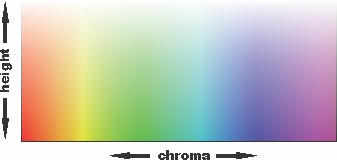
Absolute listeners perceive pitch in two dimensions: chroma and height.
Visually, this can be represented as a kind of color box, where chroma is hue and height is brightness.
Color hue, as we normally perceive it, is not a continuum. Instead, you can see boundaries where one color fades into the next. You see these boundaries because you have categorical perception for colors. Each bounded area along the spectrum is a different category; within the boundaries of a category, light waves appear to be the same color as each other; on different sides of a boundary, they look different.
Colors' actual wavelengths are irrelevant because of our categorical perception. That is, even though the wavelength of blue is shorter than that of red, giving blue a higher frequency, we don't literally see blue as "higher" than red. It just has a different quality. Orange is close to red in its appearance, but that doesn't automatically make us think of orange as physically "next to" red. It just has a similar quality. You don't perceive colors as "higher" or "lower" than each other in a self-evident and continuous order. They are simply categories that you recognize from their different, unrelated qualities. That is why we have to invent mnemonics like ROY G BIV. To ilustrate—here is a rectangle that is changing colors. Are the colors changing in the order of their wavelengths, or are they changing in random order?

If you did not perceive color categorically, you'd have known the answer immediately, because you would have directly seen it move from "high" to "low", and you would've clearly noticed the moment it returned to the mathmatical starting point, in the same way that you see this rectangle change along the non-categorical continuum of shade.

For the same reason, absolute listeners do not perceive pitch "height". They do not perceive pitches as "higher" or "lower" or physically "next to" each other. As musicians, of course, absolute listeners learn that, metaphorically, pitches are "higher" and "lower" than each other, because they can see these relationships on a page of sheet music. They also learn that, theoretically, "distance" between notes exists, because you can count the semitones that separate them, and you can see the "distance" between keys on an instrument. But, to an absolute listener, neither "height" nor "distance" has any direct perceptual reality.
For example, when a non-absolute listener hears a guitar slide, we literally hear something moving down. But an absolute listener's experience is nearer to the color-changing rectangle above. They hear a series of discrete pitches, changing—not moving—from one to another. Although they know the sound has "descended" from their knowledge of the musical scale, the sound does not give them a literal experience of downward movement as it does to non-absolute listeners.
If you find it difficult to believe that anyone could fail to perceive that a descending slide actually, well, descends, there is an example that you yourself can hear. All you need to do is sing a sequence of vowels. Any vowels might do, but, in terms of wavelength frequencies, this sequence ascends in its pitch frequencies: oo (as in food), uh (as in look), aw (as in jaw), ahh (as in body), ah (as in had). If you sing these vowels, in a monotone, and let yourself slide from each one to the next, then the vowels' higher formant frequencies produce a musically ascending slide. But you didn't perceive anything literally moving up, and the vowels don't seem to be "higher" or "lower" than each other. The vowels simply changed from one to the next. This is because, to you, vowels are just differnet categories with different qualities. This is how an absolute listener perceives pitches: they hear qualitative differences in chroma, not relative levels of height.
Now here's the problem with that, as far as learning perfect pitch is concerned.
Chroma is "height".
Perception of both chroma and "height" is from the same input: the fundamental frequency of a given pitch. The difference is that absolute listeners recognize its absolute quality while non-absolute listeners recognize its relative magnitude.
This is a critical reason why all perfect-pitch training systems have failed. For many years, we've known that absolute listeners perceive both height and chroma, while non-absolute listeners perceive only "height". Therefore, logically, it would seem that "learning perfect pitch" should mean "learning to hear chroma", because chroma + height = perfect pitch. But we already hear chroma. We just don't hear it the right way. Consequently, perfect-pitch training systems that have been designed to try to teach you to hear chroma have never worked, because, as I explained in what I last wrote, attempting to "hear chroma" by remembering (or assigning subjective qualities to) points on the auditory spectrum cannot and will not alter our perception of it as a continuum. We don't need to learn to hear chroma. We need to change our concept of pitch height.
Our existing concept of "height" is exactly what you think it is. Just imagine an ascending musical scale. That is increasing pitch "height" and, at the same time, changing pitch chroma.
But height, to absolute listeners, has nothing to do with chroma. It is an entirely different aspect of the musical sound. Height is the vertical axis, the brightness, of the color box. As you can see from the color box analogy, height is not a categorical perception—there are no boundaries separating one "octave" from another—and, critically, changing height has no effect on chroma.
In other words, non-absolute pitch "height" is between pitch classes, whereas absolute pitch height is within a pitch class. Absolute pitch height is nearer to what we would call timbre—namely, the strength of a sound's overtones.
You can perceive absolute pitch height. Click the links below to hear a series of tones that change from one octave to the next while remaining within a single pitch class. These two samples are the same digital sound file, reversed, so one is ascending and the other descending.


The differences among all these tones are differences in absolute height. I'm intrigued by the way I hear these. Whichever octave I hear first seems to fix itself in my mind as a kind of anchor, so that the subsequent tones seem to stay that octave until the very last one—and then it suddenly changes, and I hear the other octave only. The same thing happens in either order: if I hear the lower octave first, all but the last tone is low; if I hear the higher octave first, all but the last tone is high. Yet the middle tones are the same in both files. They just seem different to me depending on what I heard first. You can probably hear it either way, yourself. In any case, the differences you are hearing in these files are differences in absolute height.
When chroma is "height", octaves are unambiguous. With eleven semitones of "distance" between each octave, they can hardly be confused. But when height is a dimension separate from chroma, octaves stay within the same pitch class; so, in between octaves, there is no distance and no height. Octaves may become brighter and darker, thicker and thinner, sharper and duller—but they are not "higher" and "lower". To an absolute listener, height is a characteristic of a musical tone, a coloration of its quality, just as timbre is to a non-absolute listener. Changes in absolute height do not affect the chroma of a pitch. Pitch height, therefore, makes no contribution to the identity of a pitch.
It may be helpful to adjust our terminology. If we recognize that chroma is "height" and height is timbre, then, for one, we can appreciate that we already hear chroma and, therefore, understand that time spent trying to isolate and recognize chroma is not going to move us toward learning absolute pitch. But it should also make clear that learning absolute pitch isn't just a matter of noticing (and memorizing) something that you weren't paying attention to previously. It means completely reconceptualizing a feature you are already intimately familiar with—a feature that your brain has been developing and reinforcing, actively and passively, throughout your entire lifetime. Learning absolute pitch will mean learning to understand "height", and becoming able to think about it, in a completely different way. We will need to convert our perception of "height" to that of chroma.
